Daijiworld Media Network - Florida
Florida, May 29: Blue Origin’s heavy-lift New Glenn rocket was completely destroyed in a massive fireball during a routine pre-launch engine “hotfire” test at Cape Canaveral Space Force Station in Florida.
The incident took place at Launch Complex 36 (LC-36), causing extensive damage to the launch infrastructure and forcing an indefinite delay to upcoming missions.
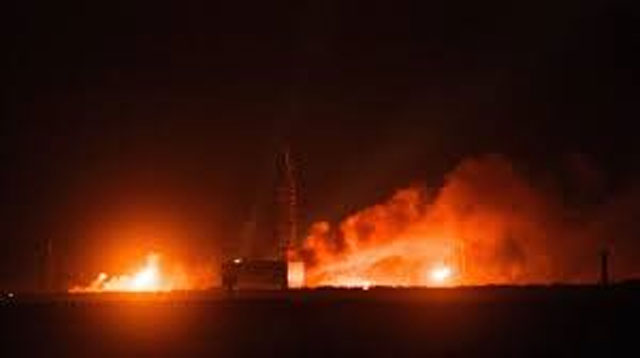
According to reports, the explosion triggered multiple fires across the launchpad complex, with flames continuing to burn for more than an hour after the blast.
Helicopter footage and ground observations reportedly showed severe destruction at the site.
The massive erector-gantry system used to transport and position the 322-foot-tall rocket was either flattened or completely destroyed during the explosion.
One of the launch complex’s large lightning protection towers also collapsed in the blast.
As LC-36 is currently Blue Origin’s only operational launchpad capable of supporting the New Glenn rocket, the vehicle is expected to remain grounded for several months while reconstruction work is carried out.
Officials confirmed that both the first-stage booster and upper stage of the brand-new New Glenn rocket were completely consumed in the explosion caused by ignited liquid oxygen and methane fuel.
No commercial payloads were onboard during the test.
The 48 Amazon Project Kuiper internet satellites scheduled for the rocket’s upcoming mission were safely stored inside a payload processing facility and were not damaged.
Blue Origin founder Jeff Bezos confirmed that all personnel and emergency crews at the launch site were accounted for safely and that no injuries had been reported.
The company’s upcoming fourth mission, designated NG-4 and originally expected to launch as early as June 4, 2026, has now been postponed indefinitely.
The incident is also expected to impact Amazon’s Project Kuiper satellite deployment plans aimed at competing with SpaceX’s Starlink internet constellation.
Blue Origin had reportedly been contracted to carry out up to 12 New Glenn launches this year.
The explosion could additionally affect NASA’s Artemis programme after the US space agency recently awarded Blue Origin contracts related to lunar logistics infrastructure for future Moon missions.
NASA officials are currently assessing the long-term implications of the launch pause on broader Artemis mission timelines.
Meanwhile, the Federal Aviation Administration (FAA) and the US Space Force have launched a formal investigation to determine the exact cause of the explosion before the New Glenn rocket is cleared for future flights.