Media Release
Bengaluru, Jun 13: Alliance University hosted ‘Demystifying Quantum: An executive dialogue on Quantum Technologies, AI, and DeepTech’ at its Central Campus, bringing together distinguished leaders from science, academia, industry, research, cybersecurity, data science, autonomous mobility, entrepreneurship, and public policy to explore the future of emerging technologies and their impact on India’s innovation ecosystem.
The event also marked the ceremonial unveiling of AU-QUASAR; Alliance University - Quantum AI School for Advanced Research, a future-focused initiative that reflects the University’s commitment to advancing frontier research, interdisciplinary inquiry, industry collaboration, and innovation-led learning in quantum technologies, artificial intelligence, and deep-tech domains. The AU-QUASAR campus is situated in the heart of India’s Silicon Valley in Bengaluru at Electronics City.
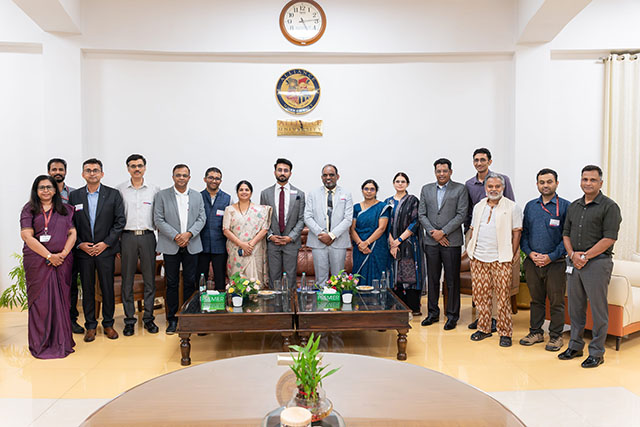
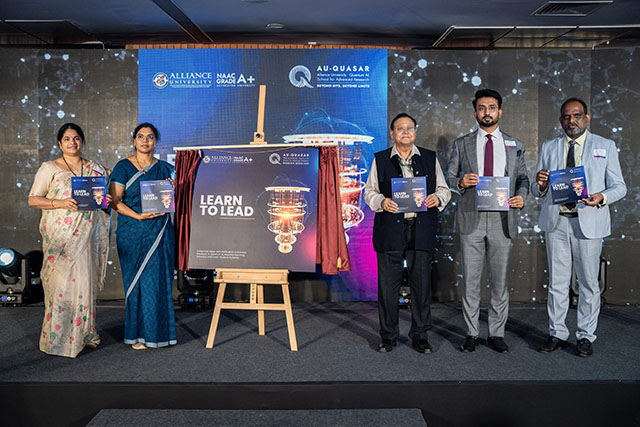
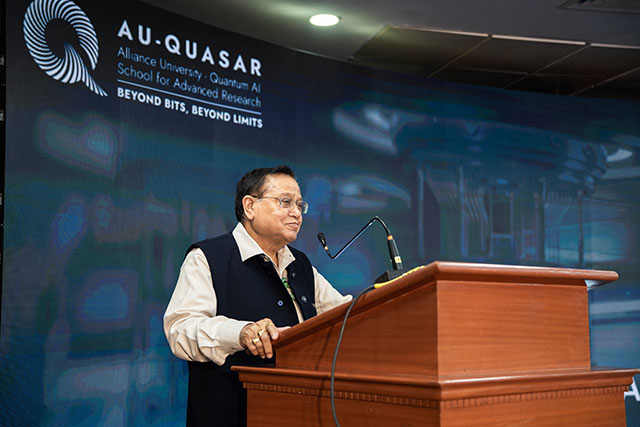
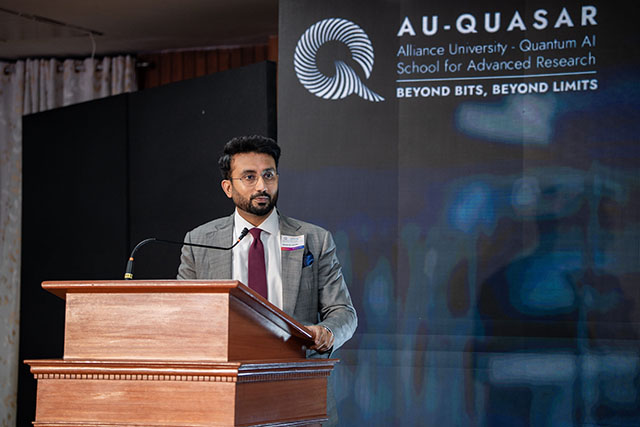
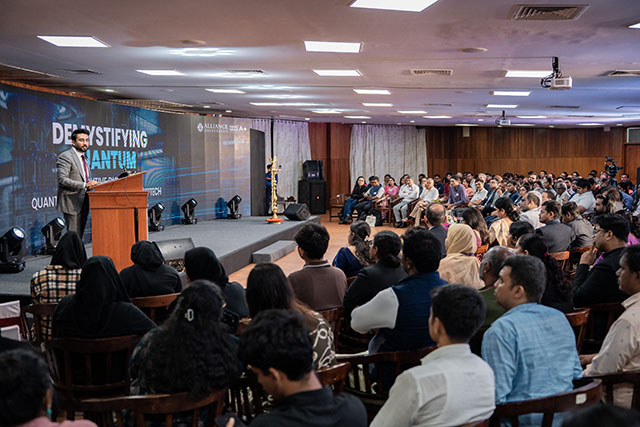
The occasion was graced by Padma Bhushan Dr V K Saraswat, former member, NITI Aayog, and chairman, research & technology council and principal advisor, technology, energy and strategic initiatives, Alliance University, who delivered the distinguished address. Congratulating Alliance University on establishing AU-QUASAR, Dr Saraswat described the initiative as a timely step towards strengthening India’s capabilities in emerging technologies. Reflecting on India’s technological journey, he emphasised the need for the country to move from being a consumer of technology to becoming a creator of indigenous innovations. He also highlighted the significance of the National Quantum Mission and called for sustained investment in research, infrastructure, talent development, and industry-academia collaboration.
“Universities have a critical role to play in preparing future generations with the knowledge and skills required to lead advancements in quantum computing, quantum communication, cybersecurity, and other deep-tech domains,” he noted, adding that initiatives such as AU-QUASAR can contribute meaningfully to India’s vision of becoming a global leader in innovation, research, and technological self-reliance.
The programme featured an address by Gopika Chaganti, chief operations officer, Quantum AI Global, who spoke about the transformative potential of quantum technologies and the importance of nurturing curiosity, scientific inquiry, and innovation among students and researchers. She observed that quantum technologies are rapidly emerging as strategic assets for nations and noted that India has responded proactively through initiatives such as the National Quantum Mission. Encouraging students to explore opportunities in the field, she highlighted that quantum technologies extend beyond physics and open pathways across computing, communication, sensing, healthcare, hardware, software, and advanced engineering.
Addressing the gathering, Abhay G Chebbi, pro-chancellor, Alliance University, emphasised the pivotal role of academia in shaping the future of quantum technologies. He described AU-QUASAR as a collaborative platform where academia, industry, researchers, policymakers, and students can come together to address real-world challenges. Positioned in Bengaluru’s technology corridor, the initiative aims to strengthen research, industry engagement, and applied innovation in quantum technologies and artificial intelligence. He also invited organisations to bring forward practical business and technology challenges that could be explored through quantum-led solutions.
Dr B Priestly Shan, vice-chancellor, Alliance University, reflected on the rapid pace of technological transformation, tracing the journey from computers to artificial intelligence and the emerging era of quantum technologies. Encouraging students to embrace innovation rather than fear it, he noted that technological shifts have historically created new opportunities alongside disruption. Speaking on the launch of AU-QUASAR, he said, “The establishment of the Alliance University–Quantum AI School for advanced research reflects Alliance University’s commitment to driving frontier research and nurturing the next generation of innovators. As quantum technologies continue to reshape industries and economies worldwide, the University aims to play a key role in advancing knowledge, collaboration, and technological leadership.”
The event included a student-focused session by Aditya Locharla, founder, Raivata Bionex Private Limited, who introduced participants to the fundamentals of quantum computing and its future possibilities. His session covered key concepts including young’s double-slit experiment, qubits, superposition, entanglement, quantum gates, quantum architecture, and quantum algorithms. He also highlighted emerging career pathways across software and algorithm development, hardware and electronics, systems and infrastructure, research, entrepreneurship, and interdisciplinary domains.
A lively fireside chat between Dr Dinesh Kumar Murugesan, CEO, EzyAct Consulting, and Dr Anjani Priyadarsini, Quantum Technologies Industry specialist, explored questions that often arise among students encountering quantum computing for the first time. The conversation covered the meaning of quantum, its applications, and the wide range of opportunities emerging in the field. Dr Anjani also shared her own journey from a software career at Infosys to quantum technologies, offering students a relatable perspective on curiosity, interdisciplinary learning, and navigating non-linear career paths.
A corporate panel discussion brought together industry leaders including Souvik Das, director – cybersecurity, EY; Kartheek NS, principal enterprise architect, Bottomline; Arun Shankar, head of innovation – autonomous mobility, AUMOVIO; Sivaram L, senior consultant – data science, Dell Technologies; and Bharath Reddy, associate fellow, The Takshashila Institution, who also moderated the discussion. The panel examined how quantum technologies, artificial intelligence, cybersecurity, data science, autonomous mobility, and cyber-physical systems are reshaping industries. The discussion highlighted how the pace of application deployment has accelerated significantly, reducing development cycles from years to months. Panellists emphasised the growing importance of multidisciplinary skills and noted that universities such as Alliance University play a vital role in preparing students for this evolving ecosystem. Real-world examples, including the role of mechanical engineers in autonomous vehicle innovation and digital application teams, illustrated how domain expertise and technology skills are increasingly converging.
The dialogue also underlined the continued relevance of cybersecurity in AI-driven and quantum-enabled environments, with speakers noting that protocols developed for classical computing are becoming even more critical as intelligent systems become more deeply embedded in business and society.
The student session as part of the event concluded with an insightful session on “The Art of Articulation” by Manish Jhanwar, professor of practice, Alliance University, who highlighted the enduring value of effective communication in a technology-driven world. He emphasised that while machines can process information, the ability to communicate ideas with clarity, context, and empathy remains distinctly human.
The programme also featured student mentoring sessions, leadership addresses, an interactive Q&A, and networking opportunities. Surekha Shetty, registrar general, Alliance University, delivered the vote of thanks, acknowledging the chief guest, speakers, university leadership, organising teams, students, and participants who contributed to the success of the event. She highlighted that the event reflected less on any technology but more on the quality of conversations that presented deeper insights on future technologies.
With the theme “Be part of the conversation that builds the future,” Demystifying Quantum became a meaningful platform for dialogue, learning, technological imagination, and collaboration. Through the launch of AU-QUASAR, Alliance University has taken a significant step towards strengthening future-ready education, advanced research, and innovation-led engagement in quantum technologies, artificial intelligence, and deeptech.
Applications are open for the BTech. Programmes at Alliance University - Quantum AI School for advanced research CSE (Quantum Computing & Information Science); AI & machine learning; Robotics & artificial intelligence; and Cyber-physical systems. For more information, visit: https://quasar.alliance.edu.in or contact: +91 74118 08485 / +91 96060 48544.