Daijiworld Media Network - Chandigarh
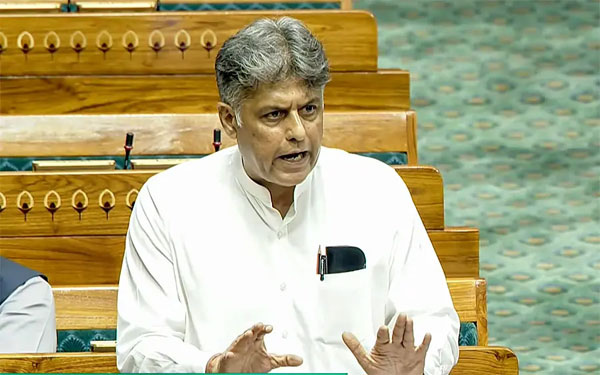
Chandigarh, Jul 3: Senior Congress leader Manish Tewari on Friday endorsed India's position on the Indus Waters Treaty (IWT), asserting that Pakistan's continued support for cross-border terrorism makes the suspension of the treaty justified, while also backing a Supreme Court-monitored investigation into the alleged misuse of funds at the Ram Temple in Ayodhya.
His remarks came after the Ministry of External Affairs (MEA) reiterated that the Indus Waters Treaty would remain in abeyance until Pakistan takes credible and irreversible steps to end its support for cross-border terrorism.
Addressing the media, MEA spokesperson Randhir Jaiswal said India's position on the treaty remains unchanged and linked its suspension to Pakistan's alleged sponsorship of terrorism.
Reacting to the statement, Tewari recalled Prime Minister Narendra Modi's observation that "blood and water can't flow together" following the Pahalgam terror attack and said there was broad political consensus in the country on the issue.
He noted that Parliament had passed resolutions on Pakistan-sponsored terrorism in 1994 and 2013 and said India's diplomatic outreach after last year's military action against Pakistan had consistently highlighted that terrorism and dialogue cannot coexist.
"There is a national consensus that blood and water cannot flow together, and the government should continue to uphold that position," Tewari said.
On the controversy surrounding the alleged embezzlement of donations meant for the Ram Temple in Ayodhya, the Congress MP supported party colleague K.C. Venugopal's demand for a Supreme Court-monitored investigation.
Tewari said the allegations deserved an impartial inquiry because they concerned a place of immense religious significance and the faith of millions of devotees.
"The birthplace of Ram Lalla holds deep sanctity. While respecting the sentiments of the people, any allegations regarding misuse of funds should be investigated through a fair and independent probe under the supervision of the Supreme Court," he said.
Commenting on the implementation of the Uniform Civil Code (UCC) in BJP-ruled states, Tewari questioned whether the proposed framework could genuinely be described as "uniform."
He argued that previous discussions on the issue had indicated that Scheduled Tribes and certain minority communities with distinct customary laws would remain outside its scope.
"If large sections of society are exempted from its provisions, then calling it a Uniform Civil Code is misleading," he said, adding that such an approach undermines the very concept of uniformity.