Daijiworld Media Network - Mashhad
Mashhad (Iran), July 9: The funeral procession of Iran’s slain Supreme leader Ayatollah Ali Khamenei moved towards the country’s holiest Shi’ite shrine in Mashhad on Thursday for his burial, as huge crowds gathered carrying revolutionary slogans and a massive banner reading “We Will Kill Trump” alongside the cortege.
The burial ceremony marked the culmination of a week-long series of funeral events following Khamenei’s death, while uncertainty continued to surround his son and successor, Mojtaba Khamenei, who has remained out of public view after suffering severe injuries in the strike that killed his father.
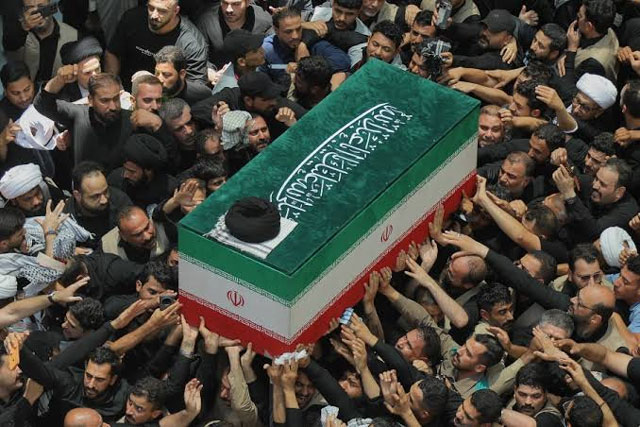
Khamenei’s body was transported slowly by truck through the packed streets of Mashhad towards the golden dome and minarets of the Shrine of Imam Reza, accompanied by white-turbaned clerics. Thousands of mourners dressed in black followed closely behind, waving Iranian flags, holding photographs of the late leader and carrying red placards featuring revolutionary slogans.
The funeral comes amid renewed tensions with the United States despite a truce, with Iran continuing to maintain control over the strategically important Strait of Hormuz and declaring victory after surviving a months-long military campaign by its most powerful adversaries.
Iranian authorities have portrayed the massive turnout at Khamenei’s funeral and burial as a demonstration of support for the country’s theocratic system and its ideological influence nearly five decades after the 1979 Islamic Revolution.
However, beneath the public display of unity, Iran continues to face deep internal challenges, with Khamenei’s 37-year rule remaining a subject of intense debate in a country where large sections of the population have repeatedly protested against economic hardship, poverty and repression.
‘Kill Trump’ chants echo at funeral ceremony
The whereabouts of Mojtaba Khamenei, who was declared Supreme Leader by a clerical assembly a week after his father’s death, remain unknown to many Iranians.
He has not appeared publicly since the conflict began with the strike that killed Ayatollah Ali Khamenei on February 28. Although he has issued written statements, authorities have released no photographs, videos or voice recordings of him.
Sources in Tehran said Mojtaba Khamenei suffered serious injuries in the same strike, including facial disfigurement and severe wounds to his limbs. While senior officials have said he is recovering, he has reportedly not yet been fit enough to make public appearances. Security agencies are also believed to be restricting his exposure amid concerns over further US attacks.
As mourners gathered in Mashhad for the funeral procession, crowds chanted slogans calling for revenge against US President Donald Trump, whom they blamed for Khamenei’s killing.
“I swear by the blood of the Supreme Leader, Trump, we will kill you!” the crowds shouted, while women held up placards carrying the message “Kill Trump”.
The roads leading to the shrine were filled with thousands of black-clad mourners on Thursday, many responding to chants praising Khamenei and condemning Iran’s enemies, including the long-standing revolutionary slogan “Death to America”.
With temperatures soaring in the July heat, water hoses sprayed mist over the crowds waiting for the coffins of Khamenei and his family members, providing relief to mourners gathered outside the shrine.
Khamenei’s remains, along with those of four family members killed alongside him, had already been taken through Tehran, the Shi’ite religious centre of Qom, and the Iraqi shrine cities of Najaf and Karbala.
At each location, large crowds filled the streets as Shi’ite mourning chants and revolutionary slogans accompanied the processions.
Martyrdom occupies a central role in Shi’ite Islamic tradition, and Khamenei’s death in an attack blamed on foreign enemies has reinforced a religious and political narrative deeply rooted in the Islamic Republic.
Khamenei’s long rule and contested legacy
The funeral takes place at a critical turning point for Iran, marking the end of nearly four decades of Khamenei’s leadership and coming months after the latest wave of nationwide protests against the Islamic Republic.
Security forces suppressed the unrest, which was fuelled by anger over an economy weakened by sanctions, with thousands of demonstrators reportedly killed during a crackdown that echoed previous episodes of violence in recent years.
While analysts believe Iran emerged from the conflict with its strategic position strengthened, particularly through maintaining control over the Strait of Hormuz, the country has suffered widespread damage that has further intensified its economic difficulties.
Khamenei became Supreme Leader in 1989, a decade after the Islamic Revolution, and over nearly four decades strengthened the political, economic and military authority of his office.
His consolidation of power increasingly reduced the influence of Iran’s elected president and parliament and was carried out in close coordination with the Islamic Revolutionary Guard Corps (IRGC), which expanded its influence throughout his tenure.
Mojtaba Khamenei’s appointment as successor was backed by the Guards, who are now regarded as one of the most powerful forces shaping Iran’s political and strategic direction.