Daijiworld Media Network - Washington
Washington, Jul 18: US lawmakers have renewed calls for the Senate to approve comprehensive legislation regulating digital assets, saying a clear legal framework is essential to safeguard investors, encourage cryptocurrency businesses to operate domestically and maintain America's leadership in financial technology.
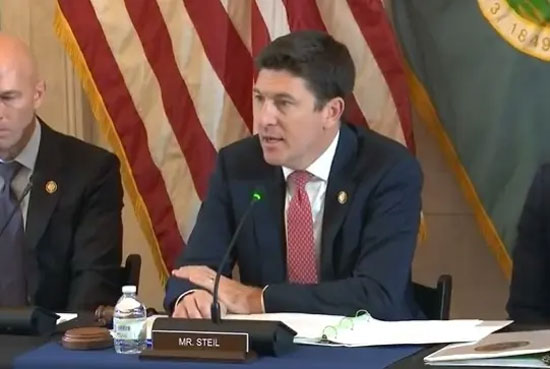
The appeal came during a hearing of the House Financial Services Subcommittee on Digital Assets, Financial Technology and Artificial Intelligence at New York's Federal Hall, where lawmakers and industry representatives backed the proposed CLARITY Act.
The legislation seeks to establish a transparent regulatory structure by dividing oversight of digital assets between the Securities and Exchange Commission (SEC) and the Commodity Futures Trading Commission (CFTC).
Subcommittee Chairman Bryan Steil said the primary objective of the bill is to replace what he described as regulation through enforcement with a clear and predictable set of rules for the digital asset industry.
The House of Representatives approved the CLARITY Act last year with bipartisan support in a 294-134 vote, and the Senate is now considering its own framework for regulating the rapidly expanding cryptocurrency market.
House Financial Services Committee Chairman French Hill said stable and predictable regulations are necessary to position the United States as the global hub for digital finance. He added that advancing the legislation aligns with President Donald Trump's goal of making the country a leader in the digital asset ecosystem.
Industry leaders told lawmakers that years of regulatory uncertainty had driven investment, innovation and crypto businesses to jurisdictions outside the United States.
Randi Abernethy, Head of Clearing and Group Risk at digital asset company Bullish, said the firm initially operated under regulatory regimes in Germany, Hong Kong and Gibraltar because the US lacked a comprehensive federal framework for digital assets.
She stressed that the industry was seeking regulatory certainty rather than operating without oversight, noting that federal rules would require registered exchanges to maintain safeguards such as segregated customer funds, capital standards, market surveillance and regular regulatory examinations.
Abernethy argued that clear legislation would not only strengthen investor protection but also encourage digital asset activity to return under the supervision of US regulators.
Sarah Aberg, Chief Legal Officer at Nova Labs, said regulatory ambiguity had imposed significant legal and financial burdens on the company, which supports the Helium decentralised wireless network serving millions of users through more than 140,000 hotspots.
She pointed to a lawsuit filed by the SEC against Nova Labs in January 2025 over digital asset-related allegations that were later dismissed with prejudice, saying the company had spent years defending claims that were ultimately withdrawn.
Meanwhile, Ryan Louvar, Chief Legal Officer at WisdomTree, said the tokenisation of financial assets has the potential to modernise ownership, transfers and settlement processes while keeping existing securities regulations intact.
He said the future of finance would inevitably become increasingly digital, adding that the key question is whether the United States will continue leading the development of next-generation financial infrastructure.
The CLARITY Act aims to define when a digital asset should be regulated as a security under the SEC and when it should be classified as a digital commodity under the CFTC. The proposal also includes legal protections for software developers and technology providers that do not directly control customer assets.