Daijiworld Media Network - Washington
Washington, Aug 8: Researchers have used artificial intelligence to design novel bacteriophages — viruses that infect and destroy bacteria — in a breakthrough that could open new avenues for treating infections that have become resistant to conventional antibiotics and even to naturally occurring bacteriophages.
The study, led by researchers from Stanford University and the Arc Institute, used genome language models known as Evo 1 and Evo 2 to generate complete genetic blueprints for bacteriophages capable of infecting Escherichia coli. Unlike conventional approaches that modify or select existing phages, the AI models were used to design new viral genomes by learning patterns from millions of genetic sequences.
The researchers generated hundreds of candidate genomes and selected nearly 300 designs for laboratory testing. Of these, 16 produced functional bacteriophages that were capable of infecting and killing E. coli. The resulting viruses contained genetic sequences that were not identical to naturally occurring phages, demonstrating that AI could generate viable viral genomes rather than simply reproduce known biological designs.
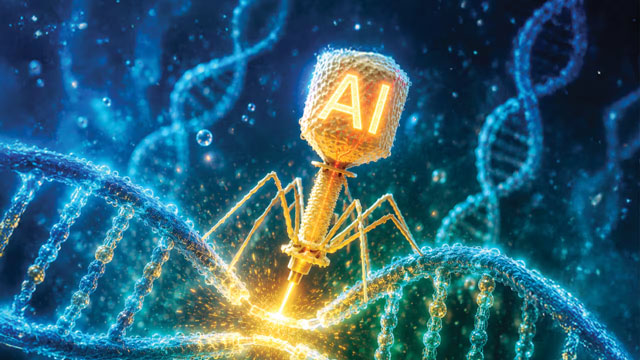
The findings are particularly significant because bacteria can evolve resistance not only to antibiotics but also to bacteriophages. In laboratory experiments, a combination of the newly designed phages was able to rapidly overcome resistance that had developed against the natural bacteriophage ΦX174 in several E. coli strains. The researchers said the approach could eventually help develop phage therapies tailored to rapidly evolving bacterial pathogens.
Bacteriophages are being investigated as an alternative or complementary treatment for difficult bacterial infections because they can selectively target bacteria while leaving human cells unaffected. However, phage therapy has faced challenges including limited host range, bacterial resistance, phage stability and difficulties in reaching bacteria protected within biofilms. Recent research has identified AI and CRISPR-based technologies as potentially useful tools for addressing some of these limitations.
The new findings could therefore have implications for personalised phage therapy, in which a virus is selected or designed to target a particular bacterial strain. AI-assisted design could potentially speed up the process by identifying genetic combinations that are more likely to produce functional phages and by generating candidates that differ substantially from existing viruses.
The researchers, however, cautioned that the ability to generate complete viral genomes also raises important biosafety and biosecurity questions. The models used in the study were trained on sequences from viruses known to infect bacteria, while sequences associated with human, animal and plant viruses were excluded. The resulting phages were designed to target bacteria rather than humans.
Experts have nevertheless warned that advances in generative biology could eventually create new risks because AI is becoming capable of designing biological systems that do not already exist in nature. Researchers have called for appropriate safety controls, laboratory safeguards and governance to develop alongside these technologies.
The study represents an important proof of concept rather than an immediately available treatment. The AI-designed phages were tested in laboratory settings, and further research will be required to determine their safety, effectiveness and suitability for use in animals or humans.
Researchers said the ability to rapidly design and test bacteriophages could ultimately expand the toolkit available for combating antimicrobial resistance, particularly as bacteria continue to develop resistance to existing treatments.