Media Release
Udupi, Sep 15: In a rare feat of paediatric cancer surgery, a team of doctors at Kasturba Hospital, Manipal, a unit of MAHE Teaching Hospitals, removed a large-sized tumour from the liver of a three-month-old infant. Three years on, the child is healthy, growing well, and free of the cancer.
The infant was brought to the hospital as a newborn after doctors found an enlarged liver and an alarmingly high level of alpha-fetoprotein (AFP), a marker of liver cancer. Tests confirmed hepatoblastoma, one of the rarest childhood cancers, seen in only about one to two children per million.
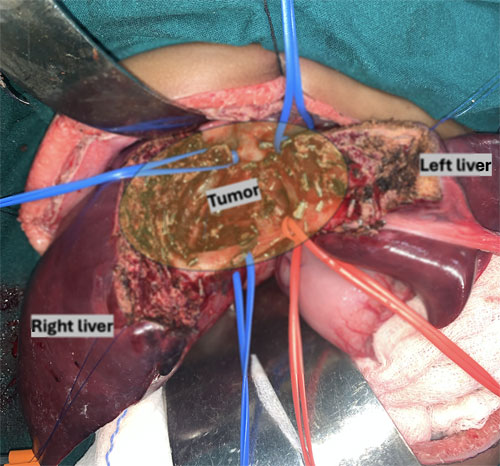
What made the case even more unusual was a genetic finding. Detailed evaluation revealed that the baby also had Simpson-Golabi-Behmel syndrome, a rare inherited overgrowth disorder that predisposes children to such tumours. Fewer than 15 cases of hepatoblastoma along with this syndrome have been reported anywhere in the world, doctors said.
The tumour sat in the very centre of the liver, ringed by major blood vessels, which ruled out immediate surgery. The paediatric oncology team led by Dr Vasudeva Bhat first put the infant on neoadjuvant chemotherapy to bring the disease under control and make an operation possible.
The child then underwent a central hepatectomy by the surgical oncology team, a highly specialised operation in which only the affected central portion of the liver (segments 4, 5, and 8) is removed, while the healthy right and left sections are preserved so the organ can regenerate and the child can grow normally. The surgery, seldom attempted in a patient this young, was guided by intraoperative ultrasound to ensure the cancer was removed completely and major blood vessels were preserved.
After an uneventful recovery, the baby was discharged in a stable condition. At the latest follow-up, more than three years after treatment, the child shows no signs of disease on scans or blood tests and is meeting developmental milestones with close follow-up.
"Operating on a three-month-old for a tumour sitting in the very centre of the liver is among the most demanding challenges in paediatric surgical oncology. We had to remove the affected central segments while carefully preserving enough healthy liver for the child to grow, and intra-operative ultrasound was invaluable in guiding us to clear margins and safeguard major blood vessels. To see the same child return three years later — healthy, growing and cancer-free — is the most rewarding outcome any surgical team could hope for," said Dr Naveena Kumar A N, professor and head of surgical oncology at Kasturba Hospital, Manipal.
The case drew together the departments of surgical oncology, paediatric haemato-oncology, paediatric surgery, neonatology, medical genetics, and anaesthesia. It has since been documented in the peer-reviewed international journal BMJ Case Reports (2025), adding to the sparse global literature on this rare combination of conditions.
"This outcome reflects the depth of multidisciplinary expertise across our hospitals, paediatric oncology, surgical oncology, neonatology, genetics, and critical care working seamlessly as one team. Cases such as this reaffirm our commitment to bringing world-class, tertiary-level cancer care to children from across coastal Karnataka and beyond, close to home. We are deeply proud of our clinicians and grateful for the trust the family placed in us," said Dr Sudhakar Kantipudi, chief operating officer, MAHE Teaching Hospitals.
Doctors said early and accurate diagnosis, a coordinated team approach, and disciplined long-term follow-up were key to the child's recovery and urged parents to seek prompt specialist evaluation when unusual signs are noticed in newborns and infants.