Daijiworld Media Network – Surat
Surat, Nov 12: Success is rarely a straight road. For some, it begins with opportunities and resources, while for others, it is built through years of struggle, experimentation, failures and the determination to keep moving forward. The journey of Dr Faruk G Patel, founder, chairman and managing director of KP Group, is an inspiring example of the latter.
Born into a financially modest family, Patel experienced the realities of limited resources from an early age. Before becoming the head of a major renewable energy business group, he worked at an optical shop, drove an auto-rickshaw, explored small businesses and even worked at Pizza Hut in the United Kingdom. He eventually returned to India with a bigger ambition: to build a business of his own.
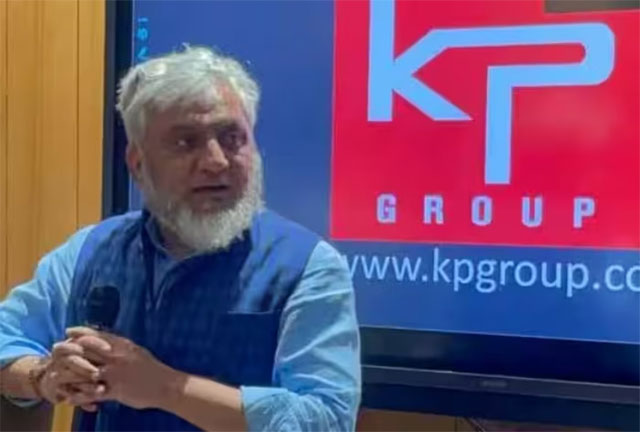
Today, KP Group has three listed companies and a combined market capitalisation of Rs 10,964 crore as of August 2026, according to an India Today report published on October 3, 2026. The remarkable transformation began in 1994 with an initial capital of approximately Rs 1 lac.
Humble beginnings shaped his outlook
Faruk Patel was born on March 24, 1972, in Saladra village in Gujarat's Bharuch district. His father, Ghulam Patel, belonged to a farming family and worked as a bus conductor with the Gujarat State Road Transport Corporation (GSRTC).
In 1974, when Faruk was just two years old, his father's transfer brought the family to Surat. They settled in a small rented house, where life revolved around careful spending and making the most of limited resources.
Growing up in such circumstances taught Patel the importance of financial discipline and respect for money. He understood that every rupee earned through honest work had value. These lessons became important foundations for his entrepreneurial journey.
After completing class 12, he did not follow a conventional career path. Instead, he explored different opportunities to earn a living and understand business. He worked at an optical shop, drove an auto-rickshaw and travelled to Mumbai to learn about the import-export trade.
He also received training in textile engineering in 1990, worked at a dress-material shop and experimented with a small retail venture. Each experience introduced him to a different aspect of business, customers and the challenges of earning a livelihood.
A job in the UK and the decision to return
In 1991, Patel moved to the United Kingdom and joined Pizza Hut. He gradually rose to the position of team leader, gaining exposure to a more structured working environment, customer service and professional management.
The experience offered him financial stability and an opportunity to understand how organised businesses operated. However, he gradually realised that remaining in a salaried job abroad would not fulfil his larger ambition.
He wanted to establish something of his own and contribute to India's growth. Acting on this conviction, he returned to India in 1993.
His decision meant giving up the relative security of employment in a foreign country and returning to an uncertain entrepreneurial path. But Patel believed that taking the risk was necessary to pursue his dream.
The beginning with just Rs 1 lac
Back in Surat, Patel entered the carting, material-handling and small construction business. In 1994, he formally established the foundation of what would eventually become KP Group, operating from a small office at Fazal Tower in Adajan Patia.
His initial capital was approximately Rs 1 lac. The business involved transporting materials and undertaking small construction-related assignments for industrial companies in Gujarat.
In the beginning, he was personally involved in almost every aspect of the operation, including managing trucks, coordinating drivers and labourers, handling customers, arranging deliveries and following up on payments.
One incident from those early days reflects his attitude towards work and commitment.
On one occasion, a truck driver and labourers failed to turn up for a scheduled delivery at Hazira Industrial Estate. Patel had two choices: explain the delay to the customer or complete the assignment himself.
He chose to fulfil the commitment. He drove the truck carrying bricks to the industrial estate and personally unloaded the consignment. He continued working until almost midnight, with brick dust covering his clothes and abrasions and injuries on his back from carrying the heavy material.
For Patel, a promise made to a customer was a responsibility that had to be fulfilled, irrespective of the difficulties involved.
However, he also understood that hard work alone was not enough; the business model itself had to be sustainable.
Within six to eight months, he realised that the initial business arrangement was not aligned with his long-term vision. Instead of continuing simply because he had already invested time and money, he handed over the trucks and business assets to his partner and returned to Surat to establish a more focused corporate entity.
This experience taught him an important entrepreneurial lesson: persistence does not mean remaining attached to one business model. Recognising when to change direction is equally important.
From telecom towers to renewable energy
The next major opportunity emerged with India's rapidly growing mobile communication sector. Patel recognised the potential of telecom infrastructure and decided to expand into the business of installing and maintaining mobile towers.
KP Group entered the telecom infrastructure sector and went on to undertake projects across 16 states over approximately 13 years. It also explored the shared-tower model, allowing multiple telecom operators to use common infrastructure instead of building separate towers.
The expansion brought significant growth. The company worked with major telecom players, including Vodafone, Reliance, Airtel and other industry participants. Its official business timeline records that it completed 1,000 telecom sites within eight months in 2009. By 2010, it had completed more than 3,500 telecom sites and laid over 900 kilometres of optical fibre cable.
However, the telecom industry subsequently experienced major disruption following the 2G spectrum controversy. Once again, Patel had to look beyond his existing business and identify the next growth opportunity.
This time, his attention turned towards renewable energy.
The turning point: Discovering the potential of solar energy
A defining moment in Patel's entrepreneurial journey came while he was working on a 105 MW solar park at Charanka in Gujarat.
Until then, much of his business involved constructing infrastructure or providing services for other companies. Solar energy presented an entirely different opportunity. It offered the possibility of developing and operating energy assets that could generate electricity and revenue over several decades while contributing to environmental sustainability.
Patel recognised the long-term potential of solar power, particularly the durability of solar panels and the growing importance of clean energy.
In 2008, he established KPI Global Infrastructure, which later became KPI Green Energy. In 2010, he founded KP Energy, marking the group's entry into wind energy.
It was a bold decision at a time when renewable energy was not as commercially established as it is today. Many of his friends and relatives questioned his move and even mocked him for investing in what they considered an uncertain sector.
However, Patel remained convinced that renewable energy represented the future.
Struggles behind the success
The transition into renewable energy was not an easy one. Unlike his earlier businesses, solar energy required substantial investment, land acquisition, long-term planning and the ability to navigate an emerging market.
The financial uncertainty and pressure of establishing a new business took a significant personal toll. In his conversation with India Today, Patel openly acknowledged that he experienced deep mental and emotional strain and went through a period of depression during this challenging phase.
He credits faith, focus and persistence with helping him continue through the difficult period.
Instead of abandoning the venture, he continued building the business, gradually strengthening its position in the renewable energy sector.
Building a business group with three listed companies
Over the years, KP Group diversified its operations across solar power, wind energy, hybrid energy, engineering, fabrication and infrastructure.
Its three listed companies are KPI Green Energy, KP Energy and KP Green Engineering. According to the India Today report, their combined market capitalisation stood at Rs 10,964 crore as of August 2026.
The group reported a renewable energy portfolio of more than 9.2 GW, with a target of exceeding 10 GW by 2030. Its engineering and manufacturing operations have also expanded. KP Green Engineering disclosed its first US export order worth Rs 23.02 crore for solar module mounting structures. Its manufacturing expansion in Bharuch includes a galvanising facility described by the company as Asia's largest.
According to KP Group's official website, the organisation has also expanded its focus towards energy storage, green hydrogen, ammonia and other emerging clean-energy solutions.
Beyond business, Patel has also placed importance on social responsibility. Through the KP Human Development Foundation, the group supports initiatives in education, healthcare and community development. One of its initiatives, Prabhu Nu Ghar, provides residential care for older persons with disabilities.
Lessons from an extraordinary journey
For Patel, the foundation of success lies in speed, dedication, commitment and loyalty. He believes that opportunities in emerging industries do not remain available indefinitely and that entrepreneurs must be prepared to recognise and act on them at the right time.
His career demonstrates the importance of making difficult decisions: leaving a stable job in the UK, moving away from an unsuitable business model, entering the telecom sector during its expansion and investing in renewable energy when many people around him were sceptical.
His advice to aspiring entrepreneurs is straightforward: "Start small but think big."
He believes that starting a business does not necessarily require substantial financial resources. What matters is the conviction to begin, the resourcefulness to utilise available opportunities and the dedication to continue working towards a larger vision.
From a small rented house in Surat to leading a business group with three listed companies, Faruk Patel's journey is much more than a story of financial growth. It reflects the power of learning through experience, accepting failures, adapting to changing circumstances and having the courage to pursue opportunities that others may overlook.
His journey offers an important lesson to young people and aspiring entrepreneurs: one's background need not define one's future. A modest beginning, limited resources or early setbacks cannot determine the ultimate destination when ambition is supported by hard work, determination and the willingness to take calculated risks.