The Swiss Jesuit Who Turned Outcasts into Children of God

October 9, 2026

A century after his death, the legacy of Fr Faustine Corti, a Swiss-Italian Jesuit priest who abandoned an elite academic post to live among the most exploited communities on the Canara coast, remains a powerful testament to human dignity and social liberation. 
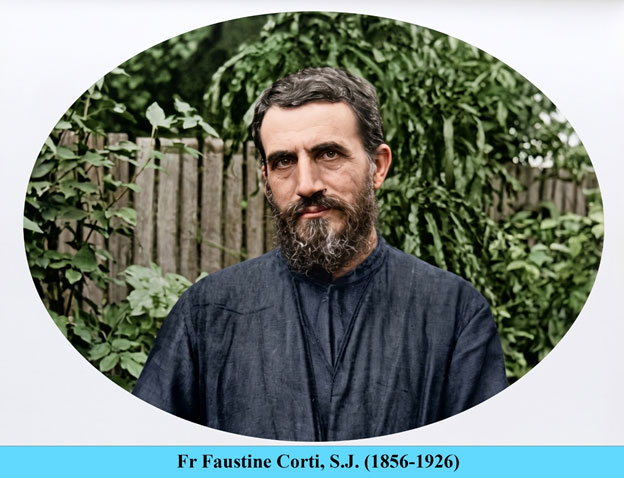

Image credit: Emmanuel Banfi (Enhanced using AI)
 

It was the early 20th century, and a wealthy clique of local landlords watched the raging waters of a river near Ajekar with triumphant satisfaction. They had bribed the local ferrymen to refuse passage to a Swiss-Italian Jesuit priest, Fr Faustine Corti, who was rushing to the Karkala court to defend an exploited “outcast” against his oppressors. Without hesitation, the priest stroked his faithful mare, Kempi, and urged her into the hissing rapids. As they vanished beneath the foaming waves, the landlords cheered, shouting, “Mansere Guru poye,” (this is the end of the Pariah’s priest). But to their surprise, Kempi emerged on the opposite bank, and the bedraggled priest galloped away, making it to court just in time to secure justice for the poor.

This October marks the 100th death anniversary of Fr Faustine Corti, S.J. (1856-1926). Today, he is remembered not only as the Catholic missionary who built St Antony’s Church in Naravi, but also as a revolutionary social reformer who fundamentally transformed the Mangalore Mission. In an era of brutal caste oppression and bonded labour, Corti saw those deemed “untouchable” as children of God. He offered them more than a new theology: something far more dangerous to the social order of the time, that is, dignity, identity, and liberation. 

From the classroom to the mud hut

Born in Curio, Switzerland, in 1856, Corti arrived in Mangaluru in 1884 with a burning desire to work in the missions. Instead, for the first two decades of his life in India, he was stationed at the prestigious St Aloysius College. There, he served as a strict but tender-hearted Prefect of Discipline and Vice Principal, known to wipe the perspiration from a nervous schoolboy’s face with a clean white handkerchief.

In 1905, nearing fifty and struggling with the local languages, he finally received permission to move to Narol (Naravi), a remote village roughly 30 miles from Mangaluru.

Initially, Corti attempted to follow the strategy of earlier missionaries, seeking to convert the powerful Jain and Brahmin landlords. For nearly seven years, he lived a life of extreme asceticism, hoping to win over the upper castes. The result was total failure. The landlords despised him; they viewed a European without a caste as polluting, yet resented him because he positioned himself as an equal or superior. 

The deep roots of untouchability

To understand the radical nature of Corti’s pivot, one must understand the social depth in which the Dalits (Pariahs or Harijans) lived. They were treated as bonded labourers, known as padials, bought and sold as chattel on the land they worked.

They were forbidden from entering the houses of Hindus and were forced to stay in cattle sheds. They were barred from using public or private wells, forced to dig holes in fields or drink from muddy tanks where cattle wallowed. Men were prohibited from wearing a coat or carrying an umbrella, and women were forbidden from covering their bodies above the waist. If a Pariah dared to wear an upper garment, landlords would publicly strip them and set the clothing on fire. They were subjected to barbaddi or slave pay, a system of slave-pay where they were forced to hand over a portion of any meagre wages they earned elsewhere to their landlords.

Fr Corti stepped into this brutal hierarchy, shattering every taboo. He walked directly into the squalid Pariah colonies, squatted on the ground, and ate their meagre rice gruel. He invited them into his own humble, smoke-filled, thatched mud hut, where they would crowd around him. Visitors noted that his rudimentary dwelling had no bed, chair, or table; instead, he slept on the floor alongside sick calves, chickens, and feverish, coughing outcasts whom he refused to turn away. 

The guru of the outcasts

Corti understood that spiritual liberation was impossible without social emancipation. He took up the title Mansere Guru (the priest of the Pariahs) and Bhutale Vairi (enemy of the devils), actively challenging both the spiritual fears and physical chains binding his flock.

In one instance, when the local headman sent henchmen at night to kidnap a Pariah named Mudara and sell his family to a coffee plantation, Mudara fled to Corti, crying, “Swami, save me!” Corti seized the opportunity to urge them to cast aside their fear of malevolent spirits and put their trust in God. That night, Corti’s catechist confronted the kidnappers, warning them that under British law, no master had the right to keep slaves, and that the family was now under the protection of the Swami. Mudara and his companions were saved, and within months, dozens of families asked to join Corti.

Corti’s intervention was a shock to the feudal system. He dragged abusive landlords to court, securing convictions that terrified the oppressors and emboldened the oppressed. He became a formidable advocate, fiercely defending the vulnerable.

When three high-caste men beat two Pariahs unconscious, Corti personally went to the blood-stained scene, transported the victims to the hospital, and initiated a police inquiry. When the attackers begged for his forgiveness, Corti replied that he would gladly forgive them for the love of Christ if they had beaten him, but he would not compromise when it came to the rights of the Pariahs. 

Building identity and belonging

In addition to providing legal protection, Corti gave marginalised people a sense of pride and identity. In a move to showcase his profound understanding of human psychology, he decided to form a Catholic musical band for his converts.

When local upper-caste musicians refused to play for a visit by the bishop, intimidated by landlords who threatened them, Corti was furious that the true God was deprived of music. He wrote to his native Switzerland and secured four crates of brass instruments. He hired a Protestant bandmaster from Mangaluru to teach his converts how to play.

This venture had a miraculous psychological effect. “The ancient fear caused by long oppression disappeared, and now all could go with head held high,” Corti observed. “The music had made them courageous”.

His radical inclusivity even caused friction within the Church. Older Catholic converts, infected by the region’s caste prejudices, complained about sharing pews with the “unclean”. When Bishop Perini visited Naravi in 1910 and saw Corti being forced to hold baptisms outside, the bishop sternly ordered the Pariahs inside the church. He admonished the older Christians, declaring, “You are all children of God... You must treat them as your younger brethren in the Faith”.

The last days

Corti worked without rest. He suffered from a virulent hydrocele and malaria, yet continued to ride his horse through the monsoon rains to visit the sick. In September 1926, exhausted and in severe pain, he collapsed after a long journey. Even as he was transported in a bullock cart to Fr Muller’s Hospital in Mangaluru, he begged to be allowed to die in Naravi. He passed away on October 9, 1926. By the time of his death, he had transformed a small, neglected mission into a vibrant community, leaving behind thousands of local Christians.

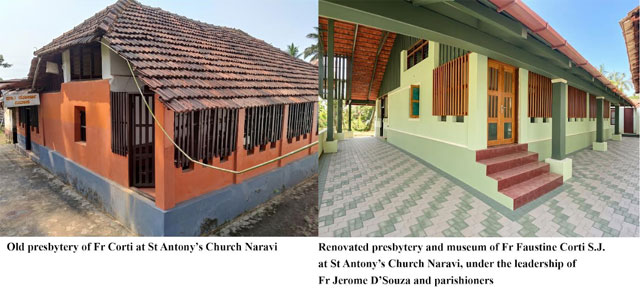
Today, the grand St Antony’s Church in Naravi of the Mangalore Diocese stand as a testament to his vision, built largely on the foundations he laid. Corti’s true monument is on the enduring dignity of the communities he served. He did not merely bring a new religion to the Canara coast; he introduced a revolutionary concept of human worth, proving that no one is an outcast in the eyes of the divine. 

Emerging modern challenges

Fr Faustine Corti’s most profound legacy wasn’t a building; it was the fact that he spent years operating out of a smoke-filled, thatched mud hut while prioritising the immediate survival and dignity of the marginalised.

Modern parishes often fall into the trap of prioritising institutional maintenance over their true mission. Pouring vast resources and energy into upgrading physical structures and managing administrative bureaucracy subtly threatens to neglect the spiritual and social needs of their surrounding communities.

Today’s pressing challenge for Catholic institutions is to shift their focus from maintaining comfortable boundaries to practising radical proximity. Just as Corti sat on the same bench and shared his meagre rice gruel with those deemed untouchable, today's Church is called to physically and socially integrate with marginalised groups like the migrants, the unhoused, or the economically exploited. True solidarity requires leveraging institutional privilege to advocate for the voiceless, transforming the parish from a private sanctuary into a public defender of human dignity.

When a parish treats social justice not as a side project but as the very heartbeat of its faith, the physical structures become a tool for the mission rather than the mission itself. By focusing on human capital and systemic advocacy, modern Catholic institutions can reclaim their prophetic voice and build communities rooted in genuine belonging rather than architectural grandeur.


Reference

Banfi, Emmanuel. Among the outcasts: A history of the pioneering Jesuit missionaries in the diocese of Mangalore, 1970.

Kamath, Devadatta. The Burning Bush: The History of Karnataka Jesuit Province, Vol II.


By Fr Joswin Pereira SJ
To submit your article / poem / short story to Daijiworld, please email it to news@daijiworld.com mentioning 'Article/poem submission for daijiworld' in the subject line. Please note the following:

  • The article / poem / short story should be original and previously unpublished in other websites except in the personal blog of the author. We will cross-check the originality of the article, and if found to be copied from another source in whole or in parts without appropriate acknowledgment, the submission will be rejected.
  • The author of the poem / article / short story should include a brief self-introduction limited to 500 characters and his/her recent picture (optional). Pictures relevant to the article may also be sent (optional), provided they are not bound by copyright. Travelogues should be sent along with relevant pictures not sourced from the Internet. Travelogues without relevant pictures will be rejected.
  • In case of a short story / article, the write-up should be at least one-and-a-half pages in word document in Times New Roman font 12 (or, about 700-800 words). Contributors are requested to keep their write-ups limited to a maximum of four pages. Longer write-ups may be sent in parts to publish in installments. Each installment should be sent within a week of the previous installment. A single poem sent for publication should be at least 3/4th of a page in length. Multiple short poems may be submitted for single publication.
  • All submissions should be in Microsoft Word format or text file. Pictures should not be larger than 1000 pixels in width, and of good resolution. Pictures should be attached separately in the mail and may be numbered if the author wants them to be placed in order.
  • Submission of the article / poem / short story does not automatically entail that it would be published. Daijiworld editors will examine each submission and decide on its acceptance/rejection purely based on merit.
  • Daijiworld reserves the right to edit the submission if necessary for grammar and spelling, without compromising on the author's tone and message.
  • Daijiworld reserves the right to reject submissions without prior notice. Mails/calls on the status of the submission will not be entertained. Contributors are requested to be patient.
  • The article / poem / short story should not be targeted directly or indirectly at any individual/group/community. Daijiworld will not assume responsibility for factual errors in the submission.
  • Once accepted, the article / poem / short story will be published as and when we have space. Publication may take up to four weeks from the date of submission of the write-up, depending on the number of submissions we receive. No author will be published twice in succession or twice within a fortnight.
  • Time-bound articles (example, on Mother's Day) should be sent at least a week in advance. Please specify the occasion as well as the date on which you would like it published while sending the write-up.

Comment on this article

  • Royston Rodrigues, Mangalore/Mumbai

    Tue, Oct 13 2026

    Indeed an exemplary life lived by Fr Faustine Corti, S.J. Nice teaching to better integrate in ourselves as to how we are called to live and do what is good in the eyes of God, by striving hard for our lesser privileged brothers in Christ.

  • Clifford, Mangalore

    Tue, Oct 13 2026

    My grand father is from Belthangady. He used to tell me lot of stories about Corti and another Swiss missionary from Belthangady. Fr. Corti was called by Brahmins, Mansere Guru. Means Priest of low caste. Thanks for nice article.

  • Joe Britto, Nakre/Bangalore

    Mon, Oct 12 2026

    Fr. Faustine Corti S.J., widely revered as the "Saint of Naravi," was a Swiss-Italian Jesuit missionary whose 21-year service in the Belthangady taluk permanently transformed the socio-economic and spiritual landscape of the region. Notably, today—October 9, 2026—marks exactly the centenary of his passing. Away . The educational legacy of Fr. Faustine Corti and the subsequent missionaries in Naravi has blossomed into a comprehensive network of institutions under the banner of St. Antony Educational Institutions. Managed by the Catholic Board of Education, Mangalore, these institutions serve students from the surrounding rural areas. The church mission currently runs the following key educational institutions in Naravi: St. Paul's Primary School: The foundational institution that continues the mission's earliest efforts to provide basic literacy and early education to the local agrarian and marginalized communities. Naravi High School: Established in 1966, this aided high school provides secondary education to students from Naravi and neighboring villages, acting as a crucial stepping stone for higher education. St. Antony Pre-University (PU) College: A co-educational institution offering 11th and 12th-grade equivalent courses. It bridges the gap between high school and degree programs for local students.  St. Antony College of Commerce: Established in 2013, this degree college expanded the mission's educational scope into higher education. Affiliated with Mangalore University, it offers undergraduate program, most notably the Bachelor of Commerce (B.Com) degree.  From basic primary schooling to an undergraduate degree, the campus today realizes Fr. Corti's vision of holistic social upliftment through continuous education. Perhaps it’s really time for the concerned to recommend his cause for Sainthood!

  • Sr Gracy Rodrigues, Chikka Kammanahalli, Bengaluru

    Sat, Oct 10 2026

    It's a really inspiring article on Fr Corti, and it makes me feel more deeply because I worked at the Naravi mission from 2014 to 2021. I had the joy of serving the poor and needy tiny tots in the Nursery as a teacher for eight years, and I looked after their needs like a mother. At the same time, I was given the responsibility of a warden to look after the needs of the girls in the girls’ hostel. Their emotional struggles, discipline issues, care and safety, studies and health were the big responsibilities I had to shoulder. But every challenge became an opportunity to become a mother when they were sick, a teacher during their night study and a friend when they needed someone to listen. This hostel catered to all types of children, regardless of caste or religion. All credit goes to Fr Corti, who began the mission. The spiritual life of these children was sustained through group rosaries and prayers, along with liturgical celebrations. My greatest joy was seeing these children grow up with confidence, progress in their studies, and take responsibility for their lives. In addition to this responsibility, I was visiting the families. This helped me come to know their joys and sorrows, difficulties and struggles in life, and to take their needs to the Lord in prayer. The people, young and old, could approach me freely to share their joys and seek help and guidance in their needs and problems. These eight years of experience have taught me that true education occurs not only in classrooms but also in hostels and in people's homes. The need of the hour in this polarised world is not to get stagnated with the sacramental celebrations, but to identify students and people who are crucified unjustly by the corrupt world and cater to them with the spirit of Fr Corti.

  • Ancy Paul, Byndoor

    Sat, Oct 10 2026

    Very well written article about a saintly priest. I truly appreciate the thought, efforts and care you have taken to bring out the good done by this priest. Congratulations Fr. Joswin. Keep sharing your beautiful reflection and research. God bless you

  • Richard Mascarenhas, Puttur/Bangalore

    Sat, Oct 10 2026

    It's a very well written article Fr Pereira. It is a nice way of introducing our missionaries and their great contributions to the present generation. A good message indeed . Congratulations to Fr Joswin Pereira SJ.

  • William Pais, Mangalore

    Sat, Oct 10 2026

    Nice article Indeed. Timely reflection of the bygone time which we need to reminsce . Well researched. The story of Kempi the horse reconnected the tales I heard earlier from oral sources. We need to see Fr Cortis work in the light of his time where caste was a predominant social evil. He started at a time when odds were stacked against him. I can imagine Naravi , still a secluded village today, how backward it was 120 years ago . Village like it was governed by rich jain landlords whose word was final on almost everything. In such feudal set up how could a Jesuit set up a machine that was to change caste dynamics. He was pioneer in that sense for caste uplifting of the last and least. He is role model for priest. Like him many Jesuits pioneered many projects in Mangalore diocese, benefits of which are plenty. Mangalore diocese of the present need to do so much in their memory. The last two paragraphs of the article gives this message in very subtle way. There is so much to be done with so much infrastructure around but so little is done. Congratulations dear Fr Joswin for timely memorising such a great historic personality.

  • Harry Rasquinha, Muscat/Mangalore

    Sat, Oct 10 2026

    Thank you Fr Joswin for this inspiring article on Fr Corti. Lot to learn for all of us from the life of this uncanonized saint- Fr Faustine Corti.

  • Gilbert John Pinto, Bejai, Mangalore

    Sat, Oct 10 2026

    You have dug out a jewel out of Canara catholic history. Very inspiring . God bless you.

  • Zeenal Fernandes, Byndoor

    Sat, Oct 10 2026

    A truly inspiring and heart-touching article, Father! 🙏 Your words beautifully highlight the power of compassion, faith, and selfless service. The story reminds us that every human being deserves dignity, love, and acceptance. Thank you for sharing this wonderful message of humanity and God’s unconditional love. ✨

  • Shanal Fernandes, Byndoor

    Sat, Oct 10 2026

    Superb... It Helped me to gain some knowledge about Jesuits Good work Father

  • Meinar Nahak, Bangalore

    Sat, Oct 10 2026

    Inspiring life story of a priest who really loves God and His people. To be with the need and fight the injustuce should be core calling of every christians. Fr Faustin pray for us

  • asha dias, Byndoor

    Fri, Oct 09 2026

    Keep going on father.beautiful message.useful theme.

  • Rita, Germany

    Fri, Oct 09 2026

    Interesting to know this Priests work for the Poor.Still this outcast problem is not yet gone :These ?Highclass Brahmins problem or lower class persons is still exists.It has not gone even after so many years .Self some of our own catholic have this in their blood of looking for brides or bridegrooms for thier sons or daughters.Thank you for introducing the Jesuit Priest.


Leave a Comment

Title: The Swiss Jesuit Who Turned Outcasts into Children of God


You have 2000 characters left.

Disclaimer:

Please write your correct name and email address. Kindly do not post any personal, abusive, defamatory, infringing, obscene, indecent, discriminatory or unlawful or similar comments. Daijiworld.com will not be responsible for any defamatory message posted under this article.

Please note that sending false messages to insult, defame, intimidate, mislead or deceive people or to intentionally cause public disorder is punishable under law. It is obligatory on Daijiworld to provide the IP address and other details of senders of such comments, to the authority concerned upon request.

Hence, sending offensive comments using daijiworld will be purely at your own risk, and in no way will Daijiworld.com be held responsible.