Media Release
Mangaluru, Dec 29: With the message ‘Protect Our Oceans, Preserve Our Future,’ the NITTE–GOK Centre of Excellence in Aquamarine Innovation (NITTE-GOK COE | AQUAMARIN), supported by KTech, Government of Karnataka, and hosted at the Nitte University Centre for Science Education and Research (NUCSER), NitteDU, in association with the NSS cell of NitteDU and Rotary Club Mangaluru, organised a 5-km walkathon on the theme ‘Together Against Overfishing’ at Tannirbhavi Beach on December 28.
The walkathon aimed to create public awareness on the impacts of overfishing, promote sustainable fishing practices, and encourage community participation in marine conservation, in line with the United Nations’ SDG-14 (Life Below Water) initiatives.
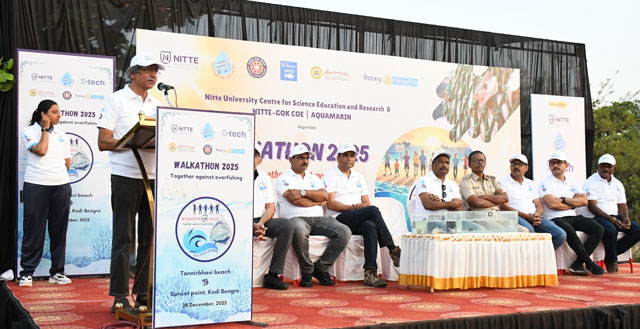
Dr Anirban Chakraborty, director, NUCSER, who is in charge of NITTE-GOK COE | AQUAMARIN, said that NitteDU has been at the forefront of activities pertaining to the United Nations’ Sustainable Development Goals and has been championing the cause of a ‘sustainable and livable planet’ for several years.
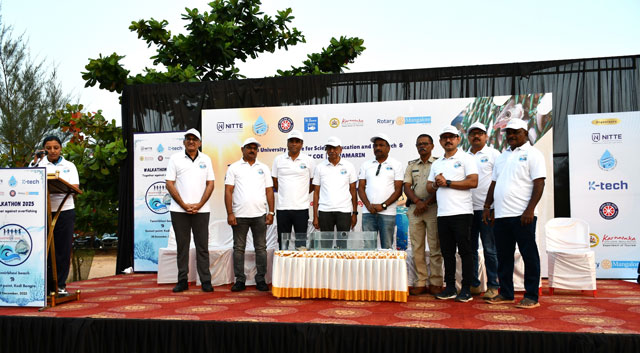
Eminent personalities including Dr Iddya Karunasagar, advisor – research and patents, Nitte Deemed to be University; Dr Shivakumar Magada, director general, Arabian Sea Fisheries Management Coordination Committee (Sea-MC²); Dr Ram Savan, professor of immunology, University of Washington, Seattle, USA; Dr Rajesh K M, principal scientist, ICAR-CMFRI; Prof Vinod Aranha, director, Nitte Institute of Architecture and president, Rotary Club Mangaluru; Manjunath H, entrepreneur; and Sanjaya Suvarna, president, Mahajana Sabha, Mangaluru, were present.
Jnaneshwar, police sub-inspector, Panamboor police station, Mangaluru, flagged off the event after a brief formal stage programme.
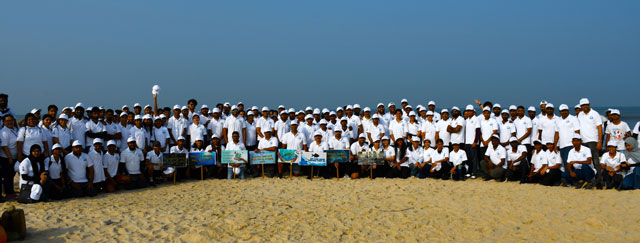
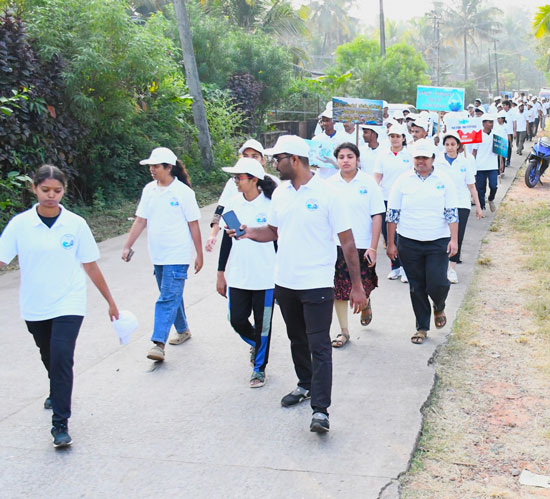
The event witnessed participation from over 250 members, including students, the general public, environmental enthusiasts and fishermen. The 5-km walkathon from Tannirbhavi to Bengre and back saw participants carrying placards advocating marine conservation and sustainable fisheries.
The initiative highlighted the impacts of overfishing and the importance of conserving marine biodiversity. Special emphasis was placed on community participation and the role of students and the public in marine conservation, stressing the need to fish responsibly to ensure sustainable marine catch for future generations.