Daijiworld Media Network - Hingoli
Hingoli, Jan 4: Breaking the rigid caste barriers that have divided society for generations has been a lifelong aspiration of Nanasaheb Gangabai Anandrao Kadam, a Maharashtra government officer who has quietly led a social transformation in his native village, Ranjara, in Hingoli district.
Kadam, who began his career as an assistant registrar of a cooperative society and currently serves as officer on special duty to BJP minister Atul Save in the Other Backward Class (OBC) welfare ministry, says his inspiration came early in life from social reformers Mahatma Jyotiba Phule, Rajarshi Shahu Maharaj and Dr B R Ambedkar.
“Since childhood, I was fascinated by the reforms they brought. They challenged dogmatic mindsets and showed that education and social equality were the true paths to dignity. Their work was a mission, and that thought stayed with me,” Kadam said.
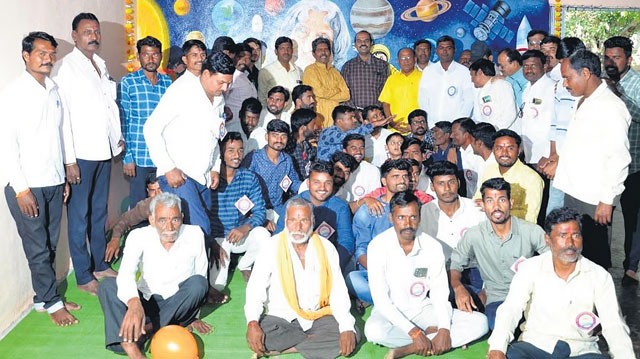
Determined to give back to his village, Kadam joined hands with his college friends, all government employees, and adopted an unconventional approach — using human psychology to reshape social thinking. Instead of confrontation, they focused on subtle, inclusive changes.
One of their first initiatives was painting village walls with strong social and scientific messages. “We created a ‘scientific wall’ near the Hanuman temple. The idea was simple — without scientific temperament, there can be no real development. People visiting the temple would read science-related information, and children slowly developed curiosity and interest,” he explained.
Another innovative step was renaming housing colonies. Traditionally, colonies were named after caste leaders or religious figures, often leading to disputes. “We felt it was strange that even in the 21st century, colonies were named on caste lines. So we introduced a new concept — naming them after universal human values,” Kadam said.
Children were asked to pick chits carrying values such as equality, fraternity and liberty. Colonies were then named Brotherhood Colony, Affection Colony and Blissful Colony. “These names were accepted by everyone, irrespective of caste or creed. There was no opposition, and peace was maintained. It helped change mindsets without conflict,” he added.
The group also set up a library and encouraged children to read books and share their thoughts. They organised talks by social thinkers to expose villagers to ideas beyond their immediate surroundings. “We wanted to build a bridge between spirituality and science. I come from the Bhakti movement tradition, which embraces all castes without discrimination,” Kadam said.
Initially, the response was discouraging. Pamphlets explaining their vision were distributed to every household, inviting villagers to a meeting. “Hardly anyone turned up. People gather easily for political or religious events, but human mind development didn’t attract them,” he recalled.
Undeterred, Kadam and his team changed their strategy. Workshops were organised during festivals, gradually drawing people in. They also began celebrating Bali Raja Jayanti, recalling the legendary farmer-king whose reign symbolised prosperity and justice. “Farmers’ families still sing songs during Diwali inviting Bali Raja to return and end their suffering. We used this cultural connect to encourage storytelling and interaction,” he said.
Drawing from his earlier experience as a government primary school teacher, Kadam emphasised patience and simplicity. “You must think progressively but explain things simply,” he said.
The initiatives have since expanded to cleanliness drives, encouraging every household to plant a tree and reuse water for gardening. “Our next goal is to build a good school for our children,” Kadam said, adding that true development begins with changing minds before changing systems.