Media Release
Bengaluru, Jan 24: Dr Peter Wilson Prabhakar, a historian and scholar of the Basel Mission, delivered a lecture on January 20, organised by Centre for Religion and Culture at St Joseph’s University (SJU).
The lecture titled, The Legacy of the Basel Mission in Karnataka, emphasised the underrepresentation of Christian literary and industrial contributions in public discourse. This underrepresentation became the focus of the lecture delivered by Dr Peter Wilson Prabhakar, a historian and scholar of the Basel Mission, on January 20, organised by Centre for Religion and Culture at St Joseph’s University (SJU).
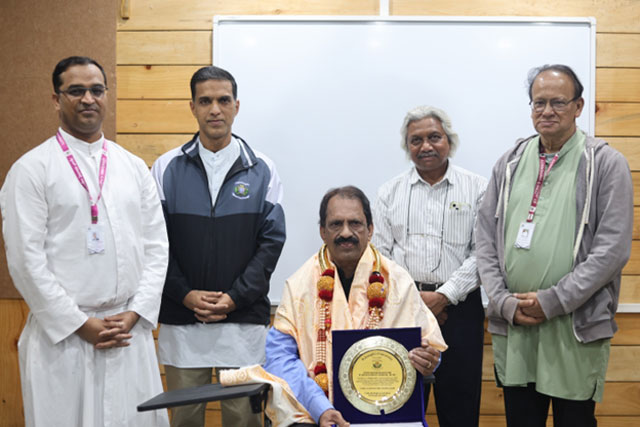
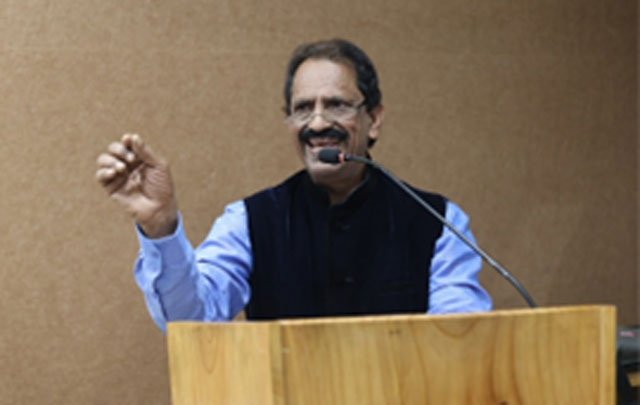
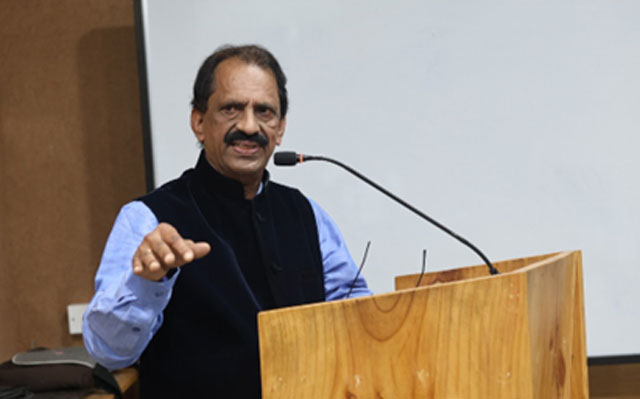
Prabhakar introduced a ‘compelling’ concept to explain this phenomenon, the ‘mission compound culture’, a tendency of Christian organisations to confine their narratives within institutional walls rather than sharing achievements with the broader public. ‘We should always try to take the achievements of Christian institutions and organisations to the people,’ Prabhakar emphasised, arguing that self-imposed isolation has fostered public indifference. The Basel Mission (a Swiss Protestant missionary society) has transformed coastal Karnataka through groundbreaking works, including establishing the first Anglo-vernacular (English-Kannada) school in 1837, pioneering Kannada and Tulu literature, and inventing khaki in 1852, which became the global standard for military uniforms. They also established Mangalore Tiles, an internationally recognised brand. Despite their lasting impact, many of these contributions remain largely invisible to those who have benefited the most from them.
History that speaks
When eight young seminary students in war-torn Basel made a desperate vow in 1815 as Napoleon’s armies threatened their city, they could not have imagined their promise would rewrite Karnataka’s cultural and industrial destiny. The seminary they established in 1816 eventually became the Basel Evangelical Missionary Society, which arrived on Mangaluru’s shores on October 30, 1834. Three missionaries Samuel Hebich, John Christian Lehner, and Christian Greiner stepped onto a coastline that would become their laboratory of transformation.
Educational contributions
The Basel Mission’s first work focused on education, establishing institutions for both Christians and non-Christians. They created nursery schools, night schools, middle schools, training schools, and vocational institutions. An important principle they followed was for every ten schools opened, they established one for depressed classes and one for drummers and other handicapped people. The first Anglo-vernacular school (teaching both English and Kannada) in the entire coastal belt was established in 1837, the present Mission BM School at Car Street, Mangaluru. It continues to operate from primary through PUC level, even today, after 189 years, making it the first English-Kannada school in the coastal belt.
Education was closely connected with printing. The first printing press in the coastal belt was established in Mangaluru in February 1841, under the charge of John Wegel. The first book printed was the Tulu Kirtane (a portion of the Bible containing the Gospel of Saint Luke) in the Tulu language. For nearly fifty years, it remained the only press in the region until the Kodial Bale Press was established in 1882. From 1840 to 1940 almost all textbooks for the Madras and Bombay governments were printed at the Mangalore press. Today, this press continues under the name Balmatta Institute of Printing Technology.
Literary and scholarly contributions
The true revolution lay in the missionaries’ linguistic humility. They learned Tulu, Kannada, and Malayalam not as tools of conversion but as bridges to genuine partnership. Dr Hermann Mogling, a German linguist who mastered Kannada, launched Mangaluru Samachara in 1843, the region’s first newspaper covering district affairs, international news, and even medical information. His Bibliotheca Karnataka preserved classical literature, and Rajendranama, a historical texts boldly reformed Kannada script by eliminating complex conjunct consonants, making literacy accessible to common people. Tubingen University recognized this brilliance, awarding Mogling the first doctorate in Kannada literature from a foreign university in 1858.
Ferdinand Kittel built upon this foundation, creating the monumental Kannada-English Dictionary published in 1894. His work remains the gold standard, unmatched by later lexicographers. For Tulu, missionaries August Manner and James Brigel compiled comprehensive dictionaries and grammars that still define the language. Even Malayalam owes its first English dictionary to Hermann Gundert, another Basel missionary. Three languages, three definitive dictionaries, one missionary society that chose to preserve rather than replace.
Industrial contributions
The industrial contributions defy every stereotype of missionary work. When Christian converts faced ostracism and employment discrimination, the missionaries manufactured livelihoods. In 1844, they established the region’s first modern weaving factory. By 1852, John Hebler had extracted oil from cashew nut shells to create a dye that would become the world’s first true khaki. When the Madras Governor witnessed the colour, he recommended it to the British government. The result, every British soldier worldwide, and subsequently military forces across continents, donned khaki invented in Mangaluru by missionaries. Transport workers, schoolchildren, and conductors still wear this legacy daily.
The tile industry tells a similar story of accidental globalization. Karnataka’s traditional ‘Nada Hanchu’ tiles were crude and leaky. Basel missionary Georg Plebst, trained in German engineering, introduced modern manufacturing techniques in Jeppu, Mangaluru. The ‘Mangalore tile’ brand became so synonymous with quality that sixty-seven factories eventually adopted the name, exporting across the British Empire. A product born from missionary necessity became a global standard.
Medical and agricultural outreach
The Basel Mission entered the medical field relatively late but with significant impact. They established three major hospitals: the Calicut Hospital in 1886, the Gadag-Betigeri Hospital in 1903, and the Udupi Hospital (Lombard Memorial Hospital) in 1923. These three medical centres served different regions of Karnataka. The mission also established a farm in Mudabidre, which became one of the finest farms of that era, specializing in pineapple and coconut cultivation.
Lessons from the ‘mission compound’
Dr Prabhakar’s concept of ‘mission compound culture’ remains strikingly relevant. Christians often confine their achievements within institutional walls, creating public indifference. The Basel Mission’s greatest lesson transcends its tangible achievements.
These German missionaries succeeded because they surrendered linguistic arrogance. They documented local knowledge, celebrated indigenous literature, and created infrastructure that served entire communities regardless of faith. Their evangelical purpose may have faded from memory, but their cultural and industrial imprint remains indelible. Dr Prabhakar emphasised, taking these achievements to the broader public is essential for fostering a more inclusive understanding of Karnataka’s development.