Industry-integrated undergraduate programmes in AI-Augmented Software Systems, Media & Creative Technologies to commence from Academic Year 2026
Media Release
Mangaluru, Feb 19: St Aloysius Deemed to be University and Sierra Learning Academy have signed a Memorandum of Understanding (MoU) to introduce two industry-integrated undergraduate programmes built on a clear principle: by the time students graduate, they will have already spent a full year working within a professional environment rather than merely preparing for it.
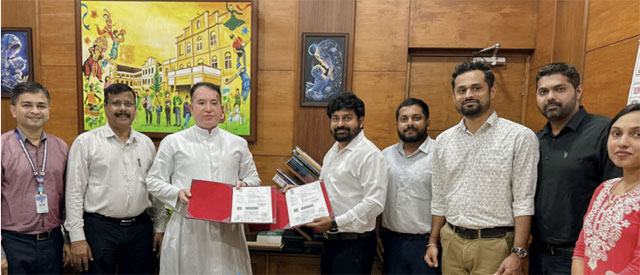
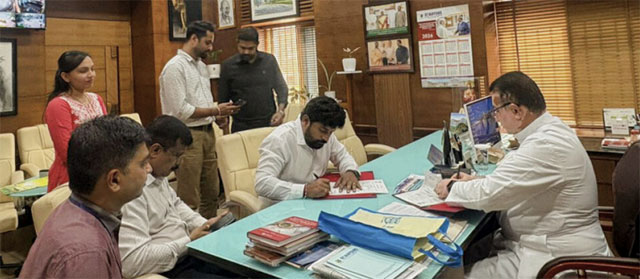
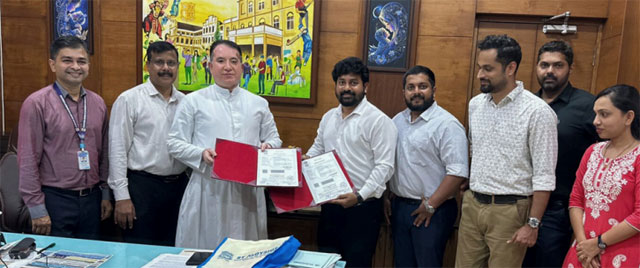
The programmes, scheduled to commence from the 2026 academic year, include:
• BCA in AI-Augmented Software Systems (Software Engineering, Cloud Platforms, Automation, Applied Artificial Intelligence)
• BSc in Media and Creative Technologies (Media Systems, Design, Creative Technology, Professional Production Workflows)
Both programmes follow a structured three-year degree model, integrating formal coursework with progressive industry exposure and a full-time paid internship embedded within the academic framework in the final year.
Academic Structure with Industry Immersion
Years 1 and 2: Students build strong academic foundations while simultaneously engaging with industry-oriented assignments, applied projects, professional toolsets, and mentor-led sessions. Industry professionals contribute through structured lectures, studio interactions, and guided project reviews.
Year 3: Students undertake a full-time, paid industry internship for the entire academic year. Unlike short-term training modules, this internship is embedded within the academic framework, carries academic credit, and allows students to work within professional teams under structured mentorship.
By the time students graduate, they complete not only their academic requirements but also one full year of documented professional experience.
Curriculum Developed with Industry Participation
What distinguishes these programmes from conventional placement oriented models is the point at which industry engagement begins.
The curriculum has been developed in collaboration with organisations that are part of the broader internship and recruitment ecosystem. Professionals from these organisations participate as mentors, guest faculty, and project evaluators, engaging with students throughout the academic journey rather than only at the recruitment stage.
Projects and assessments are structured around real industry problem statements rather than hypothetical case studies. As a result, students begin building professional relationships and demonstrating capability while still in their first and second years of study. By the time internship and placement processes commence, students are not entering unfamiliar systems through cold applications. Instead, they are progressing within networks and environments where their work, performance, and professional conduct are already known. The same industry participants who contribute to the curriculum framework also guide and evaluate students, forming an informed and structured recruitment ecosystem around these cohorts.
A Different Learning Environment
These programmes emphasise practical, tool-based learning from the first semester. Students work on industry-relevant software platforms and production systems currently used in professional environments.
Artificial Intelligence is not treated as a standalone subject limited to a single semester. Instead, it is integrated into the learning process across domains — from software automation and cloud systems to media production workflows and creative technologies. Professional discipline, collaborative practice, and ethical application of technology are incorporated within the academic culture of the programmes.
Why This Matters for Students in Mangaluru
For students in Mangaluru and surrounding regions seeking undergraduate programmes in AI, software systems, or media and creative technologies, this collaboration offers a structured pathway that combines academic depth with sustained industry exposure.
For many families, a long-standing concern has been the gap between classroom learning and workplace expectations. These programmes seek to address that gap by positioning industry not as a placement-stage visitor, but as an academic partner from the outset — contributing to curriculum design, mentoring, and evaluation throughout the degree.
Industry engagement begins in Year 1 and progressively evolves into structured internship pathways by Year 3, making placement a continuation of demonstrated capability rather than a late-stage intervention.
Sierra Learning Academy has delivered mentor-led, hands-on training programmes with an emphasis on real-world tools and measurable professional outcomes, including cohorts involving learners from institutions such as IITs, NITK, and other nationally recognised institutes.
“A classroom should feel like the workplace. Same tools, same pace, same problems. The only difference is, here you have mentors helping you rise every time you stumble. That’s the environment we have built,” said Vinol Savio D’Costa, founder, Sierra Learning Academy.
Admissions Philosophy and Selection Process
Admissions to these programmes are selective and aptitude-led. The focus is on identifying students with logical reasoning ability, disciplined curiosity, learning agility, and the capacity to work within structured problem-solving environments aligned to professional standards.
The admission process includes:
Aptitude Assessment: Candidates undergo a structured assessment designed to evaluate logical reasoning, problem decomposition, pattern recognition, and practical thinking through scenario-based prompts.
Personal Interview: Shortlisted candidates participate in a personal interaction that assesses motivation, communication clarity, learning attitude, and alignment with an industry-embedded, portfolio-driven academic model. The objective is not to test prior expertise, but to identify students who demonstrate the mindset required to thrive in a rigorous, practice-oriented learning environment.
Admissions and Enquiries
Admissions for the 2026 academic year will open in advance of the academic session, with detailed timelines to be announced through official communication channels. Prospective students and parents may contact either institution for eligibility criteria, fee structure, and application timelines.
St Aloysius Deemed to be University (UG Admissions Office)
• Website: https://ugadmissions.staloysius.edu.in/
• Phone: 0824-4117701
Sierra Learning Academy
• Website: https://www.sierralearning.in/ug-home-page
• Email: bde@sierralearningacademy.com
• Phone: +91 93535 04965
About Sierra Learning Academy
Sierra Learning Academy is a Mangaluru-based institution specializing in industry-aligned education across software systems, artificial intelligence, media production, design, and creative technology domains. The academy follows a mentor-led, practice-intensive model that emphasises structured project workflows, contemporary toolchains, and measurable professional outcomes.
Since its inception, Sierra has trained over 2,000 learners across multiple specialised cohorts and has delivered advanced workshops and industry-oriented programmes within broader engineering and technology ecosystems, including engagements involving learners from institutions such as IITs, NITs, NITK, and other nationally recognised colleges. Its programmes are built around real-world problem solving, portfolio development, and employer-aligned skill benchmarks. Learners trained through Sierra’s programmes have progressed into roles across software development, media production, design, and technology-driven organisations. The academy’s emphasis on applied skills and portfolio-based evaluation has contributed to consistent placement and career advancement outcomes across these domains.
Through this collaboration with St Aloysius Deemed to be University, Sierra extends its industry-integrated learning model into a formal undergraduate framework for students in Mangaluru and the surrounding region.
About St Aloysius Deemed to be University
Established in 1880 in Mangaluru, St Aloysius is a nationally recognised institution with a long-standing academic legacy. The institution was granted deemed-to-be-university status by the UGC in 2024 and holds NAAC A++ accreditation (Cycle IV) with a CGPA of 3.67 out of 4.0. In the NIRF 2024 rankings, it was placed among the top colleges in India (Rank 58 in the College category), reflecting its academic excellence and institutional standing.
As a deemed-to-be university, the institution is expanding its academic portfolio to include skill-integrated and industry-aligned programmes that complement its traditional strengths, aligning contemporary professional expectations with its established academic foundation.