Daijiworld Media Network – Udupi (TP)
Udupi, Apr 7: In a major relief to victims of a large-scale insurance fraud, over 57,000 policyholders from Chikkamagaluru district have finally received compensation following a prolonged legal battle. The affected individuals, who had invested crores of rupees in premiums under a micro insurance scheme of the Life Insurance Corporation (LIC) of India, were defrauded by intermediaries appointed by the corporation.
As per court orders, policyholders have now been refunded their paid premiums along with litigation costs and an additional compensation of Rs 3,000 each.
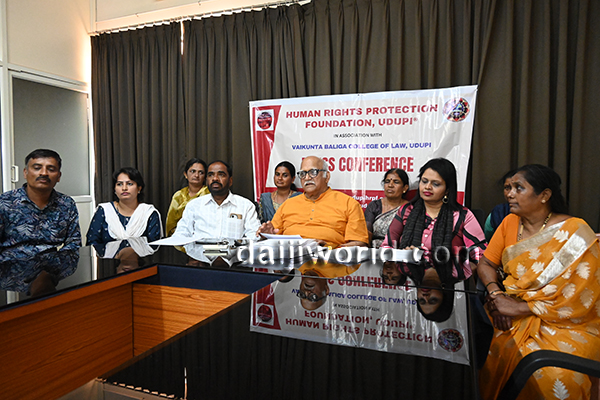
Addressing a press conference on Monday, April 6, Dr Ravindranath Shanbhag, president of the Human Rights Protection Foundation (HRPF), Udupi, said, “In 2005, following guidelines by the Insurance Regulatory and Development Authority (IRDA), LIC introduced a Micro Insurance Scheme aimed at the economically weaker rural population. The scheme offered a policy of Rs 15,000 for a 15-year term, with an affordable annual premium of around Rs 600. A monthly instalment option of Rs 50 was also provided.”
Under the scheme, anganwadi workers in villages were entrusted with collecting premiums and handing them over to LIC-appointed intermediary organisations at the district level. Between 2009 and 2010, more than 58,000 people from over 200 villages across taluks such as Kadur, Chikkamagaluru, Arsikere, Tarikere, Mudigere, and NR Pura enrolled in the scheme.
The collected premiums were handed over by anganwadi workers to three intermediary organisations: Samanvaya Grameena Abhivrudhi Samsthe, Shubhodaya Grameena Abhivrudhi Samsthe, and Mukkaneshwari Yuvathi Mandal. Instead of depositing the funds with LIC, staff members of these organisations allegedly misappropriated the money and absconded.
The scam came to light in July 2013 when a death claim was rejected on the grounds that the policy was inactive. Investigations revealed that LIC had received only the initial premium instalment, while subsequent funds had been siphoned off.
The revelation caused panic and outrage across villages. Many policyholders held local anganwadi workers responsible as they were the primary points of contact for money collection. This led to protests and instances of violence against the workers; some women were reportedly assaulted, and one worker tragically died by suicide.
Despite the scale of the fraud, LIC officials were slow to act, and police complaints were delayed by nearly a year. Significant progress followed only after the intervention of the Human Rights Protection Foundation in 2016.
Initially, a group of 60 policyholders approached the District Consumer Commission in Chikkamagaluru. The commission found LIC negligent and ordered a refund of premiums with penalties and legal costs. LIC's compliance with this verdict effectively admitted liability.
Subsequently, the HRPF filed a larger case on behalf of thousands of remaining victims before the State Consumer Commission. After nearly a decade of litigation, LIC agreed to compensate all affected policyholders.
Following the court’s directive, thousands of victims have now received a full refund of their premium payments, litigation costs, and a compensation of Rs 3,000 each. The resolution has also brought long-awaited relief to the anganwadi workers who were wrongly blamed in the fallout of the scam.