Daijiworld Media Network - Riyadh
Riyadh, Apr 10: Recent attacks on Saudi Arabia’s energy infrastructure have significantly impacted its oil production and export capacity, raising concerns over global supply stability.
According to a report citing official sources via Saudi Press Agency (SPA), the attacks have reduced the Kingdom’s oil production capacity by around 600,000 barrels per day (bpd), while throughput on the critical East-West Pipeline has dropped by approximately 700,000 bpd.
The disruptions come amid escalating regional tensions linked to Iran, with Saudi authorities intercepting multiple missiles and drones in recent weeks.
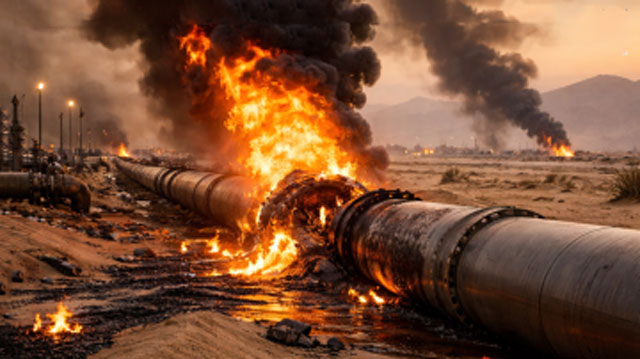
A strike on one of the pumping stations along the East-West Pipeline — a key export route amid restrictions in the Strait of Hormuz — led to a sharp fall in its operational capacity. At the same time, upstream damage to major oilfields further compounded the impact. The Manifa oilfield saw a reduction of about 300,000 bpd, while a previous strike on the Khurais oilfield cut another 300,000 bpd, taking total production losses to nearly 600,000 bpd.
The attacks also hit downstream infrastructure, affecting major refineries including SATORP, Ras Tanura, SAMREF and the Riyadh refinery. Processing facilities at Ju’aymah were impacted by fires, disrupting exports of liquefied petroleum gas and natural gas liquids.
Global energy firms such as TotalEnergies and ExxonMobil have stakes in some of the affected facilities, increasing international concern over the disruptions.
Officials indicated that the attacks have also strained operational and emergency inventories, limiting the Kingdom’s ability to offset supply gaps. Analysts warn that reduced flows through the East-West Pipeline could further tighten already constrained global oil markets.
Reflecting the uncertainty, Brent crude prices rose in post-settlement trade after closing 1.2 per cent higher at $95.92 per barrel.
The developments come despite a recently announced two-week ceasefire, which remains fragile amid continued regional hostilities, including strikes in Lebanon and ongoing constraints on transit through the Strait of Hormuz.
Saudi Arabia, the world’s largest oil exporter, plays a crucial role in global energy markets. Any prolonged disruption to its production, refining or export infrastructure could intensify supply pressures and increase price volatility.
The ministry also confirmed casualties in the attacks, with one industrial security personnel killed and seven others injured, highlighting the growing risks to critical energy infrastructure in the region.