Daijiworld Media Network - New Delhi
Shillong, Jun 19: Union finance minister Nirmala Sitharaman on Friday said Meghalaya’s long-standing tradition of environmental conservation and community-led resource management gives the state a distinct advantage in becoming a national leader in premium organic agriculture.
She made the remarks while inaugurating Northeast India’s largest organic spice processing facility in Ri-Bhoi district.
The Rs 32-crore project, developed by the Eastern Ri-Bhoi Organic Farmer Producer Company (FPC), is expected to directly benefit around 5,500 organic farmers from Meghalaya and other northeastern states by enhancing value addition, reducing post-harvest losses and improving access to domestic and international markets.
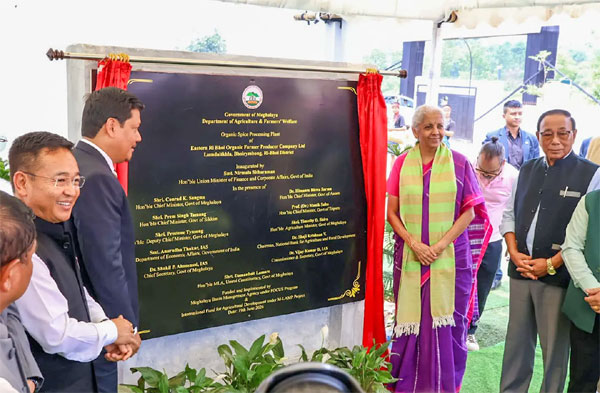
The inauguration ceremony was attended by Meghalaya Chief Minister Conrad K. Sangma and Sikkim Chief Minister Prem Singh Tamang.
Addressing farmers and local community leaders, Sitharaman said the future of agriculture will depend not on producing larger quantities but on delivering products that are cleaner, safer, traceable and environmentally sustainable.
She noted that Meghalaya had embraced sustainable practices long before they became a global priority and praised traditional Khasi values that emphasise accountability towards nature and responsible use of natural resources.
According to the Finance Minister, decisions concerning soil conservation, water management and farming methods will play a decisive role in ensuring long-term agricultural resilience.
“Consumers across the world are increasingly demanding high-quality, sustainably produced and fully traceable agricultural products. Meghalaya is naturally positioned to take advantage of this growing market,” she said.
Sitharaman described the project as the outcome of nearly a decade of efforts to strengthen farmer-led institutions and said it demonstrated how community participation, strategic investments and government support can work together to create inclusive economic growth.
The newly inaugurated unit is the first organically certified spice-processing facility in the Northeast and is equipped with cold storage, dry storage, washing, drying and pulverising systems.
The facility will be capable of processing more than 10,000 metric tonnes of high-value organic spices annually, including ginger, turmeric, black pepper and chilli.
Certified under both the National Programme for Organic Production (NPOP) and European Union Organic Standards, the unit is expected to open up direct access to premium global markets.
Highlighting Meghalaya’s agricultural strengths, Sitharaman referred to the internationally recognised Lakadong turmeric, which received Geographical Indication (GI) status in 2024, as well as the state's high-quality low-fibre ginger varieties.
She stressed that the region should move beyond selling raw agricultural produce and instead focus on value-added products with strong branding and packaging.
“Processing, certification, branding and packaging are essential if we want more economic value, employment opportunities and income generation to remain within the region,” she said.
Chief Minister Conrad K. Sangma described the project as a transformational initiative and said Meghalaya has already operationalised 11 processing units that are benefiting nearly 55,000 farmers and their families.
He added that the state government is steadily developing infrastructure aimed at connecting farmers to larger markets and strengthening rural livelihoods.