Daijiworld Media Network - New Delhi
New Delhi, Jun 21: The Bharatiya Janata Party (BJP) has rejected allegations that it engineered rebellions in opposition parties, including the Trinamool Congress (TMC) and Shiv Sena (UBT), and instead blamed the recent political turmoil on what it described as a “leadership deficit” within these parties.
The BJP-led National Democratic Alliance (NDA) stands to benefit from the splits, as rebel groups from both parties have indicated their willingness to support the ruling alliance. The NDA, which currently has 293 members in the Lok Sabha, could see its strength increase to 319 if 20 rebel MPs from the TMC — who have merged with the Nationalist Citizens Party of India (NCPI) — and six MPs from Shiv Sena (UBT) move towards the NDA.
Opposition parties have accused the BJP of encouraging defections and weakening rival parties, but the ruling party has denied the allegations, claiming that the unrest stems from dissatisfaction among leaders and grassroots workers.
A senior BJP lawmaker said legislators generally consider factors such as their political future, the direction of their party, the relationship between leadership and cadre, and other personal considerations before deciding to switch sides.
“The recent developments in the TMC and Shiv Sena (UBT) show a disconnect between the top leadership and party workers,” the BJP leader said.
Speaking about Shiv Sena, the leader said that late Balasaheb Thackeray maintained a strong bond with party leaders and workers, which helped keep the organisation united. However, the BJP leader claimed that this connection weakened later, with some Shiv Sena workers feeling that Uddhav Thackeray’s alliance with the Congress went against the party’s original Hindutva ideology.
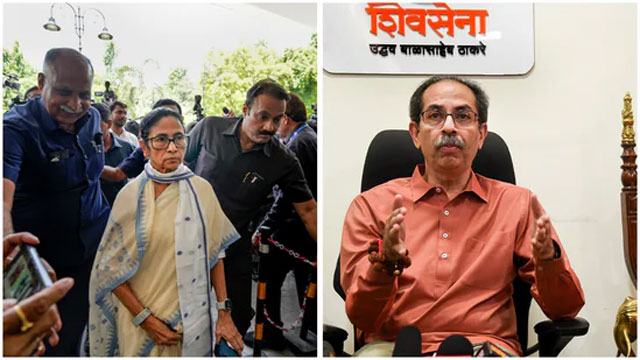
Uddhav Thackeray, while addressing party workers on Friday, rejected the allegations and even offered to step down as Shiv Sena (UBT) president if required. He accused the BJP of attempting to attract opposition MPs to increase its numbers in Parliament and gather support for key legislations that require a two-thirds majority.
Former West Bengal Chief Minister Mamata Banerjee has also accused the BJP of instigating rebellion within the TMC. However, rebel leaders from the party blamed TMC national general secretary and Mamata’s nephew Abhishek Banerjee for administrative failures that contributed to the party’s poor performance in the recent Assembly elections.
A BJP leader from West Bengal claimed that the developments in the TMC were not limited to a few leaders but had reached the level of a major internal challenge, with MLAs reportedly choosing Ritabrata Banerjee as the Leader of Opposition in the Assembly and 20 MPs deciding to merge with the NCPI.
“The party was being run like a fiefdom and elected representatives had no voice,” the BJP leader alleged.
The TMC suffered a major setback in the April-May Assembly elections, with the BJP winning 207 of the 294 seats while the TMC managed to secure only 80 seats.
The BJP leader further claimed that several TMC leaders had approached the party even before the elections due to disagreements over issues including illegal immigration and alleged failure of the state government to act against syndicates accused of forcing people to pay bribes.
Another BJP functionary said strong leadership and internal mechanisms were necessary to keep a party united. He highlighted the BJP’s internal review process and the role of the Rashtriya Swayamsevak Sangh (RSS) as additional support systems to resolve differences within the organisation.
The BJP leader also differentiated the recent developments in the TMC and Shiv Sena (UBT) from individual leaders leaving the BJP.
Referring to leaders such as BS Yediyurappa, Uma Bharti and K Annamalai, the leader said their exits were due to personal reasons and not because of organisational issues.
“The fact that they returned to the party shows the strength of the organisation,” the BJP functionary added.