Daijiworld Media Network - Srinagar
Srinagar, Jun 27: Jammu and Kashmir Lieutenant Governor Manoj Sinha on Saturday said that Sanatana Dharma, regarded as the world's oldest living religion, has always upheld the principles of coexistence and inclusivity, asserting that it never sought to impose itself on others but instead welcomed diversity and mutual respect.
Addressing an 'Interfaith Dialogue' organised by the National Council for Promotion of Urdu Language in collaboration with the Inter-Faith Harmony Foundation of India, Sinha highlighted India's civilisational ethos of religious harmony and peaceful coexistence.
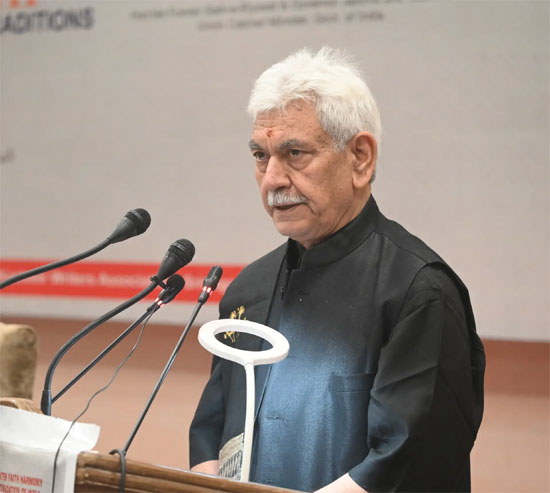
He said India's ancient philosophy has, for centuries, provided space for different faiths to flourish, making the country a unique example of unity amid diversity.
"The world recognises that Hinduism, or Sanatana Dharma, never imposed itself. It embraced diversity and coexistence, allowing religions such as Christianity, Islam, Judaism and Zoroastrianism to grow freely on Indian soil," the Lieutenant Governor said.
Referring to the increasing conflicts and intolerance witnessed across the world, Sinha said the values embedded in Sanatana Dharma and Indian philosophy could offer meaningful solutions to bridge divisions based on religion, language and race.
He described India as a civilisation founded on the belief that humanity is one family and urged the younger generation to preserve and promote this vision of peaceful coexistence.
Explaining the concept of "Bhartiyata" or "Indianness", Sinha said it represents India's enduring tradition of respecting all religions, seeking truth, celebrating diversity and nurturing a shared cultural identity.
"Our Vedas and Upanishads, which represent a knowledge tradition spanning over five thousand years, have consistently taught humanity the importance of harmonious living. They emphasise that people of different faiths should live together while respecting each other's beliefs," he said.
He noted that India's ancient sages believed truth could be reached through multiple paths and viewed diversity as a strength rather than a source of division.
The Lieutenant Governor said this philosophy is reflected in Jammu and Kashmir's long-standing tradition of communal harmony.
He observed that the idea of "Kashmiriyat" is deeply rooted in the broader philosophy of "Bhartiyata" and symbolises India's timeless message of equal respect for all religions, cultures and traditions.
Sinha also spoke about the arrival of Islam in India during the 12th and 13th centuries, saying Sufi saints and Islamic scholars who came to the country encountered a culture deeply rooted in spirituality, compassion and equality.
According to him, many Sufi saints drew inspiration from the teachings of the Vedas, Upanishads, Buddhism and Jainism, while several Sanskrit texts were translated into Arabic, reflecting centuries of intellectual and cultural exchange.
Recalling the ancient Sanskrit prayer, "Sarve Bhavantu Sukhina?, Sarve Santu Niramaya?" (May all be happy, may all be free from illness), Sinha said the prayer is meant for the welfare of all humanity, irrespective of religion or community.
"India has never asked anyone to abandon their faith. Instead, it has always welcomed people to practise their own religion and traditions while living together in harmony. That is India's uniqueness and the strength of its spiritual heritage," he said.
The event was attended by former Union Minister Dr. Karan Singh, University of Kashmir Vice Chancellor Nilofer Khan, Inter-Faith Harmony Foundation of India President Khwaja Iftikhar Ahmed, National Council for Promotion of Urdu Language President Md. Shams Equbal, Dara Shikoh Centre Founder Director Jyotsna Singh, Inter-Faith Harmony Foundation Operations Director Nasreen Shama, Kashmir Writers Association President Fida Firdous, National Coordinator Navaid-ul-Islam Khan, Srinagar Senior Superintendent of Police G.V. Sundeep Chakravarthy, Deputy Commissioner Akshay Labroo, senior government officials, literary personalities and prominent citizens.