Daijiworld Media Network - New Delhi
New Delhi, Jul 4: Union Road Transport and Highways Minister Nitin Gadkari has said the government is working on introducing up to 15 per cent isobutanol blending in diesel, describing the biofuel as a promising alternative that could reduce India's dependence on imported crude oil.
Speaking at the launch of India's first flex-fuel passenger vehicle by Maruti Suzuki India Limited on World Environment Day on June 4, in the presence of Union Petroleum and Natural Gas Minister Hardeep Singh Puri, Gadkari said ethanol cannot be blended directly with diesel, prompting the government to develop isobutanol from ethanol as a suitable substitute.
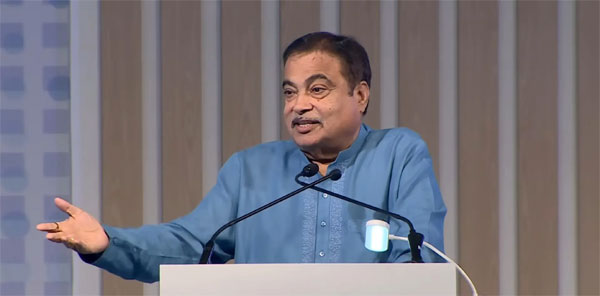
He said isobutanol has the potential to emerge as an effective alternative fuel for diesel-powered vehicles and equipment, adding that the Centre is actively working towards permitting 15 per cent blending of isobutanol with diesel.
The minister noted that testing of the fuel has already commenced for construction machinery and agricultural equipment, with initial trials yielding encouraging results.
Gadkari also said he had inaugurated two generator sets operating entirely on ethanol and isobutanol, demonstrating that engines can be successfully designed to run on these alternative fuels.
According to the minister, the proposed blending initiative forms part of the government's broader strategy to promote cleaner fuels, reduce reliance on fossil fuel imports and strengthen India's energy security.
He highlighted several alternative energy sources that are being promoted by the government, including ethanol, sustainable aviation fuel (SAF), bio-CNG, methanol, biodiesel, liquefied natural gas (LNG), hydrogen, and electric mobility, as part of the country's transition towards cleaner and more sustainable transportation.
Gadkari observed that despite significant progress in adopting alternative fuels, India continues to import substantial quantities of fossil fuels, making it essential to diversify the country's energy mix.
He also urged automobile manufacturers to speed up the development of flex-fuel vehicle technologies and explore the possibility of converting existing BS-VI (Euro-VI) vehicles into flex-fuel-compatible models through authorised service centres.