Daijiworld Media Network - New Delhi
New Delhi, Jul 3: The Defence Acquisition Council (DAC), chaired by Defence Minister Rajnath Singh, has approved capital procurement proposals worth nearly Rs 52,000 crore to enhance the operational capabilities of the Indian Army, Navy and Air Force, the Ministry of Defence announced on Friday.
The approvals, granted under the Acceptance of Necessity (AoN) framework, cover a wide range of indigenous defence systems, including anti-drone technologies, missiles, kamikaze drones, unmanned naval platforms and high-altitude surveillance systems.
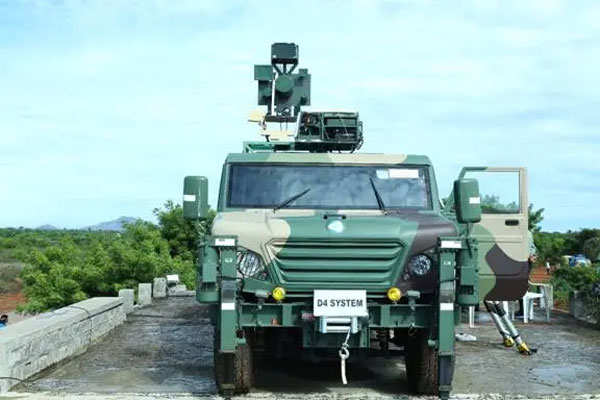
For the Indian Army, the DAC approved the acquisition of the AKASH TARANG Anti-Unmanned Aerial Vehicle (UAV) Electronic Warfare System, Man Portable Anti-Tank Guided Missile (MPATGM) systems, Medium Range Surface-to-Air Missile (MRSAM) weapon system, Very Short Range Air Defence System (V-SHORADS), Active Protection Systems (APS) for tanks and Jet-Based Kamikaze Drone Systems.
According to the ministry, the AKASH TARANG system will significantly improve the Army's ability to detect and neutralise hostile drones, while the MPATGM will strengthen infantry units in combating enemy tanks and mechanised formations.
The MRSAM system is expected to provide robust medium-range protection against multiple aerial threats, whereas the V-SHORADS, equipped with advanced multi-spectral sensors, will enhance air defence by improving resistance to enemy countermeasures.
The council also approved the induction of Active Protection Systems for tanks to improve battlefield survivability by intercepting incoming threats before impact. The Jet-Based Kamikaze Drone System is intended to boost the Army's offensive electronic warfare capability by delivering precision strikes with greater effectiveness at a comparatively lower cost.
For the Indian Navy, the DAC cleared proposals for the procurement of Multi Influence Ground Mines (MIGM), Naval Shipborne Unmanned Aerial Systems (NSUAS) and the establishment of a Land-Based Testing Facility (LBTF) for electric propulsion technologies.
The ministry said the Multi Influence Ground Mine would strengthen the Navy's capability to restrict or deny enemy naval movement in strategic waters, while the NSUAS will enhance maritime surveillance, reconnaissance and situational awareness through advanced onboard sensors.
The proposed Land-Based Testing Facility will support the design, development and validation of electric motors and propulsion systems for future naval platforms, contributing to the Navy's indigenous technology development programme.
For the Indian Air Force, the council approved the procurement of a Fixed-Wing High Altitude Pseudo Satellite (FW-HAPS) platform.
The system is designed to provide long-endurance intelligence, surveillance and reconnaissance (ISR), telecommunications support and remote sensing capabilities by operating at extremely high altitudes for extended durations.
The Ministry of Defence said the Acceptance of Necessity (AoN) represents the government's in-principle approval for a capital acquisition proposal and marks the first step in the defence procurement process before formal acquisition procedures begin.