Daijiworld Media Network – Washington
Washington, Jul 16: The United States has launched a fresh wave of airstrikes against Iran, targeting military capabilities that Washington said were being used to threaten commercial and naval vessels transiting the Strait of Hormuz.
The latest strikes came shortly after US President Donald Trump warned Tehran to "behave", marking a further escalation in tensions between the two countries.
In a post on X, the US Central Command (CENTCOM) said the second wave of strikes was launched at 3 pm ET on Wednesday under the direction of the Commander in Chief.
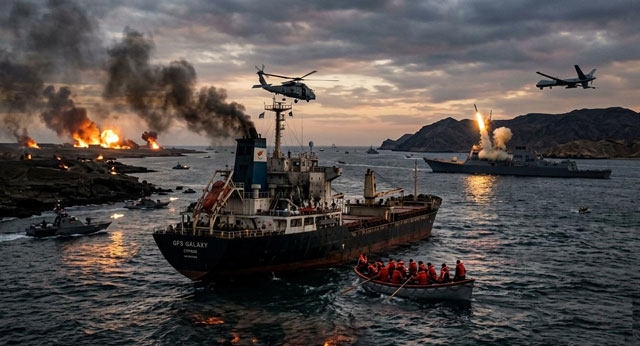
"The strikes are targeting Iranian military capabilities used to threaten vessels freely transiting through the Strait of Hormuz, an international waterway vital to global commerce. The US military is holding Iran accountable at the Commander in Chief's direction," CENTCOM said.
Following the strikes, Iranian media reported explosions in the southern cities of Ahvaz and Chabahar. However, it was not immediately clear whether the explosions were directly linked to the US operation.
Earlier on Wednesday, CENTCOM said it had completed a 90-minute operation using precision-guided munitions against Iranian coastal defence systems and cruise missile storage and launch sites on Greater Tunb Island. According to the US military, the operation further weakened Iran's capability to target commercial shipping in the strategically important Strait of Hormuz.
Meanwhile, the United States has reimposed a naval blockade on Iran, citing Tehran's attacks on vessels attempting to pass through the vital maritime route.
Iranian officials claimed the latest US strikes hit an army barracks, killing at least seven soldiers and injuring hundreds of people across the country.
The renewed military exchanges have effectively ended the interim truce that had temporarily eased hostilities. The agreement, reached after the US imposed a naval blockade in April, had paused the conflict for 60 days to allow negotiations, including talks on Iran's nuclear programme.
With negotiations now stalled and military action intensifying, concerns are mounting that the region could once again slide into a wider conflict, threatening global energy supplies passing through the Strait of Hormuz.