Daijiworld Media Network - New Delhi
New Delhi, Jul 20: At least 17 people lost their lives in rain-related incidents across northern and eastern India on Sunday, with Jammu and Kashmir accounting for 12 fatalities as torrential rain triggered flash floods, landslides and widespread destruction.
The worst-hit areas were the border districts of Poonch and Rajouri, where cloudbursts, flash floods and landslides damaged roads, houses and other public infrastructure.
The worsening situation prompted Jammu and Kashmir Chief Minister Omar Abdullah to cancel his scheduled participation in the National Conference's proposed statehood protest in New Delhi on Monday and rush to Jammu to oversee relief operations. He reached the Civil Secretariat in the evening and chaired a high-level review meeting.
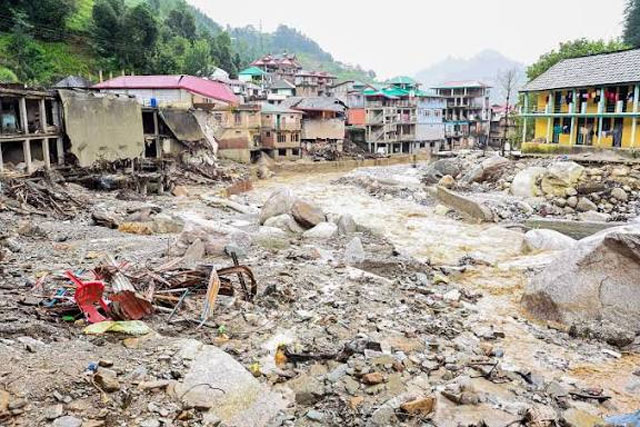
Officials said the worst devastation was reported from Surankote tehsil in Poonch district, where 10 people lost their lives. One more body was recovered in the area on Sunday evening, while two people, including a woman, died in separate flash flood incidents in neighbouring Rajouri district. Rescue teams continued search operations for those still reported missing.
In view of the adverse weather, authorities temporarily suspended the Amarnath Yatra on both the Pahalgam and Baltal routes after the India Meteorological Department (IMD) forecast widespread rainfall across Jammu and Kashmir over the coming days.
Officials also halted the onward movement of pilgrims from the Baltal and Nunwan-Chandanwari base camps in Kashmir and from the Bhagwati Nagar Yatri Niwas in Jammu.
Rain began lashing the region early on Sunday, with cloudbursts reported in forest areas of Kashmir. The weather department has forecast moderate to widespread rainfall across Jammu and Kashmir from July 19 to 23.
In Uttarakhand, two people were killed after being struck by lightning in Haridwar district as continuous rainfall affected large parts of the state.
The State Emergency Operation Centre (SEOC) said landslides triggered by heavy rain had blocked 84 roads, including two national highways. The IMD issued red and orange alerts for several districts, warning of heavy to extremely heavy rainfall over the next few days.
An orange alert has been issued for Dehradun, Tehri, Pauri, Uttarkashi, Rudraprayag, Haridwar and Bageshwar districts, while Chamoli, Almora and Pithoragarh remain under a yellow alert.
In Nagaland, at least three people died after flash floods struck Mon district, washing away houses, blocking roads and trapping several people under debris. Officials said the death toll could rise as rescue operations continued.
Himachal Pradesh authorities also issued alerts after the Shimla Meteorological Centre predicted very heavy rainfall in several districts over the next two days.
A red alert has been issued for Chamba, Kangra, Mandi and Sirmaur districts on Monday, and for Chamba, Kangra, Kullu, Mandi and Sirmaur on Tuesday.
The IMD has also forecast widespread rain and thunderstorms across Uttar Pradesh over the next 24 hours, with heavy rainfall expected at several places and very heavy rain likely at isolated locations. Thunderstorms accompanied by lightning are also expected.
In West Bengal, the IMD warned of heavy rainfall across the northern districts over the next two days, cautioning against possible landslides in hilly areas and flash floods in low-lying regions.
Continuous rain since Saturday has raised water levels in rivers including the Teesta, Torsa, Jaldhaka and Raidak across Darjeeling, Kalimpong, Jalpaiguri, Alipurduar and Cooch Behar districts. Extremely heavy rainfall is expected in Jalpaiguri and Alipurduar, while very heavy rain has been forecast for the remaining sub-Himalayan districts.
Meanwhile, Delhi recorded its warmest July night in five years, with the minimum temperature touching 31 degrees Celsius, according to the IMD. The last higher minimum of 31.7 degrees Celsius was recorded on July 1, 2021.
The maximum temperature at Safdarjung, the city's base weather station, reached 38.3 degrees Celsius, 3.1 degrees above normal, while the minimum remained 3.8 degrees above the seasonal average.
It was the second time this month that the city's minimum temperature reached 31 degrees Celsius.
Neighbouring Haryana and Punjab also experienced hot and humid conditions. Bathinda was the hottest place in Punjab, recording a maximum temperature of 40.8 degrees Celsius.