Daijiworld Media Network – New Delhi
New Delhi, Jul 21: India has hardened its position on the 65-year-old Indus Waters Treaty (IWT), stating that the agreement cannot be revived in its present form and that any future water-sharing arrangement with Pakistan would require a complete renegotiation, along with a permanent end to cross-border terrorism.
According to government sources, New Delhi has made it clear that the treaty's river water-sharing provisions can only be reconsidered if Pakistan demonstrates that it has permanently abandoned support for terrorism directed against India.
"It would be accurate to say that the IWT in its present form will not function again. If provisions related to river water sharing have to be reactivated, they have to be done in a different form, not in the present form. And only if Pakistan abjures terrorism," a government source said.
The development comes amid repeated warnings from Pakistan's political and military leadership over India's decision to suspend the treaty last year, with Islamabad cautioning that stopping water flows could lead to severe consequences, including the possibility of military conflict.
Sources said India is not actively seeking to withdraw from the treaty at present but, as a sovereign nation, retains the right to terminate any agreement found to be contrary to its national interests. Any decision to revive the treaty, they added, would depend primarily on Pakistan's actions.
"We haven't seen any evidence that they are making any effort in that direction," another source said, referring to Pakistan's alleged failure to curb cross-border terrorism.
India also rejected Pakistan's claims that the suspension of the treaty has led to water shortages, arguing that a significant volume of water allocated to Pakistan is lost because of inadequate storage infrastructure, leakages and internal disputes over water distribution among its provinces.
The treaty was placed in abeyance following the April 2025 terror attack in Pahalgam that claimed the lives of 26 civilians. Indian authorities attributed the attack to The Resistance Front, which they describe as a proxy of the Pakistan-based Lashkar-e-Taiba. In response, India launched Operation Sindoor targeting what it described as terrorist infrastructure in Pakistan.
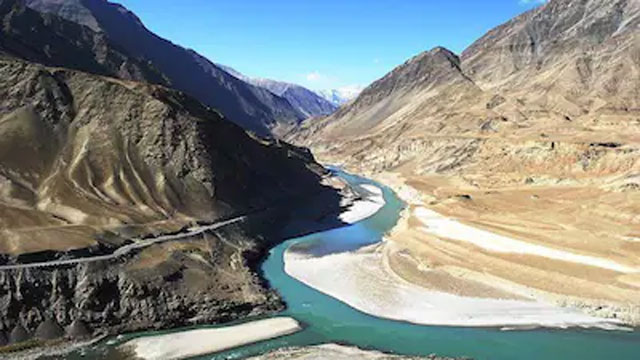
Signed on September 19, 1960, after nine years of negotiations and brokered by the World Bank, the Indus Waters Treaty allocates the eastern rivers — Ravi, Beas and Sutlej — to India, while Pakistan has primary rights over the western rivers — Indus, Jhelum and Chenab. The agreement also permits India to construct run-of-the-river hydroelectric projects, including Kishenganga and Ratle, on the western rivers subject to treaty provisions.
Indian officials have argued that the treaty requires modification due to Pakistan's repeated objections to Indian hydroelectric projects and its alleged misuse of the dispute-resolution mechanism.
According to the sources, Pakistan initially sought the appointment of a Neutral Expert in 2015 over objections to the Kishenganga and Ratle projects but later withdrew that request and instead sought a Court of Arbitration in 2016. The World Bank subsequently appointed both a Neutral Expert and a Court of Arbitration. India has participated in proceedings before the Neutral Expert but has refused to recognise the Court of Arbitration.
Government sources further alleged that Pakistan has consistently opposed nearly every Indian project on the western rivers, regardless of its size or technical specifications, including Salal, Tulbul, Baglihar, Kishenganga, Ratle and Pakal Dul, using the treaty's provisions to delay India's development projects rather than resolve genuine disputes.
They also accused Pakistan of repeatedly escalating technical issues to international forums and pursuing parallel dispute-resolution mechanisms in violation of the treaty's graded framework.
On terrorism, the sources maintained that Pakistan has taken no credible action to dismantle terror networks. They alleged that individuals and organisations sanctioned by the UN Security Council's 1267 Sanctions Committee continue to operate openly in Pakistan and that intelligence inputs indicate continued militant activity across the Line of Control.
The sources reiterated that the future of the Indus Waters Treaty would depend on Pakistan's conduct, insisting that the agreement cannot be restored in its existing form and that any future framework would require both structural changes and a verifiable end to cross-border terrorism.