Daijiworld Media Network - Panaji
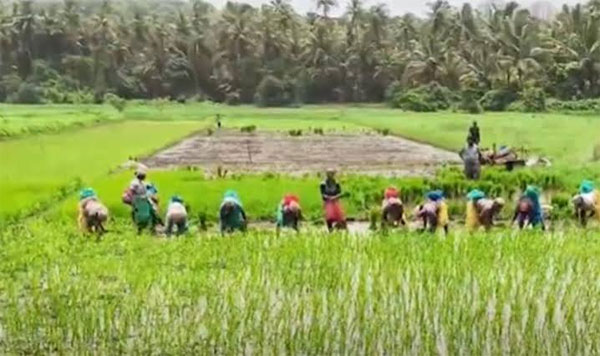
Panaji, Jul 27: After nearly 40 years of abandoned fields and declining cultivation, the village of Assolna in South Goa has revived farming through a community-driven initiative aimed at restoring its rich agricultural heritage.
Local farmers have come together to form the Assolna Xetkarancho Ekvott, a collective dedicated to bringing nearly 10 lakh square metres of agricultural land back under cultivation. The initiative was formally launched on Sunday, with the first phase focusing on the revival of around one lakh square metres of farmland.
Members of the village's Biodiversity Management Committee said Assolna has a farming tradition spanning more than two centuries, supported by fertile soil and an extensive lake system that has historically made the region ideal for paddy cultivation.
However, agriculture gradually declined as repeated destruction of standing crops by stray cattle made farming economically unsustainable. The problem was compounded by rising labour costs and an acute shortage of agricultural workers, forcing many farmers to abandon their fields.
The revival gained momentum this year after fencing was installed around the farmlands with support through Corporate Social Responsibility (CSR) funding, protecting crops from stray animals and giving cultivators the confidence to return to farming.
To tackle labour shortages, the farmers have adopted mechanised cultivation. The project is being implemented with technical assistance from Don Bosco Sulcorna, where Fr. George Quadros and his team have been engaged to prepare the land and carry out mechanised transplantation of the Jyoti variety of paddy.
Community members said earlier attempts at manual cultivation proved difficult to sustain, but the combination of mechanisation and secure farmland has made agriculture viable once again.
The initial phase covers approximately 50,000 square metres, with another 50,000 square metres set to be cultivated in the coming weeks, taking the total revived area to one lakh square metres.
Farmers also noted that the village's naturally fertile soil requires minimal use of manure, allowing the paddy to be cultivated using largely organic methods. Assolna's rice has traditionally been recognised for its quality because of these favourable natural conditions.
The Assolna Xetkarancho Ekvott currently includes 27 farmers, but organisers expect participation to grow to around 94 cultivators as additional phases of the project are rolled out.
Villagers believe the initiative can become a model for other rural communities facing similar challenges such as abandoned farmland, labour shortages and declining agricultural activity, demonstrating how collective action and mechanised farming can help restore traditional cultivation.