Daijiworld Media Network - Tokyo
Tokyo, Aug 23: A magnitude 5.9 earthquake jolted eastern Japan, including the Tokyo metropolitan area, early Sunday, injuring at least 37 people across five prefectures, while authorities said there was no tsunami threat.
The earthquake struck at around 2 am local time in southern Ibaraki prefecture, northeast of Tokyo, according to the Japan Meteorological Agency (JMA). The quake occurred at a depth of about 70 km. The US Geological Survey recorded the earthquake at a preliminary magnitude of 5.8.
The strongest shaking was recorded at lower 5 on Japan's seismic intensity scale, equivalent to 5-lower, in parts of Ibaraki, Saitama, Chiba and Tokyo. Tremors were also felt across a wide area of the Kanto region, including Kanagawa, Tochigi, Gunma and other prefectures.
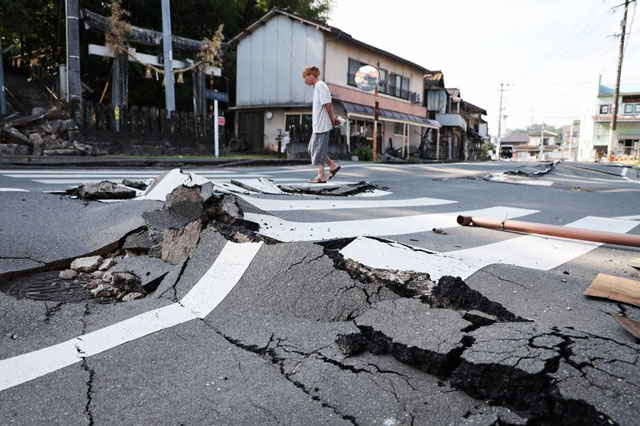
The latest reports put the number of injured at at least 37, with most suffering minor injuries. Many people were hurt after being startled awake by the powerful shaking and falling from their beds or colliding with furniture and doors while attempting to evacuate in panic. The number was initially reported as 23 as authorities assessed the situation.
Among the injured was a woman in her 80s in Yokohama, Kanagawa prefecture, who suffered a serious hip injury after falling from her bed, according to Japanese media reports.
The earthquake triggered emergency alerts on mobile phones and was strongly felt across Tokyo. Despite the intensity of the shaking, there were no immediate reports of major structural damage.
The tremor disrupted some rail services in the region. Express trains serving Tokyo and Narita Airport, along with several local services in northeastern areas, experienced delays. However, Shinkansen bullet trains continued to operate normally, according to East Japan Railway Co.
An underground water pipe also ruptured in Tokyo's Koto ward, sending water onto a roadway. Workers subsequently repaired the damaged pipe and stopped the leak.
The earthquake temporarily caused power outages affecting hundreds of homes in Tokyo, although electricity was restored later in the morning.
Japan's government immediately began assessing the possible impact of the earthquake. Prime Minister Sanae Takaichi said on X that the government had established a task force to assess the extent of any damage and coordinate the response.
Authorities also checked the country's nuclear facilities following the earthquake. The Nuclear Regulation Authority said it had received no reports of abnormalities from nuclear power plants and other facilities handling nuclear materials.
The JMA has warned that aftershocks could occur following the earthquake, and authorities are continuing to monitor the situation.
The latest earthquake comes only weeks after a much stronger magnitude 7.1 earthquake struck the Kumamoto area on Japan's southern island of Kyushu. That earthquake killed 38 people, injured 364 others, destroyed more than 1,500 buildings and damaged nearly 20,000 more, according to the reported figures.
Japan is one of the world's most earthquake-prone countries because it lies along the Pacific “Ring of Fire”, where several tectonic plates meet. The country's authorities maintain extensive earthquake early-warning and disaster-response systems because of the frequent seismic activity.
The JMA confirmed that there was no danger of a tsunami from Sunday's earthquake.