Daijiworld Media Network - Kolkata
Kolkata, Aug 23: Defence minister Rajnath Singh on Sunday called for an industrial resurgence in West Bengal while outlining a roadmap to position India as a global shipbuilding hub.
Singh was speaking at the foundation stone-laying ceremony for five brownfield expansion projects of Garden Reach Shipbuilders and Engineers (GRSE) Ltd and Yantra India Ltd (YIL) in Kolkata.
He also underlined the importance of Atmanirbharta (self-reliance) in defence, citing the successful use of indigenous weapons and systems during Operation Sindoor.
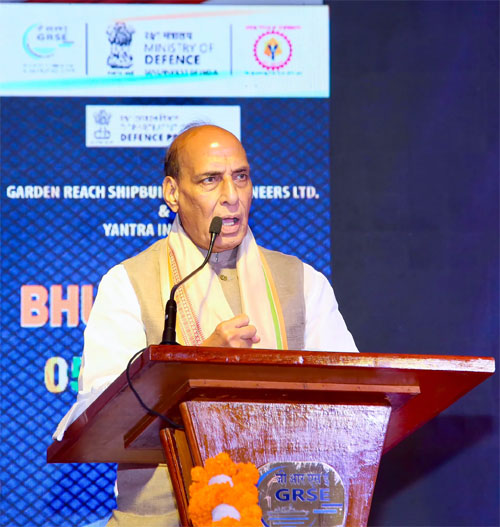
"Atmanirbharta acts as a multiplier to battlefield capabilities," Singh said, referring to Prime Minister Narendra Modi's call for India to become fully self-reliant in defence by the time the country becomes Viksit Bharat.
Focus on indigenous defence production
Singh said both GRSE and YIL were playing important roles in strengthening India's defence self-reliance.
The Next Generation Offshore Patrol Vessels (NGOPVs) being built by GRSE will have nearly 80 per cent indigenous content, he said. The Metal and Steel Factory of YIL is manufacturing high-quality components for weapons systems, while its steel and aluminium products are critical to defence manufacturing.
"The steel and aluminium that is manufactured at this factory are worth their weight in gold," Singh said.
India must seize global shipbuilding opportunity
The Defence Minister pointed out that shipbuilding involves long design-to-delivery timelines. While warships can take five to 10 years to build, large commercial vessels can take 15 to 20 years.
By the time a vessel is delivered, technology may have advanced considerably, he said, stressing the need to incorporate future technological developments during the design and construction process.
Singh said a global vacuum exists in shipbuilding and India must seize the opportunity by developing capabilities spanning ship design, construction and Maintenance, Repair and Overhaul (MRO).
He described MRO as a "low-hanging fruit", noting that it requires relatively low investment while offering the potential for strong returns.
Several countries are looking for facilities to service both naval and commercial vessels, he said, adding that GRSE had already begun exploring the opportunity.
Competitive pricing and aggressive bidding
Singh said Indian shipbuilders would have to deliver quality vessels at competitive prices and adopt aggressive bidding strategies to capture global markets.
"The profits may look thin at first, but volumes will make up for that," he said.
The Defence Minister also acknowledged challenges faced by shipbuilders such as GRSE in procuring quality spare parts and components. He said private-sector participation in the supply chain had not reached the desired level and urged industry leaders to come forward.
Such participation, he said, could prove commercially profitable while strengthening the country's defence manufacturing ecosystem.
Singh assured shipyards of full government support in addressing the challenges.
Rs 3,420 crore investment for West Bengal
Singh said the Rs 3,420 crore investment linked to the projects would contribute to employment generation and industrial growth in West Bengal.
He also said GRSE would be in a position to bid for the Next Generation Destroyers that the Indian Navy plans to procure.
Calling for an "industrial renaissance" in West Bengal, Singh said the state was undergoing change following the formation of the new government.
He cited the allocation of 1,100 acres of land within 45 days for Border Security Force (BSF) outposts and fencing, after years of requests for land from the state government.
"This government allotted 1,100 acres of land for this important work that will secure the country's border," Singh said, adding that West Bengal now had a "dynamic chief minister" and that things would change in the state.