Daijiworld Media Network - Pune
Pune, Aug 31: Maharashtra Chief Minister Devendra Fadnavis on Monday launched a sharp attack on Rahul Gandhi, Sonia Gandhi, the Congress and other opposition parties over their positions on women’s reservation and delimitation, accusing them of adopting double standards on women’s empowerment.
Addressing the Bharatiya Janata Party (BJP) State Executive meeting in Pune, Fadnavis also criticised Sonia Gandhi over her alleged reaction during the recital of the national song Vande Mataram.
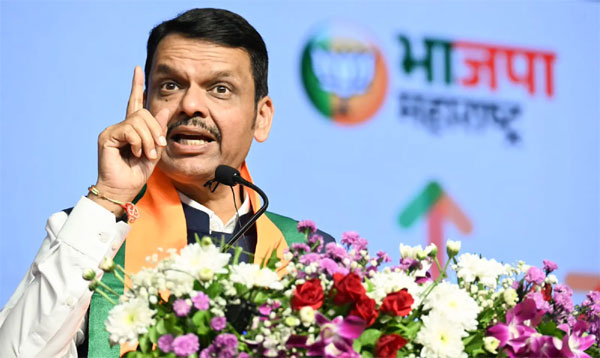
“Today, if there is an ultimate symbol of matriarchy, it is the song Vande Mataram. But as soon as it began, Soniaji started expressing outrage and had it stopped. This is the same Vande Mataram that numerous freedom fighters sang as they went to the gallows without fear. Yet, those who call this country patriarchal feel pricked when Vande Mataram is recited,” he said.
Questioning Congress’s internal dynamics, Fadnavis asked why Priyanka Gandhi was not given an opportunity when the party had the chance to promote women.
“My question to the Congress party and Rahul Gandhi is: when the time came to give opportunities to women, why was Priyanka Gandhi not given the opportunity? Rahul Gandhi and his mother will have to answer this,” he said.
Fadnavis also questioned the representation of women in Congress-governed states, asking why there were no women ministers in their cabinets.
“On one hand, they talk about women, but on the other hand, during Rajiv Gandhi’s tenure, when the Supreme Court ruled that Muslim women have the right to alimony and cannot be arbitrarily divorced, Congress amended the law in Parliament to overturn the apex court’s judgment. Where were women’s rights then? Today, if they cannot find a single woman to include in the cabinets of Himachal Pradesh or Karnataka, they have no right to come here and make grand statements about women,” he said.
The Chief Minister went on to describe Rahul Gandhi and INDIA bloc partners as the “true killers of women’s reservation”.
On Congress’s current position on the Women’s Reservation Bill and delimitation, Fadnavis said the opposition had earlier voted in favour of the legislation introduced by Prime Minister Narendra Modi’s government.
“Prime Minister Modi enacted a law to provide reservations for women in the Lok Sabha and State Assemblies. When this bill was introduced in 2023, it contained two specific conditions: providing 33% reservation for women, based on census data, followed by delimitation based on those figures. My question to Rahul Gandhi, Supriya Sule, and other opposition figures is did the law you voted for in 2023 mention delimitation or not? It did,” Fadnavis said.
He said the opposition had unanimously agreed to the sequence of conducting the census and delimitation before implementing the reservation.
“You voted for the bill because you knew the NDA had a two-thirds majority, and it would have passed regardless. You simply voted for it to jump on the bandwagon,” he alleged.
Turning to India’s energy scenario, Fadnavis highlighted the country’s dependence on foreign oil imports but expressed confidence that India could achieve greater self-reliance by 2030.
“India is currently fully dependent on other countries for petrol and diesel. However, I am confident that by 2030, 50% of the country’s fuel requirement will be fulfilled by our farmers (via biofuels), while the remaining 50% will be met through Electric Vehicles (EVs),” he said.
Linking energy self-reliance to broader geopolitical developments, Fadnavis said India was rapidly emerging as a self-reliant global power under Prime Minister Narendra Modi’s leadership. He claimed India had already become the world’s fourth-largest economy and no longer depended on other countries for weaponry.
“Certain global forces do not want to see a self-reliant India. They realise that if India is not stopped now, it will become unstoppable. Consequently, their tactics have changed. Today, among those being utilised by hostile forces, barely 5% are aware that they are being exploited, knowingly aiding such elements,” he claimed.
Drawing a parallel with Chhatrapati Shivaji Maharaj, Fadnavis said, “Shivaji Maharaj taught us how to fight. When his army entered the battlefield, they rallied around the war cry of ‘Har Har Mahadev’. Once again, a similar confrontation is approaching. The aggressors are not new, the conflict is not new—only their methodology has evolved.”
He called for a strategic understanding of the opposition’s political methods, comparing the current political landscape with historical defence strategies.
“Whenever enemies launched multi-pronged attacks on Swarajya, Shivaji Maharaj eliminated them using guerrilla tactics and intelligence networks,” he said.
Clarifying his position, Fadnavis added, “I will not call the opposition ‘enemies,’ but they are adopting new tactics. We must understand these tactics thoroughly.”
On the ongoing debate over the use of high-decibel DJ sound systems during the upcoming Ganesh festival, Fadnavis appealed to Pune residents to set an example rather than get caught up in the controversy.
With various sections demanding a ban on DJ systems over noise pollution concerns, the Chief Minister avoided taking a position on the operational dispute and instead urged citizens to celebrate Ganeshotsav in a traditional and cultural manner.
“When I step out of this meeting, the media will inevitably ask me whether DJs should be allowed during Ganeshotsav in Pune. But I want to tell the people of Pune. Pune alone possesses the capability to celebrate this festival in a purely traditional and cultural manner. This is something only Punekars can achieve,” he said.
Fadnavis appealed to citizens and local mandals to avoid the controversy surrounding DJ systems and demonstrate to the rest of Maharashtra how Ganeshotsav can be celebrated with traditional grandeur and cultural richness.