Daijiworld Media Network - New York
New York, Oct 20: US President Donald Trump’s name will not appear on the ballot in the November 3 midterm elections, but his repeated appeals to voters to imagine that he is a candidate himself and vote for Republican Party candidates are turning the polls into a referendum on his presidency as it approaches the turbulent halfway mark.
“Pretend that I am on the ballot,” Trump has told crowds at campaign rallies for Republican candidates, hoping to improve his party’s electoral prospects.
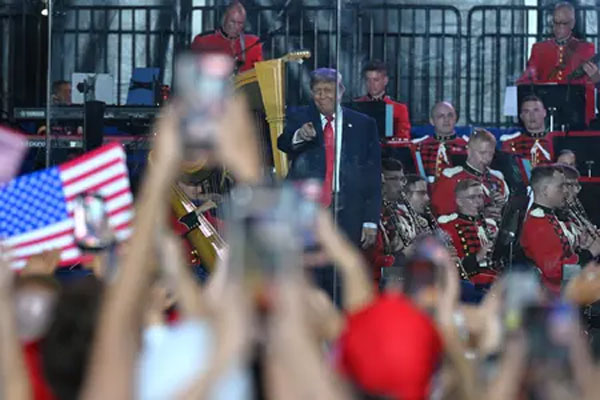
With a fortnight remaining before the November 3 elections, several opinion polls indicate challenges for the Republicans, with Democrats positioned to gain ground in the House of Representatives, while the Senate contests remain closely fought.
The economy has emerged as a major issue for Trump, with tariffs and the war with Iran contributing to higher energy prices and increasing the cost of everyday essentials, according to the report.
A CBS News poll released earlier this month found that 70 per cent of registered voters believed Trump’s policies were pushing prices higher.
Trump, who had previously dismissed the Democrats’ affordability campaign centred on rising prices, has acknowledged the issue while defending the economic consequences of his policies.
“It’s a small price to pay for keeping the world safe, keeping our country safe,” he said.
The report also cited Trump’s recent outreach to Russian President Vladimir Putin over diesel supplies amid rising prices. A year ago, Trump had criticised India, alleging that it did not “care how many people in Ukraine are being killed by the Russian War Machine”, and imposed sanctions on it.
Now, seeking to contain the price spiral, Trump has approached Moscow for diesel supplies. He has said Russia would initially provide 300,000 tonnes, followed by another 500,000 tonnes next month.
Trump’s job disapproval rating has remained close to 60 per cent in several opinion polls, reflecting voter concerns over rising prices. RealClear Politics’ polling average puts his disapproval rating at 59.3 per cent, while 62.9 per cent of respondents believe the country is on the “wrong track”.
Trump has acknowledged that the midterm results could have significant consequences for the remainder of his presidency, particularly as control of Congress hangs in the balance.
He has also recognised the possibility of facing impeachment proceedings again, as happened during his first term.
“If we don’t win, they’ll end up impeaching me,” Trump said at a recent campaign rally.
Although Democrats would need a two-thirds majority in the Senate to remove him from office following impeachment by the House, proceedings in the lower chamber could still consume political and administrative attention. Cabinet officials, including Secretary of War Pete Hegseth, have also faced impeachment threats, with one such effort already pending.
However, the polling picture comes with a caveat, as surveys in previous elections have sometimes overstated Democratic support.
RealClear Politics’ aggregation of generic congressional polls, which measures voter preferences without focusing on individual constituencies, shows Democrats leading Republicans by 8.3 percentage points. Fox News has also reported a Democratic advantage of nine percentage points.
RealClear Politics’ interpretation of House polling puts Democrats at a projected 227 seats, giving them a nine-seat majority, while Republicans could secure 186 seats. Another 22 seats remain in the toss-up category, where the contests are too close to call.
A CBS News estimate based on its polling puts Democrats at 229 seats and Republicans at 206.
The Senate picture is less clear, making it a major focus of the Republican campaign. Unlike the House, where all seats are contested every two years, senators serve six-year terms, with roughly one-third of the 100 seats coming up for election every two years.
Including seats not being contested this year and the 35 seats up for election, RealClear Politics’ Senate map shows both parties with 46 seats each, while eight seats remain toss-ups that could determine control of the chamber.
Nationally, roughly one-third of voters are generally estimated to be staunch Democrats and another third supporters of Trump’s Make America Great Again (MAGA) movement, leaving a substantial group of voters who could influence the outcome. The balance varies considerably across states, depending on their political leanings and the strength of party support.
One concern for Republicans is the possibility of erosion in support among voters who backed Trump in 2024. Democratic candidates have made gains in some states that Trump had won by substantial margins.
In Ohio, RealClear Politics’ polling average shows Republican gubernatorial candidate Vivek Ramaswamy trailing his Democratic opponent by 3.5 percentage points. Ramaswamy had been considered a strong contender when he left the Department of Government Efficiency last year to run for the post.
The Republican Senate candidate in Ohio is also trailing the Democratic contender by 2.8 percentage points, despite Trump having carried the state by 11.5 percentage points in 2024.
In Texas, Trump opposed incumbent Republican Senator John Cornyn during the party primary and endorsed Ken Paxton, a controversial state attorney general who had faced impeachment proceedings in the state legislature.
Democratic candidate James Talarico is now leading by a narrow 2.2 percentage points in the state, which Trump won by 14 percentage points in 2024.
However, these polling figures do not guarantee Democratic victories. Instead, they indicate that states and constituencies previously considered relatively secure for Republicans have become competitive.
Republicans are campaigning intensively in these states in an effort to mobilise supporters and improve voter turnout. Trump has urged his supporters to vote by mail, despite his previous scepticism about the integrity of postal ballots and efforts to restrict their use.
Midterm elections generally see lower turnout than presidential elections, as the president’s name is not on the ballot. Trump is seeking to prevent his supporters from becoming complacent and ensure they participate in the November 3 polls.
Democrats, meanwhile, are linking Republican candidates to Trump and seeking to capitalise on his low approval ratings, particularly over economic issues.
Some Republican candidates have attempted to distance themselves from the president on specific policies.
Iowa Republican Senate candidate Ashley Hinson and Ohio Senator Jon Husted have expressed differences with Trump over the war with Iran, calling for a swift end to the conflict.
On Trump’s changed approach towards Russia, Republican Senate candidates Lindsey Graham in South Carolina and Mike Rogers in Michigan have sought to distance themselves from his position. Rogers, whose state has close economic ties with Canada, has also expressed dissatisfaction with Trump’s policies towards the neighbouring country.
On immigration, a key Republican issue, Representative María Salazar has called for restraint, arguing that the administration’s policies had gone too far.
However, political association can work in both directions. Republicans have sought to link Democratic candidates with figures on the party’s left, including New York City Mayor Zohran Mamdani and Representatives Ilhan Omar of Minnesota and Alexandria Ocasio-Cortez of New York.
Some Democratic candidates have sought to distance themselves from these figures. Cait Conley, a House candidate in New York, has said she would not campaign alongside Mamdani or Ocasio-Cortez.
Trump has repeatedly described Democrats as “communists” and “socialists” as the campaign intensifies ahead of the midterm elections.