Daijiworld Media Network – Srinagar
Srinagar, Oct 26: Former Jammu and Kashmir chief minister Ghulam Nabi Azad on Sunday strongly criticised National Conference (NC) president Farooq Abdullah over his claim that Pakistan was protecting the people of Jammu and Kashmir by raising the Kashmir issue at international forums, asserting that Pakistan was an enemy of both India and the people of the Union Territory.
“I respect Farooq sahab, but his statement is completely incorrect. If anyone is an enemy of India and the people of J&K, it is Pakistan,” Azad said in a post on X.
Pointing to the situation in Pakistan-occupied Kashmir (PoK), Azad said people there were protesting for their rights. He also credited successive Central governments with contributing to Jammu and Kashmir's development since Independence, irrespective of their political affiliations.
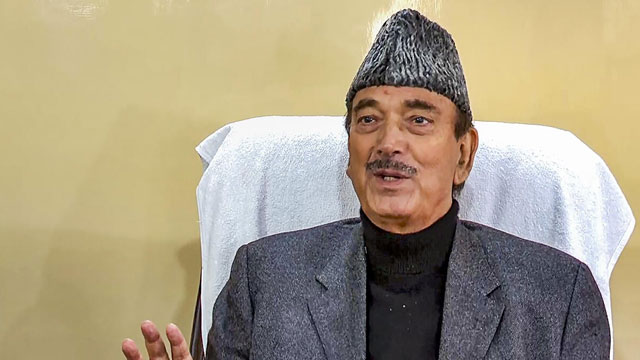
“Since 1947, successive Central governments, from Nehru to Modi, have contributed to J&K's development, irrespective of political affiliations,” he added.
Azad's remarks came a day after Abdullah triggered a political controversy with his comments at a party workers' convention in Baramulla district of north Kashmir. Abdullah had argued that Pakistan's repeated references to Kashmir at international forums were helping protect the region, while questioning the Centre's intentions towards Jammu and Kashmir.
“Our neighbour (Pakistan) is constantly after them. He (Pak PM Shehbaz Sharif) goes everywhere saying that the Kashmir issue has not been resolved. He is protecting us; otherwise, their (Centre's) intentions are not good,” Abdullah said at the convention on Saturday.
He also questioned whether the people of Jammu and Kashmir could expect justice from the Centre and urged them to stand up for their rights and identity.
“What can you expect from Delhi? Do you expect them to deliver justice for you? Have the courage to fight, or you will be wiped out, and your identity will disappear,” he said.
BJP demands action against Abdullah
Abdullah's remarks drew sharp criticism from the BJP, which accused him of lending political legitimacy to Pakistan's position on Kashmir and demanded police action against him.
BJP spokesperson Altaf Thakur described the remarks as seditious and anti-national, arguing that a leader who had taken an oath under the Indian Constitution could not question the country's intentions towards its own people while appearing to endorse Pakistan's narrative.
Thakur also accused Pakistan of inflicting immense suffering on Jammu and Kashmir through its alleged sponsorship of terrorism, which he said had resulted in decades of violence and targeted killings.
“Pakistan has given Kashmir nothing but terrorism, bloodshed, fear and uncertainty. Does Farooq Abdullah expect the people of Kashmir to forget this painful history and believe that Pakistan is their saviour?” he asked.
Jammu and Kashmir BJP president Sat Sharma demanded a public apology from Abdullah, arguing that the freedom to express such views was guaranteed by India.
“Farooq Abdullah needs to understand that he has the freedom to say whatever he wishes in this country. It is precisely because of this freedom that he is able to make such statements. Had you made these remarks in Pakistan, you might not have been spared,” Sharma said.
He maintained that Muslims in Jammu and Kashmir were safe in India and accused Abdullah of overlooking the consequences of the abrogation of Article 370.
“The BJP will not tolerate such conduct. He should publicly apologise to the people of India. Otherwise, I would say that Pakistan would be a better place for him, and he should go and settle there,” Sharma added.
Former Jammu and Kashmir BJP president Ravinder Raina also condemned Abdullah's comments, describing them as “highly condemnable and unfortunate” and accusing the NC president of committing an “act of treason”.
“Pakistan is the killer of the people of Jammu and Kashmir. Over the last 35 years, Pakistan has sought to turn Jammu and Kashmir into a graveyard and a cremation ground,” Raina said.
He accused Pakistan of fuelling terrorism in the region by providing militants with training, weapons, ammunition and explosives.
Vishwa Hindu Parishad (VHP) leader Vinod Bansal also criticised Abdullah, asserting that Kashmir was, is and would always remain an integral part of India.
Questioning Abdullah's suggestion that Pakistan was protecting Kashmiris, Bansal said the region's security depended on India's strength rather than Pakistan's intervention.
“Even when traitors of the country come to power, they do not give up their treason. They live in India and sing praises of Pakistan. Is Kashmir safe because of Pakistan or is Kashmir safe by showing India's strength to Pakistan?” he said.
Imran Ansari questions NC leadership
Shia leader and former minister Imran Ansari also criticised Abdullah, urging Kashmiris not to follow the NC president's example.
“Just a humble and brotherly request to my fellow Kashmiris. Please do not emulate Farooq sahab. He and some select band are free to say anything,” Ansari wrote on X.
Ansari alleged that the NC leadership enjoyed freedoms that ordinary Kashmiris did not, describing its political dissent as a “rented rebellion”.
“Their so-called rebellion is a rented rebellion. This space is allowed only for a select few. Whatever they say is allowed. If a common Kashmiri speaks in a similar tone, the government will in seconds put that person in detention under PSA or UAPA,” he added.
The Public Safety Act (PSA) and the Unlawful Activities (Prevention) Act (UAPA) are among the laws under which authorities can detain or prosecute individuals, subject to the provisions of the respective legislation.
Abdullah raises demolitions, calls for Muslim unity
At the Baramulla convention, Abdullah also appealed to Muslims across the country to unite against the BJP over demolitions in states governed by the party.
He alleged that properties belonging to Muslims were being disproportionately targeted and questioned how members of the community could support a political party under whose rule their homes, shops and places of worship were allegedly being demolished.
Abdullah called for collective action to safeguard the community's rights.
The BJP and governments in states ruled by the party have maintained that demolition drives are undertaken by the relevant authorities against illegal encroachments and unauthorised constructions, irrespective of the religious identity of those involved. Opposition parties and critics, however, have accused authorities of selectively targeting properties belonging to Muslims.
Abdullah also accused sections of the mainstream media of acting as “paid mouthpieces” of the ruling establishment. He alleged that financial incentives and pressure from those in power had compromised editorial independence and claimed that journalists critical of the government faced police summons and intimidation.
The political confrontation comes amid continuing differences over the Kashmir issue, the region's political status and the Centre's policies towards Jammu and Kashmir.
Pakistan has repeatedly raised the Kashmir issue, including the abrogation of Article 370, at international forums such as the United Nations and the Organisation of Islamic Cooperation (OIC).
Article 370, which granted special status to Jammu and Kashmir, was abrogated by the Centre in August 2019. The erstwhile state was subsequently reorganised into the Union Territories of Jammu and Kashmir and Ladakh.
While the BJP has consistently accused Pakistan of supporting terrorism in Jammu and Kashmir, Pakistan continues to raise the dispute at international platforms. Abdullah's latest remarks and the reactions they triggered have once again brought the issue to the centre of political debate.