Daijiworld Media Network - Muzaffarpur
Muzaffarpur, Jan 27: Rashtriya Swayamsevak Sangh (RSS) chief Mohan Bhagwat on Sunday said India is a “Hindu nation” and does not require any constitutional approval for such a declaration, as it is a “truth”.
Addressing a Social Harmony Seminar and Dialogue Programme in Muzaffarpur, Bihar, Bhagwat said there was no need to formally declare India a Hindu nation because it already is one. He stressed that Indian society is marked by diversity and not division, asserting that divisions were widened during British rule. “We have to overcome those divisions and unite Hindu society,” he said.
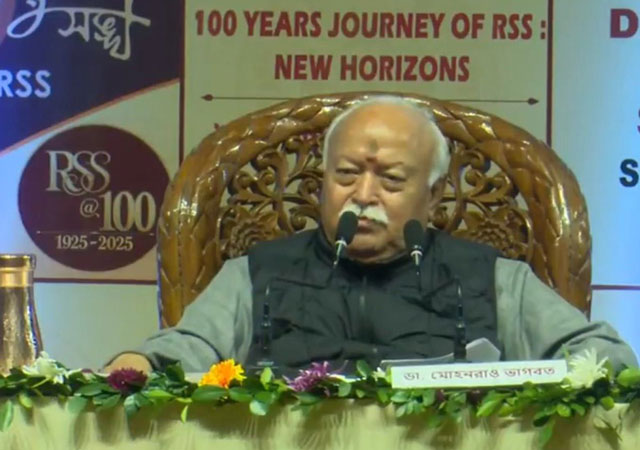
Referring to population issues, Bhagwat said no one had stopped the Hindu community from having more children, adding that the government only advises families to have one or two children. He also spoke about India’s growth, saying the country was progressing but continued to face challenges. “Some countries are unhappy with India’s progress and see it as a threat to their interests, which is why they are trying to create obstacles,” he remarked.
The RSS chief underlined the importance of harmony, both within the country and globally. He said fear between nations reduces when there is interdependence, and warned that without harmony, conflict and destruction would follow. “No foreign power conquered India solely through military strength. They succeeded by exploiting our internal divisions,” Bhagwat said.
He added that merely listing problems was not enough and emphasised the need to provide solutions that reach the grassroots level. According to him, virtuous individuals were already working to solve issues in their own capacities, but broader collective effort was required.
Earlier, Bhagwat hoisted the national tricolour at the RSS North Bihar provincial office, Madhukar Niketan, on the occasion of Republic Day. Paying tribute to soldiers, he said every martyr on the border was an Indian and called upon society to introspect on violence. He also reminded citizens that the Constitution not only grants rights but also lays down duties.