Daijiworld Media Network - News Delhi
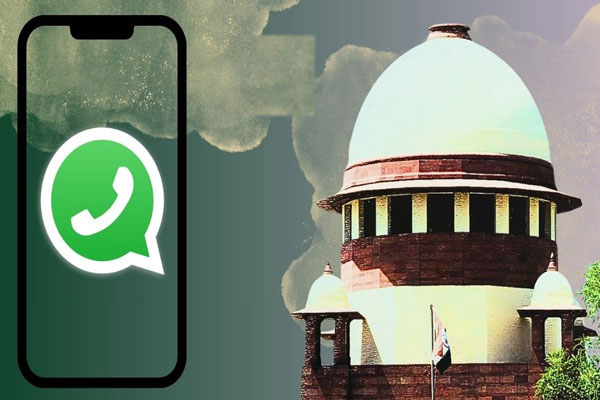
New Delhi, Feb 3: For millions of Indians, WhatsApp is not just another mobile application but an integral part of daily life. From family conversations and office coordination to small business transactions, the platform sits at the centre of India’s digital communication ecosystem. Against this backdrop, recent sharp observations by the Supreme Court against WhatsApp and its parent company Meta have drawn widespread attention.
During the hearing, the Supreme Court made it clear that constitutional principles, particularly the right to privacy, cannot be compromised for commercial convenience. A remark made from the Bench that companies unwilling to comply with constitutional requirements need not operate in India has intensified public debate on data protection and the power wielded by large technology firms.
How the WhatsApp privacy controversy began
The controversy dates back to WhatsApp’s privacy policy update announced in 2021. Users across India were repeatedly prompted to accept revised terms that allowed the sharing of certain user data with other Meta companies for service improvement and advertising-related purposes.
Users were effectively left with a binary choice: accept the updated policy or stop using WhatsApp. The absence of a meaningful opt-out option while continuing to use the service triggered public criticism, legal challenges and regulatory scrutiny.
WhatsApp subsequently clarified that personal chats between individuals remain protected through end-to-end encryption. However, it acknowledged that interactions with business accounts could be collected and used for commercial purposes, including targeted advertising on Meta platforms. This distinction did little to allay concerns, particularly given WhatsApp’s extensive user base in India.
Competition watchdog action
The matter reached the Competition Commission of India (CCI), which examined whether WhatsApp had abused its dominant position in the market. The regulator held that forcing users to accept data-sharing terms curtailed consumer choice and adversely affected competition.
In 2024, the CCI imposed a penalty of Rs 213.14 crore on WhatsApp and issued directions to limit the extent of data sharing. WhatsApp and Meta challenged the order before the National Company Law Appellate Tribunal and later approached the Supreme Court.
Supreme Court’s observations
A Bench comprising Justice Surya Kant and Justice Joymalya Bagchi raised serious concerns over the nature of user consent. The court questioned whether consent could be considered genuine when users had no realistic alternative to WhatsApp, given its near-universal adoption.
Justice Bagchi described the situation as one of “manufactured consent”, observing that users were effectively compelled to agree to the terms due to WhatsApp’s dominance. The Bench also noted that suggesting users could simply shift to another platform was impractical in the Indian context.
The court underlined that the right to privacy is a fundamental right under the Constitution and cannot be diluted merely because a service is offered free of cost.
WhatsApp and Meta’s defence
Senior advocate Mukul Rohatgi, appearing for Meta, argued that WhatsApp is a free service and that broader constitutional issues relating to data privacy are already pending before a Constitution Bench. Another senior counsel, Arun Kathpalia, submitted that WhatsApp does not share all categories of user data and that personal messages remain inaccessible to the company.
The Bench, however, appeared unconvinced, particularly in view of WhatsApp’s scale, reach and influence in India’s digital ecosystem.
February 9 deadline
The Supreme Court has directed WhatsApp and Meta to file an affidavit giving a clear and categorical undertaking that user data will not be shared in violation of privacy norms. The matter has been listed for further hearing on February 9.
The court also indicated that failure to provide such an undertaking could result in the dismissal of the companies’ appeals against the NCLAT order. While an immediate exit of WhatsApp from India appears unlikely, the court’s stance signals that global technology companies must adhere strictly to constitutional protections if they wish to operate in the country. The outcome is expected to have significant implications for data protection and regulation of digital platforms in India.