Daijiworld Media Network - Mangaluru
Mangaluru, Feb 5: The city of Mangaluru is home to a rare concentration of highly experienced cancer specialists, making it one of the few cities where comprehensive cancer care is available under one roof. This unique strength came to the fore during a special World Cancer Day awareness programme titled ‘Cancer – Hype vs Reality’, organised as part of the Cancer Gellona initiative.
Cancer Gellona is a public awareness programme launched three to four months ago by Daijiworld TV in association with MIO – Mangalore Institute of Oncology. The initiative aims to support cancer patients and their families, remove fear and misinformation surrounding cancer, and encourage people to face the disease with courage and clarity. Though World Cancer Day is observed on February 4, the organisers stressed that cancer awareness must continue throughout the year and not be limited to a single occasion.
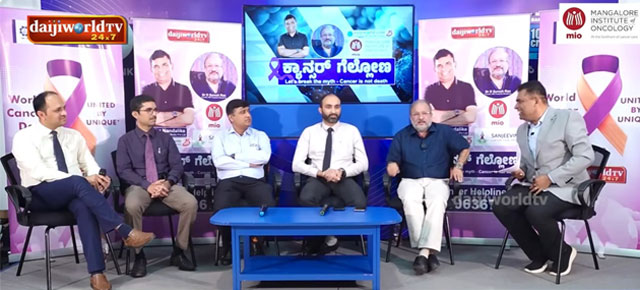
The programme was hosted at the central office of MCC Bank, reflecting the growing role of institutions in supporting community health awareness. The discussion featured five senior cancer specialists from MIO – Dr Suresh Rao, Dr Dinesh Seth, Dr Hemanth Kumar, Dr Vishwanath Sherigar, and Dr Venkatraman Kini – along with support from other oncologists and pathologists. The session was moderated by Daijiworld founder Walter Nandalike.
Doctors spoke about how cancer was once almost synonymous with death. Even among doctors, there was hesitation to specialise in oncology. However, public perception has changed significantly over the years. Today, even laypersons speak about cancer stages and treatment options, reflecting increased awareness and access to information.
Specialists emphasised that many cancers are now either curable or manageable for long periods. Lymphoma, breast cancer, and head and neck cancers have seen significant improvements in survival rates. In many cases, cancer is increasingly being treated as a chronic disease, similar to diabetes or hypertension.
Addressing the fear associated with stage 4 cancer, doctors explained that stage alone does not determine outcomes. The biology of the disease – including growth rate, hormone status, and genetic mutations – plays a crucial role. Some cancers progress very slowly and can be controlled for years with tablets, while aggressive cancers require immediate and intensive treatment. Each patient’s disease behaves differently, and generalised advice can be misleading.
The doctors shared real-life examples to underline this point. One case involved a woman who lived for nearly ten years with untreated, slow-growing breast cancer without the disease spreading. However, experts cautioned that such cases are exceptions and should never be considered a standard approach. Younger patients with aggressive cancers often need urgent treatment, as delays can be life-threatening.
The discussion also highlighted the silence surrounding cancer survivorship. Many patients hesitate to speak openly due to social stigma, unlike conditions such as heart disease. Doctors stressed that survivor testimonies are powerful tools that can inspire newly diagnosed patients and change societal attitudes.
Head and neck cancers were discussed in detail, with doctors noting that 70 to 80 percent of patients can be cured even in stage 3 or stage 4 with appropriate surgery, chemotherapy, and radiation. Advances in plastic and reconstructive surgery now allow patients to regain normal appearance and lead fulfilling lives after treatment.
Modern cancer care now involves a combination of surgery, chemotherapy, radiation, targeted therapy, and immunotherapy. Radiation therapy has become more precise, with side effects largely limited and temporary. Surgical techniques have evolved from open procedures to minimally invasive and robotic-assisted surgeries, offering better precision, less pain, and faster recovery.
Technology and artificial intelligence are increasingly assisting doctors in diagnosis and treatment planning. While AI can reduce errors and improve efficiency, doctors cautioned that it cannot replace human judgment, empathy, or clinical experience. Patients were advised not to rely solely on online tools or AI platforms for medical decisions and to always consult qualified specialists.
The programme concluded with a clear message: Cancer is no longer a death sentence. With accurate information, early diagnosis, expert treatment, and emotional support, many patients can survive and thrive. Initiatives like Cancer Gellona aim to replace fear with facts and ensure that hope, not hype, defines the cancer conversation.
Watch PART 1 of Cancer - Hype Vs Reality: