Daijiworld Media Network - Mumbai
Mumbai, Apr 9: In a significant advancement in materials science, researchers have developed innovative light-responsive materials using specially designed metal-organic cages, opening new possibilities in optoelectronics, targeted drug delivery and smart sensing technologies.
The study focused on designing and synthesising two metal-organic octahedral cages built around a flexible molecular core known as cyclooctatetraene. These structures exhibit the unique ability to alter their shape and properties when exposed to external stimuli such as light or chemical triggers.
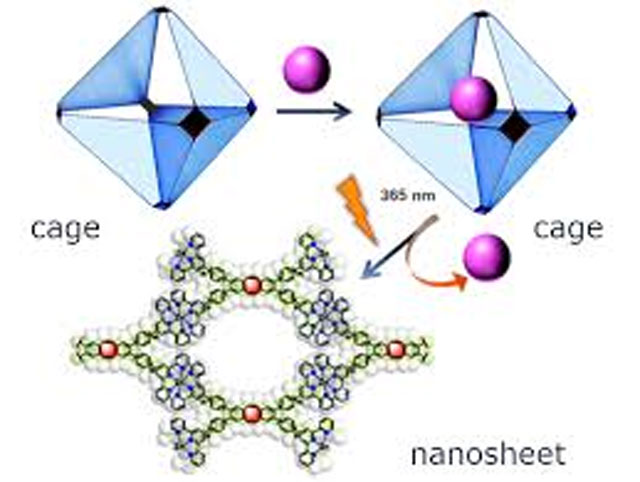
A key highlight of the research is the material’s light-responsive behaviour. When exposed to ultraviolet light at 365 nm, the cages undergo a rare transformation from a three-dimensional structure to two-dimensional nanosheets. This structural shift also enables controlled encapsulation and release of molecules, making the system highly adaptable for practical applications.
Researchers explained that the inspiration for this work comes from natural biological systems, where proteins change shape to perform specific functions. By replicating such responsive behaviour in synthetic materials, the team aims to create systems capable of dynamic structural and functional changes.
The findings demonstrate precise control over the assembly and transformation of these cages. The materials also exhibit distinct fluorescence and can be tuned to respond rapidly to environmental changes, highlighting their potential for advanced technological applications.
Experts believe these smart materials could play a crucial role in next-generation optoelectronic devices, targeted drug delivery systems and responsive sensors. The ability to control molecular trapping and release using light could particularly benefit biomedical and nanotechnology fields.
Despite the promising results, researchers noted that achieving such precise control over the self-assembly and transformation processes posed significant challenges. Extensive spectroscopic and microscopic analyses were required to confirm structural integrity and understand the mechanisms behind the light-induced changes.
Looking ahead, the team aims to develop a broader range of such stimuli-responsive materials that can be programmed to change shape, colour or function under specific conditions, paving the way for more advanced and versatile applications in science and technology.