Daijiworld Media Network – Oslo
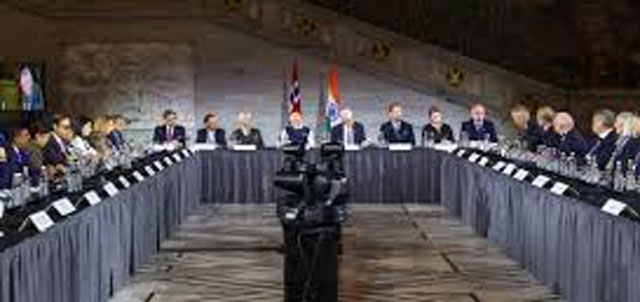
Oslo, May 19: Prime Minister Narendra Modi attended the India-Norway Business and Research Summit in Oslo, alongside Norway’s Prime Minister Jonas Gahr Støre and Crown Prince Haakon, with discussions focusing on expanding bilateral trade, investment and green cooperation between the two nations.
Addressing the summit, Prime Minister Modi welcomed the growth in bilateral trade and investments following the implementation of the Trade and Economic Partnership Agreement (TEPA). He called upon stakeholders from both countries to work towards achieving the ambitious investment target of 100 billion US dollars under the agreement and the creation of one million jobs in India.
Highlighting India’s rapid economic growth, demographic advantage and investor-friendly environment, Modi said the country offers vast opportunities for global investors. He encouraged Norwegian companies to increase investments in sectors such as blue economy, shipbuilding, renewable energy, green transition, health-tech, critical minerals and start-ups.
The Prime Minister also stressed India’s commitment towards green transition and clean energy expansion. Referring to the country’s rising energy demands and climate commitments, he pointed to India’s growing focus on renewable energy, green hydrogen and modern grid infrastructure.
Praising Norway’s leadership in clean energy investments, maritime decarbonisation, ocean sustainability and climate finance, Modi urged businesses from both nations to identify new areas of collaboration and deepen economic ties.
According to the Ministry of External Affairs (MEA), the summit witnessed participation from CEOs of more than 50 companies and over 250 representatives from Indian and Norwegian business and research communities. Several business agreements between companies and institutions from both countries were also signed during the event.
Ahead of the summit, four roundtable discussions were organised across Oslo focusing on healthcare innovation, maritime cooperation, battery and energy storage systems, digitalisation and electrification, and wind energy, the MEA said.