Daijiworld Media Network - United Nations
United Nations, Jul 14: External Affairs Minister S Jaishankar on Monday launched India's official campaign for a non-permanent seat on the United Nations Security Council (UNSC) for the 2028-29 term, asserting that India will work towards a secure, peaceful and equitable world where the voice of the Global South is heard on an equal footing.
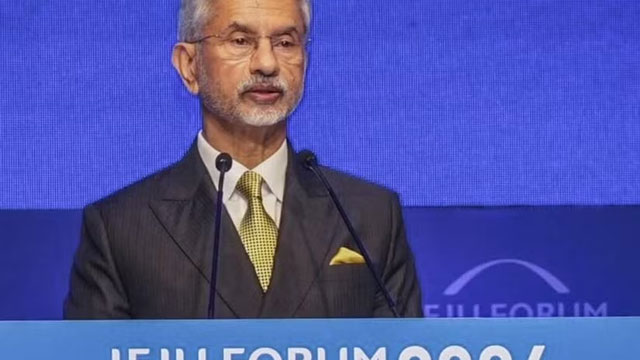
Launching the campaign at the UN headquarters in New York in the presence of UN ambassadors, diplomats and officials, Jaishankar outlined India's vision for the United Nations, saying it is rooted in 'SHANTI: Securing Holistic Advancement through Norms, Trust and Integrity.'
"India's focus will be on working for a secure, peaceful and equitable world — a world where the voice of the Global South is heard in equal measure. A world where peacekeeping is ready for contemporary and future challenges. A world where multilateralism reflects contemporary realities and provides effective solutions, not remaining a bystander," he said.
He added that India envisions "a world where the promise of technology is fully realised while safeguarding against its misuse and misapplication, and a world whose oceans are safe and secure so that maritime lifelines are not threatened."
Jaishankar further said India would continue efforts to combat terrorism by choking the resources that sustain it, while promoting climate action, climate justice, clean energy transitions and sustainable development.
During his visit, Jaishankar is also scheduled to meet UN Secretary-General António Guterres.
The minister arrived in New York after concluding an official visit to Qatar, Bahrain, Kuwait and Oman from Jul 5 to Jul 10. From New York, he will travel to Brussels on Jul 14 and 15 to participate in the third India-European Union Trade and Technology Council meeting and hold discussions with his EU and Belgian counterparts.
Elections for the 2028-29 UNSC term will be held in June next year, with India and Tajikistan contesting the lone seat allocated to the Asia-Pacific Group.
The election comes at a time of major geopolitical challenges, including the Russia-Ukraine war, the conflict in Gaza and the ongoing tensions involving Iran, Israel and the United States.
India last served as a non-permanent member of the Security Council during the 2021-22 term. It has previously held the position seven times—in 1950-51, 1967-68, 1972-73, 1977-78, 1984-85, 1991-92 and 2011-12.
Prime Minister Narendra Modi, while addressing the Parliament of Indonesia earlier this week, said the global order is undergoing rapid transformation and that developing countries are seeking greater participation in global governance.
"In this evolving global landscape, India firmly believes that reforms in the United Nations Security Council can no longer be delayed," Modi had said.
India has consistently advocated comprehensive reforms of the Security Council, including expansion of both permanent and non-permanent membership, arguing that the 15-member body established in 1945 no longer reflects present-day geopolitical realities and is not equipped to address 21st-century challenges.
New Delhi has repeatedly maintained that it deserves a permanent seat on the Security Council and has warned that reforms limited only to expanding the non-permanent category would fail to address the concentration of decision-making powers among the five permanent members.
India has also stressed that the long-standing principle of "nothing is agreed until everything is agreed" should not be used to delay meaningful reform.
Last month, India's Permanent Representative to the United Nations, Ambassador Harish Parvathaneni, said attempts by "status quoists" to invoke that principle were aimed at preserving the existing inequities within the Security Council rather than facilitating genuine reform.