Daijiworld Media Network - New Delhi
New Delhi, Oct 13: The proposed shift of protests from Jantar Mantar to three designated venues in Delhi has raised concerns over accessibility, costs, traffic congestion and the ability of demonstrators to draw public and political attention.
While Ramlila Maidan is the closest to central Delhi, it is a paid venue already in demand for seasonal events. CBD Ground in Shahdara is surrounded by residential and commercial developments, while Burari Ground lies on the outskirts of the Capital, raising questions about whether demonstrations held there can attract the same attention as those at Jantar Mantar.
Author and city chronicler Sohail Hashmi questioned the move, saying the earlier relocation of protests from the Boat Club lawns near India Gate to Jantar Mantar was itself debatable. Moving demonstrations even farther from the seat of power, he argued, would make it harder for citizens to have their voices heard.
“It was an open space for people to gather and present their demand to government… Tens of thousands of people could assemble near the seat of power. In Washington, people can gather right outside Capitol Hill. Why should we be moving people away?” he said.
Ramlila Maidan, located around 4 km from Jantar Mantar, is the closest of the three designated venues to Lutyens’ Delhi. It has a long history of hosting political rallies and public agitations. However, access comes at a cost, and availability is expected to be limited during the festive season.
A senior Municipal Corporation of Delhi (MCD) official said booking the 12-acre venue costs Rs 50,000 per day, along with a refundable security deposit of Rs 55,000. Applicants must also obtain a no-objection certificate from the Delhi Traffic Police.
“Half of the Ramlila Maidan is being used for parking space for heavy vehicles and the remaining half is open for booking. We do not offer a small section or parts of Ramlila Ground to be booked. People can only book the entire section,” the official said.
The requirement to book the entire available section could pose a challenge for smaller groups that do not need such a large space. Unlike the tree-lined stretch at Jantar Mantar, the open ground also offers little shade, potentially making prolonged demonstrations difficult during hot weather.
MCD data shows that Ramlila Maidan was booked 27 times between January 2024 and September 2026. With preparations underway for Ramlila performances and fairs, finding an available slot could become more difficult during the festive season.
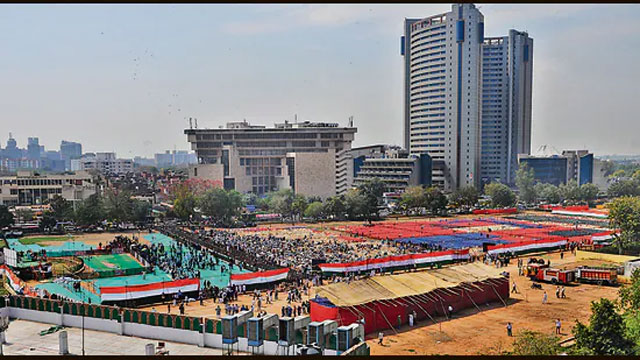
CBD Ground, spread across 12 acres in Shahdara, is maintained by the Delhi Development Authority (DDA). The venue is frequently used for weddings and other large events, but its location amid densely populated residential and commercial areas has raised concerns about traffic management and disruption to neighbouring communities.
BS Vohra, head of the East Delhi RWA Joint Front, said the ground was unsuitable for protests because of the surrounding buildings and the potential impact on local traffic.
“How can a protest site be made in such an area? There is a hotel and two malls nearby, dozens of wedding venues and so many residential enclaves. There is some open area in the middle, but how can protests be held there? Even now, you’d find Ramlila and wedding tents in the ground,” he said.
Vohra added that demonstrations often require barricades and traffic restrictions, which would be difficult to implement in such a densely populated area.
A DDA official said CBD Ground was also a paid booking facility. “We will wait for Delhi Police to clarify how protests can be carried out and whether there will be free areas,” the official said.
Burari Ground, also known as Nirankari Ground, is the largest of the three designated venues, spanning around 50 acres in northwest Delhi. Located roughly 18 km from Jantar Mantar, it is far removed from the Capital’s central administrative district.
Although its size provides space for large gatherings, its location has raised concerns about whether demonstrations held there would remain visible to policymakers, the media and the wider public.
During the 2024-2025 farmers’ protests, the ground was offered as a possible venue for demonstrators. However, farmers’ unions rejected the proposal, describing the site as an “open jail”. They argued that its isolation and fencing would confine the protests and keep them away from public view, thereby reducing their impact.
Hashmi said a protest venue must offer more than sufficient space to accommodate a crowd. It should also allow citizens to bring their grievances close to the authorities they seek to hold accountable.
“Protest sites are spaces to be heard, where media can come, people’s representatives can gather. Jantar Mantar may have been a small space, and had its own set of issues, but Burari, Ramlila Maidan and CBD Ground are farther away and have their own problems,” he said.