Daijiworld Media Network - Kochi
Kochi, Sep 27: The Kerala High Court on Saturday directed the Enforcement Directorate (ED) to produce in sealed cover the records and information it had shared with the state police in connection with the alleged CMRL-Exalogic bribery case involving former Chief Minister Pinarayi Vijayan, his daughter T Veena and son-in-law P A Mohammed Riyas.
Justice A Badharudeen issued the direction while hearing a petition filed by activist K M Shajahan, who has challenged the Kerala government's decision to conduct a preliminary inquiry instead of registering an FIR based on the material forwarded by the ED.
The court observed that the rival submissions raised an important legal question requiring detailed consideration — whether the state police can conduct a preliminary inquiry after receiving information from the ED under Section 66(2) of the Prevention of Money Laundering Act (PMLA), or whether they are required to register an FIR for the alleged scheduled offences.
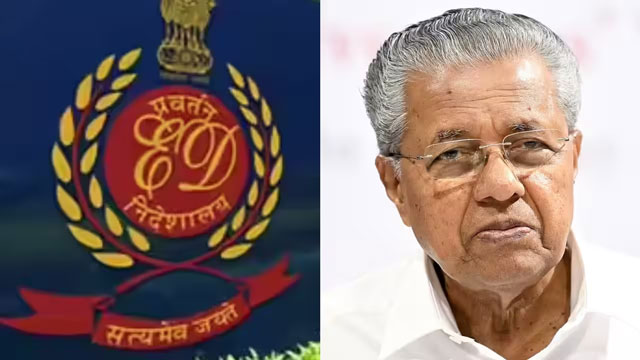
The ED had earlier written to the Kerala police seeking registration of a case against Vijayan, Veena and Riyas based on material it said was gathered during its investigation into financial transactions involving Cochin Minerals and Rutile Limited (CMRL) and Veena's now-defunct company, Exalogic Solutions Pvt Ltd.
According to the ED's allegations, CMRL made payments totalling around Rs 3.28 crore to Veena and Exalogic under the guise of consultancy services. The agency has maintained that the transactions indicated possible offences under the Prevention of Corruption Act and required investigation by the state police or another competent agency. These are allegations and have not been established by a court.
The Kerala government, meanwhile, ordered a police inquiry after receiving the ED's communication. The government has argued that receiving information from the ED does not automatically require registration of an FIR and that the state agency can independently assess whether the material discloses an offence warranting a criminal case.
During Saturday's hearing, Advocate General K Jaju Babu submitted that an FIR was not necessarily mandatory merely because information had been forwarded under Section 66(2) of the PMLA. He argued that a preliminary inquiry was legally permissible before deciding whether an offence requiring registration of an FIR had been disclosed.
The ED's standing counsel, however, took the opposite position and argued that the police were required to register an FIR and investigate the alleged scheduled offences indicated in the material supplied by the agency. The ED said its investigation had uncovered transactions that pointed to possible offences under the Prevention of Corruption Act.
The court directed the ED to place before it the communication sent to the state police chief along with the connected records in a sealed cover to maintain confidentiality.
“In order to maintain secrecy of the information and connected records, the same [are] to be produced before this Court on September 29 in a sealed cover,” the court said, directing both sides to be prepared with relevant judicial decisions on the legal issues involved.
The petition will be heard again on September 29.
The petition was filed by K M Shajahan, who has sought registration of an FIR against those allegedly involved in the CMRL-Exalogic matter and has also sought investigation by the Vigilance and Anti-Corruption Bureau. The state has also raised a preliminary objection regarding the maintainability of his petition, arguing that it was filed as a private writ petition despite being presented as a public-interest matter.
The controversy stems from the ED's investigation into transactions between CMRL and Exalogic. The matter has previously involved proceedings under the PMLA, while the latest proceedings before the High Court concern a separate question: what action the state police are legally required to take after receiving information from the ED about alleged offences.
The High Court's latest order does not determine whether the allegations against Vijayan, Veena or Riyas are established. It will first examine the legal question of whether a preliminary inquiry is permissible or whether registration of an FIR is mandatory on the basis of the ED's communication.