Daijiworld Media Network - Panaji
Panaji, Oct 1: The Bombay High Court's Goa bench has held that the draft electoral roll prepared under the Special Intensive Revision (SIR) cannot be used as the basis for deleting voters' names, stressing that administrative software systems cannot override statutory procedures.
The division bench of Justice Amit S Jamsandekar and Justice Valmiki Menezes made the observations while hearing a petition filed by six members of a family whose names were removed from the electoral roll.
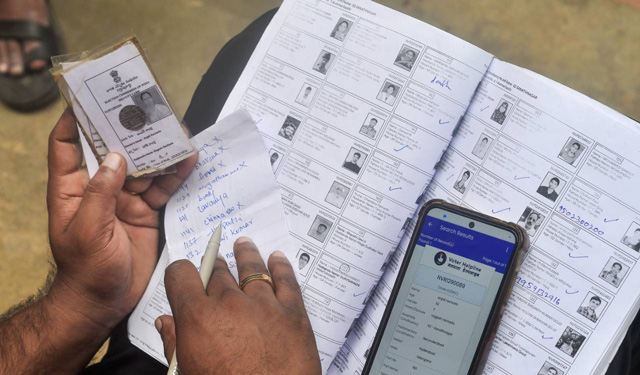
The petitioners, including Paresh Salgaonkar, told the court that they had shifted to a new house within the same Santa Cruz Assembly constituency and were advised by the Booth Level Officer (BLO) to submit Form 8 for change of address.
However, while processing their applications, the petitioners said the system showed that no record of their Elector Photo Identity Cards (EPICs) was available. The ERONET software consequently provided only the option to reject their applications.
ERONET, or Electoral Registration Officers' Network, is a web-based system developed by the Election Commission of India for processing forms and managing electoral rolls.
The petitioners said the Assistant Electoral Registration Officer subsequently informed them that their EPICs had been deleted from the electoral rolls. Since there was no option in the system to review or restore the deleted EPICs, they were asked to submit Form 6.
The family argued that Form 6 is meant for fresh inclusion of names, while existing voters shifting residence within the same constituency are required to use Form 8.
The court observed that the draft roll cannot itself become the basis for deleting voters' names.
“Otherwise, Form 6, 7 or 8 have no meaning,” the bench said, noting that the forms are prescribed for new voters, objections to entries or deletion and voters shifting residence.
Questioning the functioning of the software, the bench observed that the system had effectively treated an existing voter as a new voter because it did not allow the Form 8 application to be processed.
The judges also questioned the Election Commission over the legal provisions that could permit deletion of voters' names without giving them an opportunity of being heard.
“Show us from the Act…what empowers you to delete without hearing?” the bench asked, expressing concern that election officials appeared to have relied on the software's rejection instead of independently examining the applications.
The bench said election authorities must apply their mind after receiving a Form 8 application and verify whether the voter had actually shifted to the new address.
The judges further cautioned that such an approach could affect large numbers of voters if similar cases occurred across the state.
The court's observations come amid wider scrutiny of the SIR exercise and the procedures used to update electoral rolls. The Election Commission has maintained that omission from a draft roll does not automatically amount to final deletion and that eligible voters can seek inclusion through the claims and objections process.