Daijiworld Media Network - United Nations
United Nations, Oct 16: India has called for an immediate de-escalation of the conflict engulfing the Gulf region, stressing that it must be resolved through dialogue and diplomacy, as the hostilities affect the country's economic interests, maritime security and the safety of millions of Indians living in the region.
India's Permanent Representative to the United Nations, P Harish, made the remarks on Thursday during the Security Council's quarterly open debate on the Middle East.
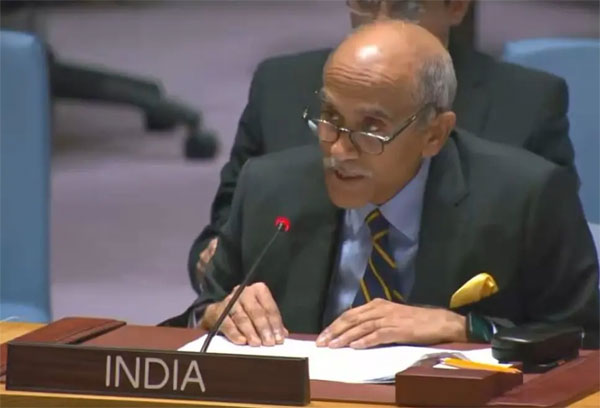
“India has very high stakes in the safety, security and stability of the Middle East,” he said, adding that India's political, economic, investment, energy and people-to-people relations with the region were extremely strong.
Harish said India's annual trade with the six Gulf Cooperation Council (GCC) countries alone stood at $180 billion, while cumulative foreign direct investment amounted to $31 billion and remittances exceeded $52 billion.
The “safety, security and wellbeing” of the 10 million Indians living in these countries remained a core national interest and a vital part of India's bilateral relationships with them, he added.
Harish also highlighted the importance of protecting Indian seafarers and ensuring the safety of commercial shipping amid the escalating conflict.
“All attacks on commercial shipping and merchant mariners are legally and morally indefensible,” he said.
He stressed that freedom of navigation and the safe and unimpeded flow of maritime commerce through international waterways, in accordance with international law, must be upheld.
Citing recent incidents, Harish referred to the attack on India-flagged vessel MV DP World Cauvery this week, as well as attacks in recent weeks on vessels operating under other flags, including MT Petro Dolphin, MT Valthera, MT On Peace and MT Kazimah III.
He said many of the vessels had Indian sailors on board and thanked Oman and the United Arab Emirates for their assistance in ensuring their safety.
Harish did not identify those responsible for the attacks on the vessels or name the principal adversaries in the conflict, which began on February 28 with a joint attack by Israel and the United States on Iran.
To address the plight of seafarers and strengthen their protection during emergencies, Harish said Prime Minister Narendra Modi had proposed the establishment of a Seafarers Emergency Support Network (SESN) at the BRICS summit.
The proposed network “could connect the Maritime authorities and embassies of the countries concerned, and facilitate distress alerts, medical assistance, communication with families, and support for evacuation”, he said.
India and Liberia, the country with the largest number of ships registered under its flag, had also jointly launched the Group of Friends on Safety and Security of Shipping and Seafarers on the sidelines of the recent UN General Assembly High-Level Week.
The group has 23 member nations, which stand ready to strengthen coordination to prevent the recurrence of such attacks and safeguard the rights of seafarers, Harish said.
Turning to the Palestinian situation, Harish, who earlier served as India's representative to the Palestinian Authority from Gaza City, said the crisis in the Strait of Hormuz should not divert attention from the dire conditions facing Palestinians.
He said India had unequivocally condemned the October 7 attack three years ago, stressing that terrorism could never be justified.
“Terrorism anywhere has no justification,” he said.
Without naming Hamas, which launched the October 7 attack, or Israel, which retaliated with military operations in Gaza, Harish said civilians, including women and children, had borne the heaviest cost of the conflict.
The international community must act together to prevent further loss of civilian lives and destruction of civilian infrastructure, he said.
Calling for a lasting resolution, Harish reiterated India's support for humanitarian relief, dialogue and diplomacy, as well as a negotiated two-state solution under which Israel and Palestine would exist as independent nations in peace.
He also highlighted India's continued assistance to the Palestinian people through several initiatives, including the construction of a hospital, the establishment of educational institutions and the provision of scholarships.
With cumulative contributions of $52 million, India was emerging as the leading contributor to the UN agency for Palestine, the UN Relief and Works Agency (UNRWA), he said.