Daijiworld Media Network - Sriharikota
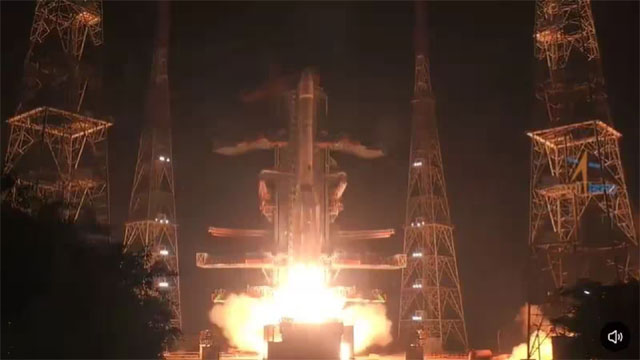
Sriharikota, Oct 31: The Indian Space Research Organisation (ISRO) successfully launched its GSLV-F18 rocket carrying the next-generation navigation satellite NVS-03 from the Satish Dhawan Space Centre in Sriharikota, Andhra Pradesh, at 11.51 pm on Friday, October 30. The satellite was successfully injected into its designated Geosynchronous Transfer Orbit, marking a significant step towards strengthening India's indigenous satellite navigation system, NavIC.
The launch marked the 20th flight of India's Geosynchronous Satellite Launch Vehicle (GSLV) and ISRO's third space launch of 2026. The 50-metre-tall, three-stage rocket, weighing approximately 420 tonnes at lift-off, took off from the Second Launch Pad following a 24-hour countdown. It carried the 2,232-kg NVS-03 satellite, which separated from the launch vehicle after approximately 18 minutes and was placed in the intended transfer orbit.
NVS-03 is the third satellite in ISRO's second-generation navigation satellite series, designed to ensure continuity and improve the availability of navigation services under the Indian Regional Navigation Satellite System (IRNSS), popularly known as Navigation with Indian Constellation (NavIC).
One of the key features of NVS-03 is its indigenously developed Rubidium atomic clock, carried alongside procured atomic clocks. Precise timekeeping is essential for satellite navigation, as positioning systems calculate a receiver's location using the time taken by signals to travel from satellites. The mission also introduces the L1 frequency signal alongside the existing L5 and S-band signals, which is expected to improve compatibility with civilian navigation devices and expand the potential applications of NavIC.
NavIC is India's independent regional satellite navigation system, developed to provide positioning, navigation and timing services across the Indian mainland and an area extending approximately 1,500 kilometres beyond the country's boundaries. It serves as India's indigenous alternative to global navigation systems such as the United States' Global Positioning System (GPS). Its services are important for civilian, strategic and security applications.
Following its successful injection into the transfer orbit, the satellite will use its onboard propulsion system to reach its designated operational orbit. ISRO will carry out the necessary orbital manoeuvres and in-orbit checks before commissioning it for navigation services. The successful launch and orbit injection mark an important milestone, although the satellite must complete these subsequent procedures before becoming operational.
The launch assumes significance as India seeks to strengthen NavIC's operational capabilities and ensure the continuity and reliability of its navigation services. The satellite is part of ISRO's second-generation programme, which envisages five satellites, from NVS-01 to NVS-05, to augment the existing constellation. The upcoming NVS-04 and NVS-05 missions are also expected to contribute to strengthening India's independent navigation infrastructure.
ISRO chairman Dr V Narayanan congratulated the scientists, engineers, industrial partners and academic institutions associated with the mission. He highlighted that the launch was accomplished with a turnaround time of just 56 days between two successive GSLV missions, the shortest interval achieved so far. He also noted the importance of indigenous atomic clock technology in strengthening India's self-reliance in satellite navigation.
The successful GSLV-F18/NVS-03 mission represents another milestone in India's efforts to develop reliable, homegrown positioning, navigation and timing capabilities and reduce dependence on foreign satellite navigation systems.