Daijiworld Media Network - Damascus
Damascus, Oct 31: Nearly two years after the ouster of Bashar al-Assad, Syrians who had hoped for a better future under President Ahmed al-Sharaa continue to struggle to afford basic necessities, with rising food, fuel and electricity prices deepening the country's economic crisis and fuelling public anger against the new administration.
The government's inability to ease the financial burden on households was highlighted in September when a steep increase in fuel prices triggered widespread protests across the country, forcing authorities to partially roll back the decision, according to a Reuters report.
On September 14, the government increased diesel prices by 40 per cent, from 125 to 175 Syrian pounds per litre. The price of 95-octane petrol was raised by 28 per cent to 195 pounds, while 90-octane petrol became 26 per cent costlier at 185 pounds per litre. Household and industrial gas prices were also increased by around 9 per cent.
The hikes triggered some of the most widespread demonstrations in Syria since Assad's removal. Protesters burned tyres, blocked major roads, including the highway connecting Damascus and Aleppo, and disrupted convoys carrying crude oil to refineries in central Syria.
Some demonstrators demanded the dismissal of the energy and economy ministers as well as the head of the Syrian Petroleum Company.
"We don't want higher wages. All we want is lower diesel and other fuel prices," Reuters quoted a protester, Yasser Salim, as saying in Aleppo.
Another demonstrator, Bassam al-Ali, directly appealed to President al-Sharaa, saying, "Border crossings bring in millions of dollars. We don't want new roundabouts or malls. We just want to live."
Following the protests, Energy Minister Mohammed al-Bashir announced a partial rollback of the diesel price increase in mid-September, introducing three different rates depending on the intended use.
Locally produced diesel would be sold at 115 Syrian pounds per litre for heating, agriculture and other eligible users. A second grade, sourced with assistance from what Bashir described as "friendly countries", would cost 150 pounds per litre for productive and service sectors and heavy machinery.
The standard grade would continue to be sold at 175 pounds per litre, while petrol and gas prices would remain unchanged.
Bashir said the government was selling standard diesel below its production cost of 206 pounds per litre. He also announced plans to restart small local refineries, known in Syria as 'burners', with a combined crude-processing capacity of up to 35,000 barrels per day. The announcement followed a meeting with President al-Sharaa to discuss the fuel crisis.
The protests have highlighted the mounting economic difficulties facing the new administration. In a separate report, the BBC spoke to several Syrians who said their financial circumstances had worsened since Assad's removal, with many struggling to buy food, pay electricity bills and find employment.
According to the United Nations Development Programme, around 90 per cent of Syrians now live below the poverty line, compared with approximately one-third before the civil war began in 2011.
As part of an austerity drive, the government has withdrawn long-standing subsidies, further increasing the cost of living. The price of bread, a staple food, has risen tenfold, while electricity tariffs have increased by several hundred per cent for some consumers.
Higher fuel prices have also pushed up transportation costs and placed additional pressure on farmers, the BBC reported.
Although the administration has revised public sector salaries and pensions, rising prices have eroded the benefits of the additional payments.
For many families, even basic food items have become increasingly unaffordable.
Fatima Saleh Eid, a 50-year-old cleaner living in a suburb of Damascus, told the BBC that her family had reduced its food consumption and could no longer afford meat.
"We eat more sparingly now. We can't afford chicken anymore, nor meat. We only eat vegetables but even [that is] expensive," she said.
Another resident, 63-year-old pensioner Nabil al-Remhein, said his family had been forced to survive on just one meal a day. None of his four adult children had been able to find employment.
He said electricity bills accounted for around one-third of the family's income, forcing them to reduce lighting and switch off their refrigerator for nearly five hours every day.
"We're now having only one meal a day. It's tragic," he said.
Similarly, 68-year-old pensioner Marwan Bashour said his monthly income was around $90, equivalent to the minimum public sector wage. He had been forced to borrow money and sell household belongings to meet daily expenses.
"Sometimes I borrow money, sometimes I sell things from my house, like an old pot or plates that we never used, gifts that were given to us. I've even had to sell furniture," he told the BBC.
The financial crisis has also affected access to healthcare. A man in his twenties said his family could no longer afford medicines for his father, who suffers from a heart condition. A young woman said she and her four children could afford a proper meal only once every two days.
Meanwhile, disruptions to fuel supplies have further compounded the country's economic difficulties.
Syria's Energy Ministry spokesperson Abdulhamid Salat said the September fuel price increases were a temporary measure prompted by higher global procurement costs and the country's heavy dependence on imports.
He said prices could be revised upwards or downwards depending on changing market conditions, Reuters reported.
Syria imported around 60,000 barrels of Russian crude oil per day this year, although Damascus had informed Washington of its willingness to sharply reduce such purchases.
Ukrainian attacks on Russian refineries have affected production, prompting Moscow to restrict petrol and diesel exports.
The three-month closure of Syria's largest refinery, Baniyas, for comprehensive maintenance has further increased the country's dependence on costly fuel imports.
Energy Minister Bashir said the overhaul was expected to increase the refinery's processing capacity to around 130,000 barrels per day.
Since February, Syrian diesel prices have more than doubled, while the cost of 95-octane petrol has increased by around 86 per cent. During roughly the same period, benchmark Brent crude prices rose by approximately 44 per cent.
The economic crisis comes as Syria continues to grapple with the devastation caused by more than 13 years of civil war. The conflict claimed around half a million lives and displaced nearly half the country's population.
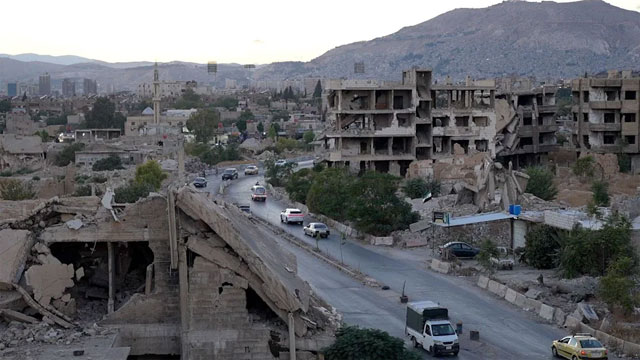
Large parts of the country remain in ruins, with many families unable to afford rent and forced to live in partially destroyed buildings.
The World Bank has estimated Syria's reconstruction costs at $216 billion, making the country's recovery heavily dependent on foreign assistance and investment.
The new administration has achieved some diplomatic gains, including the lifting of sanctions imposed during the Assad era and the removal of Syria from the United States' list of state sponsors of terrorism. However, these developments have yet to translate into meaningful economic relief for ordinary citizens.
Syrian columnist and Chatham House consulting fellow Dr Haid Haid said a significant section of the population was now worse off than before Assad's removal, describing the economic crisis as "one of the most dangerous issues" confronting the government.
He attributed the situation partly to the lack of financial resources and the legacy of the former regime, but also pointed to the impact of the new government's economic policies.
He said the administration's shift towards a liberal, free-market economy had not adequately considered the consequences for ordinary people.
Syrian economist Samir Aita, who heads the Paris-based Circle of Arab Economists, said the government's handling of public expectations and its economic policies had contributed to the crisis.
"It's unsustainable. If they don't change, I fear chaos," he warned.
However, some Syrians remain willing to give the new administration more time to address the country's challenges.
BBC quoted Abu Mahmoud, a cab driver, as saying that the new government had inherited a bankrupt country and that people needed to remain patient.
"They inherited the country bankrupt, so people need to be patient. Things don't happen overnight," he said.