Daijiworld Media Network - New Delhi
New Delhi, Nov 4: A section of the over 160-year-old Municipal Corporation of Delhi (MCD) Town Hall in Chandni Chowk collapsed on October 31 following two days of heavy rainfall last week, damaging parts of the heritage structure, an MCD official said on Wednesday.
The collapse brought down the roof and two massive beams of the entrance porch, damaging the building's facade, a section of the first floor and the walls surrounding the main entrance. The clock mounted above the entrance was also affected, while cracks appeared on an adjoining wall.
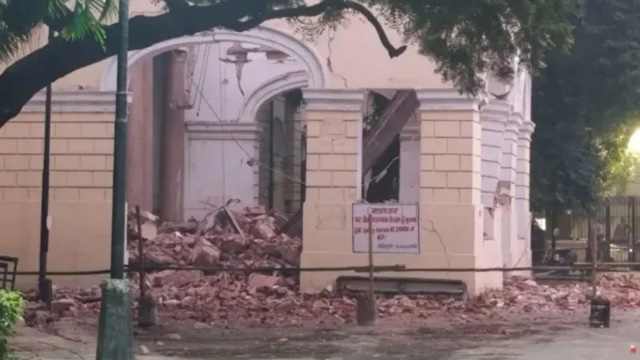
According to a senior MCD official, the affected portion had already been declared unsafe and cordoned off, with people advised against entering the area as a precaution. The section was not being used by visitors, and access had been restricted due to its structural condition.
The official said the heavy rainfall may have further weakened the already vulnerable structure, eventually causing the collapse.
The MCD will undertake debris clearance and immediate work at the site, while the Delhi Tourism and Transportation Development Corporation (DTTDC) will carry out comprehensive conservation of the historic complex, another official said.
The incident has once again drawn attention to the deteriorating condition of the Grade-I protected heritage property, large portions of which have remained underutilised since the MCD shifted its headquarters to the Civic Centre on Minto Road in 2011-12.
Construction of the Town Hall was completed in 1863 at a site that earlier housed a caravanserai built by Jahanara Begum, daughter of Mughal emperor Shah Jahan. The adjoining garden was known as Begum ka Bagh.
Following the British takeover of Delhi in 1857, the caravanserai was demolished and the garden renamed Company Bagh. The present building was subsequently constructed at the site and initially housed the Delhi Institute, also known as the Lawrence Institute.
The complex later became the centre of municipal administration and served as the municipality's headquarters for nearly 145 years before the MCD moved to the new Civic Centre.
Over the years, the building underwent several additions and modifications. Its Durbar Hall hosted ceremonial receptions, official gatherings and important meetings. Another meeting hall in the complex was inaugurated by India's first prime minister Jawaharlal Nehru on August 10, 1947, five days before Independence.
Since the relocation of the MCD headquarters, the complex has gradually fallen into disuse, with several portions showing signs of deterioration. Various proposals to restore the property and give it a new public purpose have been considered over the years but failed to materialise.
In 2013, the civic body proposed converting parts of the complex into a library, restaurant, cultural centre and boutique hotel, along with spaces for public concerts and cultural events. However, the proposal was shelved.
The erstwhile North Delhi Municipal Corporation proposed developing a heritage hotel at the site in 2018, but the plan failed to attract bidders.
In 2022, the Union Culture Ministry expressed interest in taking over the property on a 33-year lease to develop a museum, library, research centre and restaurant. However, the proposal remained stalled over differences regarding revenue sharing.
The MCD set up a heritage cell in 2023 to prepare restoration estimates. In 2024, it signed a memorandum of understanding with the Indira Gandhi National Centre for the Arts (IGNCA) for the restoration of artefacts and rare documents in its possession. The civic body also worked with the Aga Khan Trust for Culture on a conservation plan.
The latest proposal envisages transforming the complex into a 'Global Heritage Centre' showcasing Delhi's art, culture and cuisine. Chief Minister Rekha Gupta announced the plan in her budget speech in April this year.
The Delhi government and the MCD subsequently signed an MoU for the redevelopment of the complex, with the DTTDC entrusted with taking forward the conservation and development project.
The proposed initiative aims to preserve the historic character of the building while adapting the complex for cultural and tourism-related activities.