Daijiworld Media Network - New Delhi
New Delhi, Jan 17: Delhi Chief Minister Rekha Gupta on Friday directed officials to fast-track a wide range of infrastructure and pollution-control projects, stressing that delays will not be tolerated and all works must be completed within stipulated timelines.
Chairing a high-level review meeting, Gupta asked departments to expedite the induction of electric buses, expansion of Metro Phase IV, development of smart and multi-level parking facilities, road redevelopment, traffic mapping, waste management and other urban infrastructure initiatives. She underlined that pollution control remains a top priority and said both short-term and long-term plans are already under active implementation.
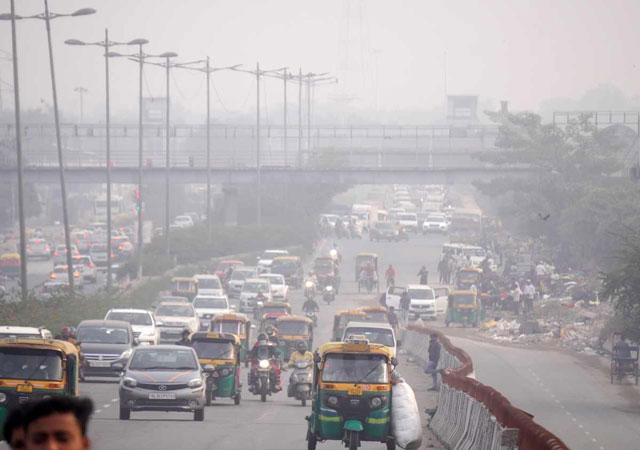
The chief minister said the government is working with a clear, measurable and outcome-oriented action plan to achieve a substantial reduction in PM 2.5 levels over the next four years. As part of this push, Delhi aims to scale up its bus fleet to 6,000 by December 2026, 7,500 by December 2027, 10,400 by March 2028 and 14,000 by March 2029. Of these, 500 will be smaller seven-metre buses to improve last-mile connectivity, integrated seamlessly with the Delhi Metro to enhance access in residential and high-density areas.
Currently, last-mile connectivity is supported by 100 electric metro feeder buses. By January 2026, the government plans pilot integration of e-autos, bike taxis and feeder cabs at 10 major metro stations.
Under the new Electric Vehicle Policy, the focus is on transitioning Delhi’s 5.8 million two-wheelers through subsidies and scrappage incentives. Public charging and battery-swapping infrastructure will be expanded from 9,000 to 36,000 points. Commercial trucks and three-wheelers will benefit from interest subvention and incentives under the Centre’s PM E-Drive scheme to encourage cleaner fuels.
To tackle congestion-related emissions, 62 traffic bottlenecks have been identified, with improvement works already underway at 30 locations. The government has also deployed 1,200 additional DTC personnel to assist Delhi Traffic Police in managing traffic more effectively.
Public transport has been identified as the backbone of the pollution reduction strategy. The Delhi Metro’s existing 395-km network, serving 6.5 to 7 million passengers daily, is being expanded by 110 km under Phase IV and another 96 km under Phases V-A and V-B. Once Phase IV is completed, daily ridership is expected to double. The NCRTC network is also set to expand to 323 km over the next four years.
The government has committed Rs 6,000 crore for road improvement, with around 3,300 km of roads requiring reconstruction or upgradation across PWD areas, municipal zones and unauthorised colonies. Plans include paving shoulders and medians, landscaping and laying underground utility ducts to prevent repeated road cutting. Tenders are expected within two months, with completion targeted within a year.
Road dust, a major pollution source, is being tackled through mechanised sweeping and dust suppression. At present, 76 mechanical road sweeping machines are in use, with more being added under the National Clean Air Programme. Large-scale projects worth thousands of crores are being rolled out to deploy additional sweeping machines, water sprinklers and dust-control equipment under long-term operational models.
Strict timelines have also been set for clearing legacy waste, with Okhla landfill to be cleared by July 2026, Bhalswa by October 2026 and Ghazipur by December 2027. The government has allocated Rs 500 crore for waste management this year, with continued annual funding planned.
Taking a zero-tolerance stance on industrial pollution, over 1,000 polluting units have been sealed so far, and large industries have been directed to install real-time emission monitoring systems. Efforts to increase green cover include planting 3.5 million trees in the Delhi Ridge over four years and developing 365 acres of brown park areas.
Measures are also being taken to curb construction dust and waste burning, including commissioning a new processing plant at Tehkhand and distributing electric heaters to prevent biomass burning during winter.
Smart parking has been identified as another key element of the pollution strategy. The government plans a major expansion of parking infrastructure with smart pricing, stricter enforcement of no-parking zones and promotion of multi-level parking in commercial and high-footfall areas to discourage excessive private vehicle use.
To strengthen enforcement against polluting vehicles, ANPR systems are being installed at Delhi’s borders to automatically identify violators. Gupta emphasised that while technology and enforcement are critical, citizen participation and behavioural change are equally essential to achieving lasting improvements in air quality.