Daijiworld Media Network – New Delhi
New Delhi, Feb 19: Prime Minister Narendra Modi on Thursday called for the democratisation of artificial intelligence, saying the technology must be open, inclusive and empowering rather than turning humans into mere data points.
Addressing the India AI Impact Summit in New Delhi, Modi said India was not only participating in the AI revolution but actively leading and shaping it.
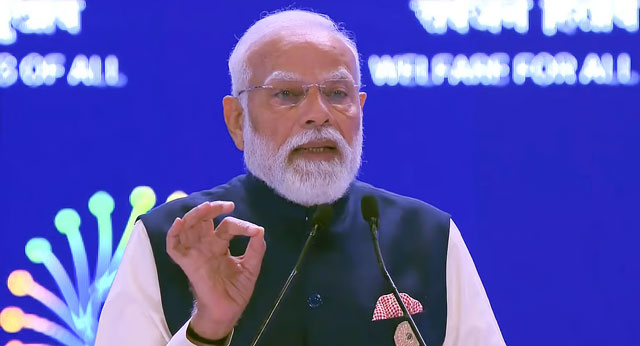
“Artificial intelligence marks a transformative chapter in human history. India is not just a part of the AI revolution, but is leading and shaping it,” he said, speaking in the presence of global leaders and CEOs of major technology companies.
He stressed that AI must not become concentrated in the hands of a few. “AI has to be democratised so that humans don't just become a data point for AI or remain a raw material for AI. We must democratise AI. It must become a medium for inclusion and empowerment, particularly for the Global South,” the Prime Minister said.
‘MANAV Vision’ for AI
Modi unveiled India’s ‘MANAV Vision’ for AI — a framework centred on ethical use, governance and sovereignty. Explaining the acronym, he said:
• M – Moral and ethical systems: AI must operate under ethical guidance.
• A – Accountable governance: Transparent rules and robust oversight are essential.
• N – National sovereignty: “Whose data, his right,” he said, underscoring data ownership.
• A – Accessible and inclusive: AI should be a multiplayer, not a monopoly.
• V – Valid and legitimate: AI systems must be lawful and verifiable.
“This MANAV vision of India will become an important link for the welfare of humanity in the AI-based world of the 21st century,” Modi said.
He added that the key challenge was not what AI might achieve in the distant future, but how it could be meaningfully deployed in the present for public good. Emphasising India’s strengths, he said the country was uniquely positioned both to develop new technologies and to scale them rapidly for large populations.
Modi’s remarks framed artificial intelligence as a tool for shared global benefit — provided it is guided by strong ethical principles, inclusive access and accountable governance.