Investing doesn’t always require a large capital base. In fact, many investors in India begin their financial journey with small but disciplined investments through Systematic Investment Plans (SIPs). Even a modest monthly investment of Rs 1,000–Rs 5,000 can gradually build wealth when placed in the right mutual fund categories. The popularity of SIPs has surged recently, with annual SIP inflows in India crossing Rs 3.04 trillion in 2025, highlighting the growing trust retail investors place in this investment method.
For beginners and small investors, choosing the right category of mutual fund is crucial. Some funds are better suited for consistent monthly investing because they smooth out market volatility and encourage long-term wealth creation, such as equity funds, balanced funds, and index funds, which can provide stability and growth potential for small investors. If you are planning to start investing with a small monthly amount, understanding the types of mutual funds that work best for SIPs under Rs 5,000 can help you make informed financial decisions.
Why SIPs Are Ideal for Small Monthly Investments
A SIP allows investors to contribute a fixed amount regularly into mutual funds. Instead of trying to time the market, SIPs help investors buy units at different price levels, which reduces the impact of market volatility through rupee cost averaging.
For investors with limited disposable income, SIPs offer several advantages. First, they make investing accessible because many mutual funds allow SIPs starting from as low as Rs 100 or Rs 500 per month. Second, they encourage financial discipline by automating monthly investments. Third, SIPs benefit from the power of compounding over long periods.
Think of SIP investing like planting a tree and watering it regularly. Each contribution may seem small, but over time the tree grows stronger and yields significant returns. The key is consistency and selecting the right type of mutual fund that aligns with your risk tolerance and financial goals.
1. Large Cap Mutual Funds
Large-cap mutual funds invest primarily in well-established companies with strong market capitalisation and stable business models. These companies are often industry leaders with consistent earnings and lower volatility compared to smaller firms.
For investors starting a SIP under Rs 5,000, large cap funds offer a relatively stable entry point into equity investing. Since these funds invest in blue-chip companies, they tend to provide steady long-term growth while reducing extreme fluctuations. Many large-cap funds in India have delivered annualised returns ranging roughly from 10% to 15% over long periods, depending on market conditions.
Another advantage of large-cap funds is their resilience during economic downturns. While markets may fluctuate, established companies often recover faster due to their strong financial position and diversified operations. This makes large-cap funds suitable for conservative investors who want exposure to equities but prefer relatively lower risk.
For someone investing Rs 3,000 to Rs 5,000 monthly, a large-cap SIP can act as the foundation of a long-term portfolio. Over time, it helps accumulate wealth steadily without exposing investors to extreme market swings, making it a reliable choice for those seeking stability in their investment strategy.
2. Flexi Cap Mutual Funds
Flexi cap mutual funds provide one of the most versatile investment options for SIP investors. These funds have the flexibility to invest across large-cap, mid-cap, and small-cap stocks, depending on market opportunities.
This flexibility is particularly valuable for small SIP investors because it automatically diversifies their portfolio across different market segments. Instead of investing in multiple funds, a single flexi cap fund can provide balanced exposure to various company sizes.
Recent industry data shows that flexi cap funds remain highly popular among investors and attracted inflows of over Rs 7,600 crore in January 2026, reflecting strong demand for diversified equity exposure.
For SIP investors contributing less than Rs 5,000 monthly, flexi cap funds offer the benefit of professional asset allocation. Fund managers actively shift investments between large-, mid-, and small-cap stocks based on market conditions, which helps optimise returns while managing risk.
Because of this adaptive strategy, flexi cap funds are often recommended for long-term investors seeking both growth and diversification through SIPs.
3. Hybrid Mutual Funds
Hybrid mutual funds invest in a mix of equity and debt instruments, creating a balanced risk-return profile. For small SIP investors, this combination can provide stability while still allowing exposure to equity-driven growth.
Aggressive hybrid funds typically allocate a larger portion to equities while maintaining a smaller debt component for stability. These funds aim to deliver better returns than traditional fixed-income investments while controlling volatility.
Hybrid funds are especially suitable for new investors who may feel uncomfortable investing entirely in equities. By combining stocks with debt securities such as bonds, these funds help cushion losses during market downturns.
For example, funds like aggressive hybrid schemes often deliver consistent long-term performance while reducing the psychological stress associated with market fluctuations. For investors contributing Rs 2,000–Rs 5,000 per month, hybrid funds can serve as an excellent starting point before gradually moving into more aggressive equity funds.
4. Mid-Cap Mutual Funds
Mid-cap mutual funds focus on companies that are larger than small caps but still have significant growth potential. These businesses are typically in the expansion stage and may benefit from increasing market share and improving profitability.
For SIP investors seeking higher growth potential, mid-cap funds can be an attractive option. Historically, several mid-cap funds in India have delivered strong long-term returns, and some have even generated over 25% SIP returns (XIRR) over five years in certain market cycles.
However, mid-cap funds also come with higher volatility compared to large-cap funds. Prices may fluctuate more in the short term, which is why SIP investing becomes particularly valuable in this category, as it helps mitigate the impact of these fluctuations on overall investment performance. By investing regularly, investors average out the cost of buying units and reduce the risk of entering at market peaks.
Young investors with a long investment horizon can significantly boost long-term wealth creation by allocating a portion of a Rs 5,000 SIP toward mid-cap funds.
5. Multi-Asset or Balanced Advantage Funds
Another category worth considering for small SIP investments is multi-asset or balanced advantage funds. These funds invest across multiple asset classes such as equities, debt, and sometimes commodities like gold.
The goal is to create a diversified portfolio that automatically adjusts asset allocation based on market conditions. For example, when equity markets appear overvalued, the fund may increase its allocation to debt or gold to reduce risk.
This dynamic asset allocation strategy is particularly helpful for investors who prefer a hands-off approach. Instead of constantly monitoring market conditions, the fund manager adjusts the portfolio to maintain balance and manage volatility.
For SIP investors with limited monthly contributions, multi-asset funds provide diversification within a single investment. This can make them an effective choice for beginners who want to spread risk while maintaining growth potential.
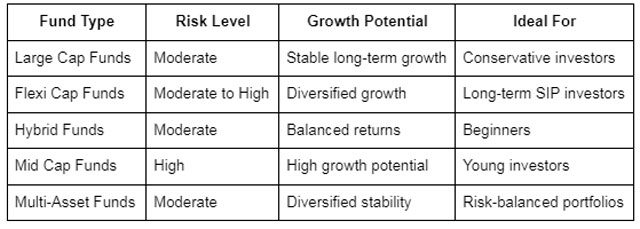
Comparison of Mutual Fund Types for SIP Under Rs 5,000
Using Tools to Plan Your SIP Investments
Before starting a SIP, it is wise to estimate potential returns and investment growth over time. Tools like aSIP Calculator can help investors visualize how regular monthly contributions may grow over the years.
For example, investing Rs 5,000 per month for 15 years at an average return of 12% can potentially grow into a substantial corpus. A calculator helps investors adjust variables such as investment period and expected returns to better understand their financial trajectory.
Understanding the broaderTypes of mutual funds also helps investors choose schemes that align with their financial goals and risk tolerance.
Conclusion
Starting a SIP with a modest monthly amount like Rs 5,000 can be the first step toward long-term financial independence. The key lies not in the size of the investment but in consistency and choosing the right mutual fund category.
Large cap funds offer stability, flexi cap funds provide diversification, hybrid funds balance risk, mid cap funds deliver growth potential, and multi-asset funds create diversified portfolios. By combining these categories thoughtfully, investors can build a well-balanced SIP strategy that suits their financial goals.
Over time, disciplined investing and patience allow small monthly contributions to compound into meaningful wealth. The journey begins with a simple step—starting a SIP and staying committed to it.