Daijiworld Media Network - Panaji
Panaji, Apr 24: A day after 15 outstation fishing vessels were seized for allegedly poaching in Goa’s territorial waters, the action has spotlighted critical gaps in enforcement, challenges posed by invisible maritime boundaries and the need for stronger deterrence.
While the joint operation by the fisheries department, coastal police and local fishermen has been widely welcomed, stakeholders said such incidents are not isolated. Repeated entries by vessels from neighbouring States point to deeper systemic issues beyond routine patrolling.
Unlike land borders, territorial waters lack physical demarcation, making enforcement dependent on navigation systems and intent. Director of Fisheries Shamila Monteiro said fishermen are expected to rely on navigation charts to avoid crossing the 12 nautical mile limit from Goa’s shoreline.
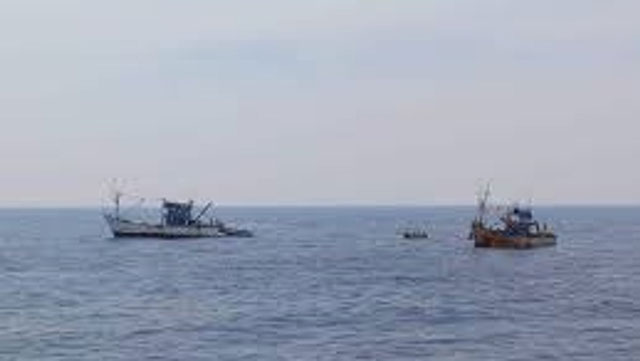
“Since there is no physical demarcation in the open sea, fishermen have to follow navigation charts. When they follow fish shoals, they sometimes drift into other waters, similar to vessels crossing international maritime boundaries,” she said.
However, local fishermen disputed claims that such incursions are accidental. Salcete-based fisherman Francisco Fernandes, popularly known as Pele, said while Goan trawlers may occasionally cross into neighbouring waters, large-scale incursions by outside vessels are unacceptable.
“Our trawlers may venture into their waters at times, but that does not give them the right to enter ours and take away 10 to 20 tonnes of fish,” he said.
Another fisherman alleged possible collusion, questioning how such vessels repeatedly manage to enter Goa’s waters without consequences.
Responding to concerns, All Goa Fishing Boat Owners Association president Jose Philip D’Souza acknowledged that boundary crossings occur on both sides, but said large-scale fishing by outstation vessels within Goa’s waters cannot be tolerated.
Authorities maintained that regular patrols are being carried out, but the recurrence of such incidents highlights limitations due to the vast coastline, limited resources and lack of continuous surveillance.
“We are intensifying patrols and coordinating with all agencies to curb such activities,” Monteiro said.
The issue also extends beyond Goa’s jurisdiction, with most of the apprehended vessels reportedly from neighbouring States. Experts pointed to weak inter-State coordination as a factor that allows repeat offenders to return with minimal consequences.
Fishermen’s groups argued that penalties are not stringent enough to deter violations. They expressed concern that those detained are often released quickly, reducing the impact of enforcement measures.
Stakeholders stressed that a comprehensive approach involving stronger enforcement, real-time surveillance, stricter penalties and greater participation of local fishing communities is essential.
They warned that the latest seizure should serve as a wake-up call to address systemic gaps before illegal fishing further strains Goa’s marine resources and the livelihoods dependent on them.