Media Release
Mangaluru, Oct 17: The inauguration of the two-day workshop on systematic review and meta-analysis organized by the School of Engineering, St Aloysius (Deemed to be University) held on October 16 in the Conference Hall of the Engineering Block.
The workshop was formally inaugurated by Dr Ruban S, dean; Dr Geetha Pinto, associate dean, School of Engineering and convenor of the workshop; and Dr Glenson Toney, assistant dean, School of Engineering. Their presence added significance to the occasion and marked the beginning of an enriching and insightful learning experience for all participants. Dr Geetha Pinto welcomed the gathering.
The sessions were led by Dr Ramya Shenoy, head of the department of MCODS, along with the resource persons, Dr Amitha Basheer and Dr Sampada Kulkarni.
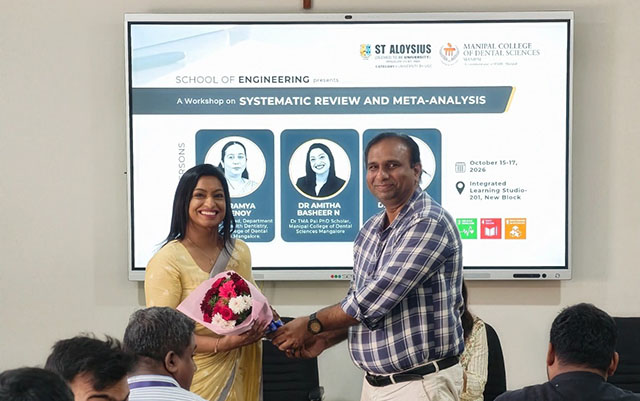
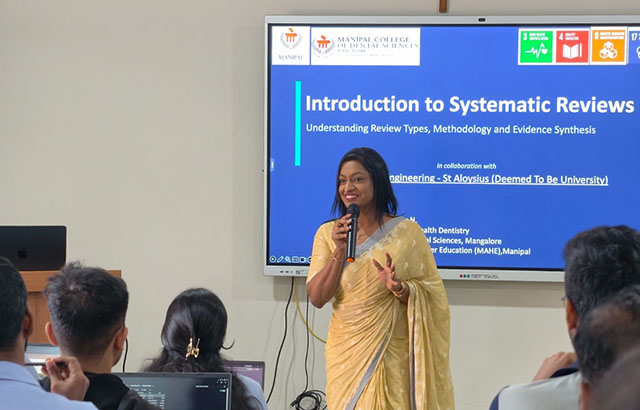
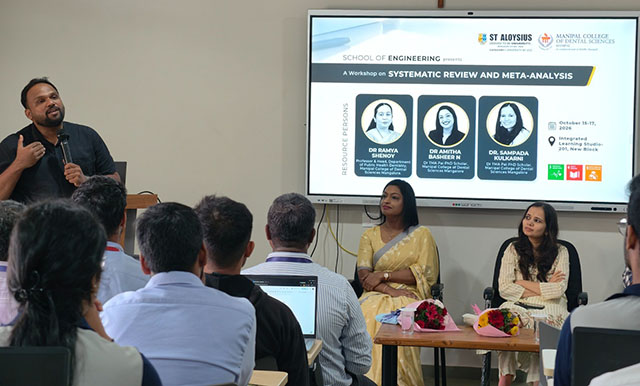
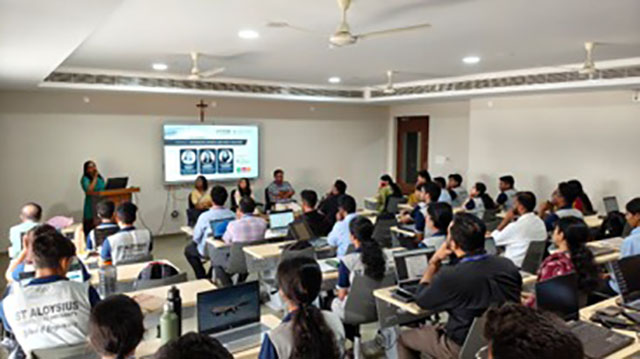
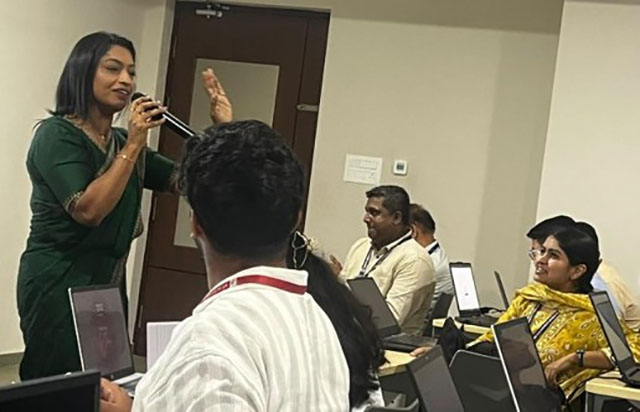
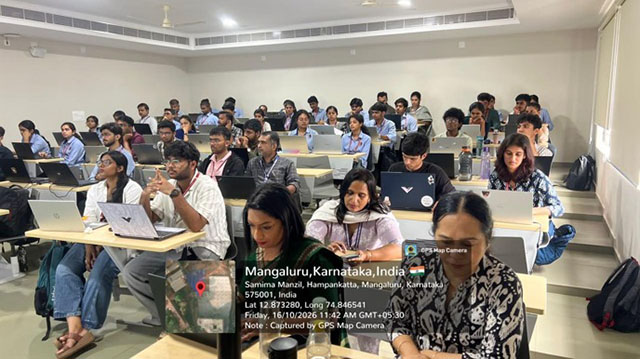
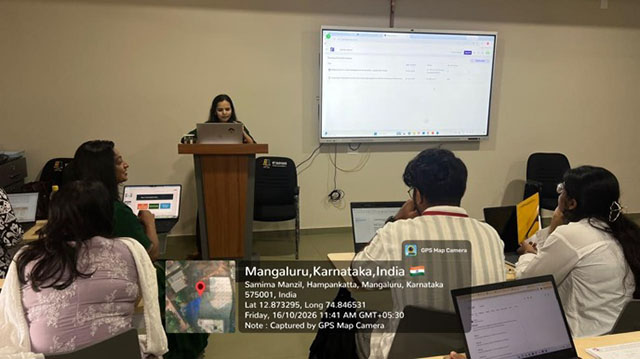
This two-day workshop introduced engineering students to the systematic review process, moving from research fundamentals and protocol planning to refining research questions, screening literature and extracting data.
The resource person for the first session was Dr Amitha Basheer N on the topic: Introduction to systematic review and meta-analysis. He spoke on the foundations of research methodology for students from electronics and AI/ML backgrounds. Research: finding out information about a topic to answer a specific question; primary research collects first-hand data; secondary research compiles and analyses published work. Data types: quantitative (measurable, eg voltage, age, weight), qualitative (eg opinions, socio-economic status) and mixed-method studies; quantitative and qualitative data are analysed separately. Study designs: cross-sectional, randomized controlled trial, case-control and cohort studies; and systematic reviews and meta-analyses sit at the top of the hierarchy of evidence. They help identify existing knowledge and evidence gaps and avoid duplicating work. The session used Mentimeter and ended with a rapid-fire classification quiz.
The second session shared by Dr Amitha Basheer N and Dr Sampada Kulkarni on the topic: Refining the research question. They spoke on the six steps of a systematic review: developing a research question, searching databases; screening studies, data extraction, quality appraisal, and data synthesis (meta-analysis for quantitative data, meta-synthesis for qualitative).
PRISMA: a 27-item checklist and flow diagram for standardized, transparent reporting, PICO framework: Population, Intervention, Comparison, Outcome. Students applied it to their own topics, such as deep learning for detecting cracks in concrete.
The resource person for the third session was Dr Sampada Kulkarni on the topic: Protocol development and search strategy. She covered the session on - A protocol is a written blueprint prepared before the review. It reduces bias, increases transparency and makes the study reproducible.
It is guided by PRISMA-P; search basics: OR combines synonyms, AND combines distinct concepts, and at least three databases should be searched; results are deduplicated, then screened by title and abstract and finally by full text; registration: protocols should be registered before screening begins, on PROSPERO (health) or OSF (engineering and technology). Amendments must be documented and justified; common pitfalls: writing the protocol after screening starts, vague eligibility criteria, no clear search strategy, and no plan for resolving reviewer conflicts; and AI use: AI tools may be used only to polish grammar after drafting, not for data extraction or generating manuscript content.
The resource person for the fourth session was Dr Amitha Basheer N on the topic: Search Strategy. He covered the session on Break the topic into PICO concepts, generate synonyms for each, and organize them in a table before building the search string; use OR within a concept and AND between concepts; avoid NOT. Use truncation (*), wildcards, exact phrases in quotation marks, and MeSH terms for biomedical searches; run searches in databases such as PubMed or IEEE Xplore using advanced search on title/abstract, apply filters (date, full text, study design), and export results as CSV or Excel for screening.
The second day covered the sessions from planning to the practical stages of conducting a review. The resource person for the first session was Dr Ramya, MCODS, Manipal. She spoke on review and refinement of research questions. Each team presented its proposed research question and draft work. Dr Ramya and her team gave feedback on whether the questions were clearly framed, focused and suitable for a systematic review, reinforcing that a well-defined question underpins study selection and every later stage.
The resource person for the second session was Dr Sampada Kulkarni. She spoke on the topic: Literature screening using Rayyan. Rayyan is an online tool for organizing and collaborating on screening. The workflow is: import references, remove duplicates, screen titles and abstracts, then assess full texts. Rayyan keeps all references in one workspace, records decisions, flags reviewer disagreements and tracks reasons for exclusion. The session stressed applying inclusion and exclusion criteria consistently rather than by personal preference.
The resource person for the second session was Dr Amitha Basheer N. He spoke on the topic: Data extraction. Data extraction means systematically recording the needed information from each included study in a consistent format. An extraction sheet may capture author and year, study design, setting or population, interventions, outcomes and key findings, with fields chosen to match the review protocol. Careful recording and checking reduce omissions and transcription errors and prepare the team for quality appraisal and synthesis.
Over two days, participants covered the full early pipeline of a systematic review: building a pre- registered protocol, framing questions with PICO, designing database searches, screening with Rayyan and extracting data in a structured way. The key takeaway is that meticulous upfront methodology guards against bias, while AI may help polish grammar but research integrity and critical analysis remain with the researchers.