May 15, 2026
In almost every career guidance session I conduct with students and parents, one question consistently dominates the discussion: “Is it still worth choosing traditional engineering branches like Mechanical, Civil, or Electrical Engineering in the age of Artificial Intelligence and emerging technologies?” This concern is understandable. The rapid rise of Artificial Intelligence (AI), Robotics, Data Science, Internet of Things (IoT), Automation, Renewable Energy, and Smart Systems has transformed the way industries operate. Students today are exposed to trending buzzwords and often believe that only Computer Science or AI-related programs guarantee successful careers. However, as a career counsellor interacting with aspiring engineers, industry professionals, educators, and recruiters, I strongly believe that traditional engineering branches are not losing relevance — they are evolving into something far more powerful.
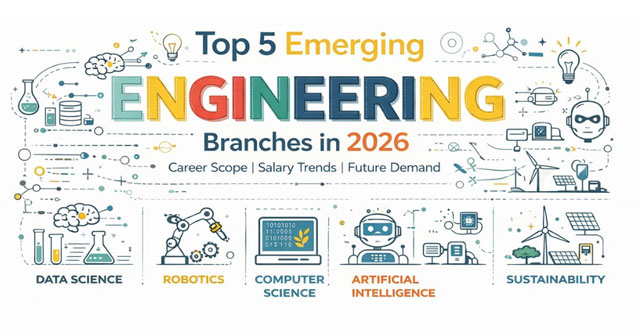
The Foundation of Every Innovation
Emerging technologies do not exist in isolation. Behind every smart factory, autonomous vehicle, intelligent building, renewable energy system, or robotic solution lies the strong foundation of core engineering disciplines.
For example:
- A robotic manufacturing system still depends heavily on Mechanical Engineering principles.
- Smart cities and intelligent infrastructure are rooted in Civil Engineering.
- Renewable energy systems require Electrical and Electronics expertise.
- AI-driven industrial automation relies on instrumentation, embedded systems, and manufacturing processes.
In reality, emerging technologies are not replacing traditional engineering; they are integrating with them.The future engineer is no longer defined by a single branch alone. The future belongs to professionals who can combine core engineering knowledge with digital and interdisciplinary skills.
The Rise of the Hybrid Engineer
The engineering ecosystem is moving toward what experts call multidisciplinary convergence. Today’s industries require engineers who can understand both physical systems and digital technologies. A Mechanical Engineer with knowledge of AI and automation becomes highly valuable in smart manufacturing. A Civil Engineer familiar with IoT and GIS technologies can contribute to smart infrastructure projects. Electrical Engineers with expertise in renewable energy systems are at the centre of the global sustainability movement.
This has created a new category of professionals often called “T-shaped engineers.”
These engineers possess:
- Deep expertise in one engineering domain
- Broad understanding of emerging technologies and business applications
Such professionals are becoming the most sought-after talent across industries.
Why Students Should Not Chase Trends Blindly
One of the biggest mistakes engineering aspirants make today is choosing courses purely based on market hype. A branch may trend for a few years, but careers are built over decades. Students should understand that technologies evolve continuously. The tools being used today may become outdated tomorrow. What remains valuable is the ability to learn, adapt, and solve problems. Strong fundamentals in mathematics, engineering principles, analytical thinking, and design remain timeless.
As Academic and career counsellors, we advise students to choose branches based on:
- Interest and aptitude
- Problem-solving ability
- Curiosity toward innovation
- Long-term career goals
A passionate Civil Engineer with digital skills can outperform someone who enters a trending branch without genuine interest.
Emerging Technologies Are Expanding Opportunities
The good news for engineering aspirants is that career opportunities today are broader than ever before.
Industries are actively recruiting engineers for roles in:
- Artificial Intelligence and Automation
|
|
|
|
- Robotics and Mechatronics
|
|
|
|
|
|
- Sustainable Infrastructure
|
|
|
|
Government initiatives such as Digital India, Make in India, Startup India, and large-scale infrastructure development projects are further increasing demand for skilled engineers.
The engineering profession is not shrinking; it is diversifying.
The Skills That Future Engineers Must Develop
Academic knowledge alone is no longer enough. The future engineer must combine technical expertise with practical and professional skills.
|
Technical Skills
- Programming fundamentals
- AI and Data Analytics
- CAD and Simulation Tools
- Automation and IoT
- Cloud Computing
- Industry 4.0 Technologies
|
Professional Skills
- Communication
- Teamwork
- Leadership
- Creativity
- Critical Thinking
- Adaptability
|
Industry Exposure
Students must actively participate in: Internships, Hackathons, Research projects, Innovation competitions, Industry certifications. Engineering education is gradually shifting from “learning concepts” to “solving real-world problems.”
The Importance of Lifelong Learning
Perhaps the most important lesson for engineering aspirants is this: Graduation is not the end of learning — it is the beginning. Technology changes rapidly, and engineers must continuously upgrade their skills throughout their careers. Professionals who remain adaptable and open to learning will thrive regardless of their branch. The most successful engineers of the future will not necessarily be those with the highest marks, but those who can: Learn continuously, Integrate technologies, Work across disciplines, Innovate with purpose
Final Thoughts
From a career counsellor’s perspective, the debate should not be about “traditional engineering versus emerging technologies.” The real conversation should focus on how traditional engineering can evolve alongside technological advancements.