A Footpath Is Not a Luxury: Why the Supreme Court Wants a Law to Protect India's Pedestrians

June 20, 2026

"A footpath is not a luxury. It is a constitutional necessity."

A city is not judged by how fast its cars move, but by how safely its people can walk.

In a significant reaffirmation of constitutional values, the Supreme Court of India, in Maniyar Iliyaz Shaik Riyaz v. P. Ayyappan (C.A. Nos. 4665-4666 of 2025), observed that pedestrians have a fundamental right to footpaths and that motorists cannot negate the right of citizens to walk safely. The Court also indicated the need for a dedicated law to protect footpaths and pedestrian rights across the country.
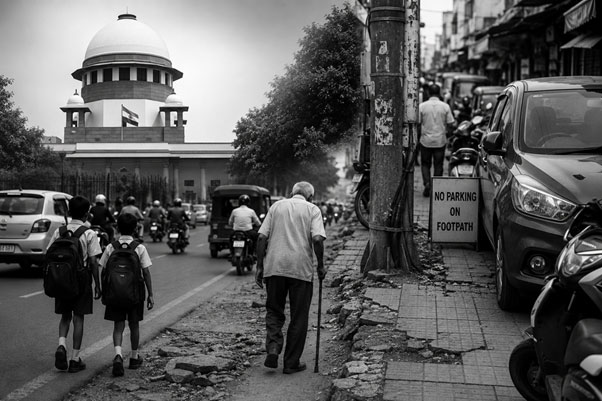
At first glance, the issue may appear to concern traffic management. In reality, it goes to the heart of constitutional governance and the fundamental rights guaranteed under Article 21 of the Constitution.

The Forgotten Majority

Despite rapid urbanisation and growing vehicle ownership, walking remains one of the most common modes of travel in India. Millions of citizens walk daily to schools, colleges, workplaces, hospitals, markets, bus stops, and railway stations.

Yet pedestrians are often treated as an afterthought in urban planning. Footpaths are routinely occupied by parked vehicles, commercial encroachments, construction debris, utility installations, and illegal structures. In many places, they are either absent or unusable.

As a result, pedestrians are forced onto roads alongside fast-moving traffic, exposing them to unnecessary risks. The Supreme Court's observations remind us that pedestrians are not secondary users of public roads. They are citizens entitled to constitutional protection.

The Constitutional Right to Walk

The Supreme Court has consistently interpreted the right to life under Article 21 as including the right to live with dignity, safety, and meaningful access to public spaces.

Walking is one of the most basic forms of human movement. Without safe pedestrian infrastructure, citizens are effectively denied access to education, employment, healthcare, recreation, and community life.

A footpath, therefore, is not merely an engineering feature. It is an essential component of the constitutional promise of dignity and equality.

Why the Judgment Matters

For decades, urban development has largely prioritised vehicular movement. Road widening, traffic management, and parking facilities often receive greater attention than pedestrian safety.

The Supreme Court's observation that motorists cannot negate the right to walk challenges this approach. Public roads are shared civic spaces and must accommodate all users, especially the most vulnerable.

The absence of safe footpaths disproportionately affects children, senior citizens, women, and persons with disabilities. For these groups, pedestrian infrastructure is not merely a convenience but a necessity.

Why India Needs a Footpath Protection Law

The Court's suggestion that India consider a dedicated legal framework for pedestrian rights deserves serious attention.

Currently, pedestrian protection is fragmented across municipal laws, traffic regulations, and planning guidelines. A comprehensive law could:

  • Recognise pedestrian rights.
  • Mandate construction and maintenance of footpaths.
  • Ensure accessibility standards.
  • Prevent illegal encroachments and parking on footpaths.
  • Fix accountability on public authorities.

Just as environmental protection evolved through legislation, pedestrian rights may require statutory recognition to ensure effective implementation.

Lessons for Coastal Karnataka

The judgment has particular relevance for rapidly growing urban centres such as Mangaluru, Udupi, Manipal, and Kundapura.

In April 2026, residents raised complaints before the Mangaluru City Corporation regarding footpaths near the railway station and Attavar being occupied by parked vehicles, forcing pedestrians onto busy roads. Road-safety reviews in Udupi have similarly identified accident-prone locations where pedestrian facilities require urgent improvement.

The tragic death of a pedestrian in Brahmavar in late 2025 serves as a reminder that inadequate pedestrian infrastructure can have fatal consequences.

For students walking to educational institutions, patients visiting hospitals, senior citizens attending places of worship, and ordinary residents carrying out daily activities, safe footpaths are not a luxury but a necessity.

Conclusion

The Supreme Court's observations in Maniyar Iliyaz Shaik Riyaz v. P. Ayyappan represent an important reaffirmation of constitutional values. By recognising that pedestrians have a fundamental right to footpaths and by calling for a dedicated legal framework, the Court has highlighted an issue that affects millions of Indians every day.

A footpath is not merely a strip of concrete beside a road. It is a public necessity, a constitutional entitlement, and a symbol of an inclusive society.

The challenge now lies with lawmakers, urban planners, municipal authorities, and citizens to ensure that India's roads are designed not merely for vehicles, but for people.


By Adv Juhi Damodar
Adv Juhi Damodar is an advocate, published author, legal researcher, TEDx speaker, and chairperson of the Child Welfare Committee, Udupi. She writes on constitutional law, child rights, family law, governance, and public policy, with a focus on social justice and the rights of vulnerable sections of society.
To submit your article / poem / short story to Daijiworld, please email it to news@daijiworld.com mentioning 'Article/poem submission for daijiworld' in the subject line. Please note the following:

  • The article / poem / short story should be original and previously unpublished in other websites except in the personal blog of the author. We will cross-check the originality of the article, and if found to be copied from another source in whole or in parts without appropriate acknowledgment, the submission will be rejected.
  • The author of the poem / article / short story should include a brief self-introduction limited to 500 characters and his/her recent picture (optional). Pictures relevant to the article may also be sent (optional), provided they are not bound by copyright. Travelogues should be sent along with relevant pictures not sourced from the Internet. Travelogues without relevant pictures will be rejected.
  • In case of a short story / article, the write-up should be at least one-and-a-half pages in word document in Times New Roman font 12 (or, about 700-800 words). Contributors are requested to keep their write-ups limited to a maximum of four pages. Longer write-ups may be sent in parts to publish in installments. Each installment should be sent within a week of the previous installment. A single poem sent for publication should be at least 3/4th of a page in length. Multiple short poems may be submitted for single publication.
  • All submissions should be in Microsoft Word format or text file. Pictures should not be larger than 1000 pixels in width, and of good resolution. Pictures should be attached separately in the mail and may be numbered if the author wants them to be placed in order.
  • Submission of the article / poem / short story does not automatically entail that it would be published. Daijiworld editors will examine each submission and decide on its acceptance/rejection purely based on merit.
  • Daijiworld reserves the right to edit the submission if necessary for grammar and spelling, without compromising on the author's tone and message.
  • Daijiworld reserves the right to reject submissions without prior notice. Mails/calls on the status of the submission will not be entertained. Contributors are requested to be patient.
  • The article / poem / short story should not be targeted directly or indirectly at any individual/group/community. Daijiworld will not assume responsibility for factual errors in the submission.
  • Once accepted, the article / poem / short story will be published as and when we have space. Publication may take up to four weeks from the date of submission of the write-up, depending on the number of submissions we receive. No author will be published twice in succession or twice within a fortnight.
  • Time-bound articles (example, on Mother's Day) should be sent at least a week in advance. Please specify the occasion as well as the date on which you would like it published while sending the write-up.

Comment on this article

  • Rich, Mangalore

    Sat, Jun 20 2026

    Good article. One can also clearly see in google street view map how our India's road side pathways are encroached . Other than parking , uneven levels ,commercial encroachments, debris etc. another common view one can see is ramps on road from the premises and this is because of storm drain type .Our storm drains are generally open channel type and flushes with road level and someone wants a entry to his premises he has to cover the drain and obviously he has to provide a ramp from the cover edge towards the road as the cover comes above road level . Again the length of ramp depends on the cover thickness, higher the thickness longer the ramp . Our roads are narrow ,traffic is increased and these ramps creates a hurdle particularly for pedestrians and bikes etc. and many times accidents are happening.


Leave a Comment

Title: A Footpath Is Not a Luxury: Why the Supreme Court Wants a Law to Protect India's Pedestrians


You have 2000 characters left.

Disclaimer:

Please write your correct name and email address. Kindly do not post any personal, abusive, defamatory, infringing, obscene, indecent, discriminatory or unlawful or similar comments. Daijiworld.com will not be responsible for any defamatory message posted under this article.

Please note that sending false messages to insult, defame, intimidate, mislead or deceive people or to intentionally cause public disorder is punishable under law. It is obligatory on Daijiworld to provide the IP address and other details of senders of such comments, to the authority concerned upon request.

Hence, sending offensive comments using daijiworld will be purely at your own risk, and in no way will Daijiworld.com be held responsible.