E20 Petrol: Progress for Nation, Pain for Motorists?

July 12, 2026

India is pushing to make E20 petrol—a blend with 20% crop-based ethanol—the standard fuel. This has sparked a lively national debate. The government promotes the change as a key move to cut carbon emissions and lower costly oil imports. However, regular drivers are experiencing a different reality. Protesters in Delhi are questioning the financial benefits of this rollout. They argue it harms them through reduced fuel efficiency, which strains their monthly budgets, and leads to engine wear and performance issues, like decreased acceleration. Affordable alternatives are lacking since unblended or lower-blend petrol is heavily taxed and can cost up to 50% more.
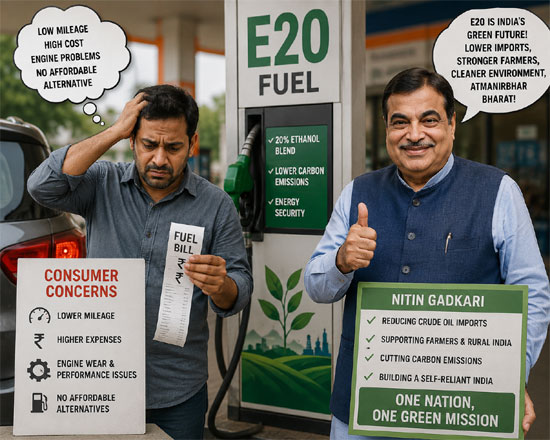

AI-generated image

There is a significant gap between official positions and public feelings. The Federation of Automobile Dealers Associations (FADA) and major car manufacturers claim they haven't received official complaints. Yet surveys reveal that 66% of petrol vehicle owners who purchased their cars before 2023 have seen a drop of over 10% in fuel efficiency since E20 became widely available. This problem relates to vehicle compatibility and fuel chemistry. Modern engines can handle E20, but older cars, designed for E10 or less, are suffering because ethanol absorbs moisture from the air, leading to corrosion and fuel system issues. 

The mandate has also turned into a political issue, balancing policy and profits. Opposition leaders have raised concerns about possible conflicts of interest, claiming the government initiated the rollout to help the commercial ethanol lobby. They specifically highlight the financial benefits accruing to companies linked to the Road Transport and Highways Minister. In response, the government firmly denies these claims. Minister Nitin Gadkari insists that his personal stake in these companies is a mere 0.07%, providing no financial influence. The government also stresses that the Ethanol Blended Petrol (EBP) program is a joint Cabinet decision involving various ministries and scientific organizations, not just one ministry's directive. Additionally, it points out that the family-linked companies produce less than 0.5% of the total ethanol output in India, with over 550 ethanol-producing units nationwide. 

Amidst confusion about whether the Road Transport Ministry or other agencies hold the ultimate responsibility for engine emissions and compatibility standards, the government stands firm on its broader economic defense. It argues that the transition is crucial for India’s stability. The aim is to reduce crude oil import costs to protect the economy against geopolitical uncertainties while also providing significant advantages to farmers by turning excess crops into valuable ethanol. 

To manage this transition, vehicle owners are adopting practical strategies to protect their engines. Experts recommend that owners of cars made before 2023 upgrade factory fuel lines and gaskets with alcohol-resistant materials. They also suggest using aftermarket fuel conditioners to prevent phase separation, using upper-cylinder lubricants to combat internal rust, and finding premium fuel options with lower ethanol levels. There is a growing demand for consumer choice and fuel access, with calls for fuel stations to offer various petrol grades—including E5, E10, and E20—so owners of both older and newer vehicles can select the blend that best fits their engines while the transition continues gradually.


By Allwyn Mascarenhas
Allwyn Mascarenhas is the resident editor of Daijiworld.com.
To submit your article / poem / short story to Daijiworld, please email it to news@daijiworld.com mentioning 'Article/poem submission for daijiworld' in the subject line. Please note the following:

  • The article / poem / short story should be original and previously unpublished in other websites except in the personal blog of the author. We will cross-check the originality of the article, and if found to be copied from another source in whole or in parts without appropriate acknowledgment, the submission will be rejected.
  • The author of the poem / article / short story should include a brief self-introduction limited to 500 characters and his/her recent picture (optional). Pictures relevant to the article may also be sent (optional), provided they are not bound by copyright. Travelogues should be sent along with relevant pictures not sourced from the Internet. Travelogues without relevant pictures will be rejected.
  • In case of a short story / article, the write-up should be at least one-and-a-half pages in word document in Times New Roman font 12 (or, about 700-800 words). Contributors are requested to keep their write-ups limited to a maximum of four pages. Longer write-ups may be sent in parts to publish in installments. Each installment should be sent within a week of the previous installment. A single poem sent for publication should be at least 3/4th of a page in length. Multiple short poems may be submitted for single publication.
  • All submissions should be in Microsoft Word format or text file. Pictures should not be larger than 1000 pixels in width, and of good resolution. Pictures should be attached separately in the mail and may be numbered if the author wants them to be placed in order.
  • Submission of the article / poem / short story does not automatically entail that it would be published. Daijiworld editors will examine each submission and decide on its acceptance/rejection purely based on merit.
  • Daijiworld reserves the right to edit the submission if necessary for grammar and spelling, without compromising on the author's tone and message.
  • Daijiworld reserves the right to reject submissions without prior notice. Mails/calls on the status of the submission will not be entertained. Contributors are requested to be patient.
  • The article / poem / short story should not be targeted directly or indirectly at any individual/group/community. Daijiworld will not assume responsibility for factual errors in the submission.
  • Once accepted, the article / poem / short story will be published as and when we have space. Publication may take up to four weeks from the date of submission of the write-up, depending on the number of submissions we receive. No author will be published twice in succession or twice within a fortnight.
  • Time-bound articles (example, on Mother's Day) should be sent at least a week in advance. Please specify the occasion as well as the date on which you would like it published while sending the write-up.

Comment on this article

  • Prakash, Mangalore

    Sun, Jul 12 2026

    E20 petrol shouldn't be a nationwide experiment. Test it for at least one year on 100+ vehicles across different models before making it mandatory. Don't make motorists pay for untested policies. Our R&D standards need to be much stronger.

  • Jay, Mangalore

    Sun, Jul 12 2026

    This minister wants to promote his sons ethanol business.

  • aaam admi, bangalore, Mangalore

    Sun, Jul 12 2026

    How BJP fooled the middle class. 1. They said there were ₹1.25 lakh crore oil bonds, so excise duty had to be increased. They raised the duty from ₹9 to ₹33 within just a couple of years. 2. In the name of those bonds, they extracted nearly ₹42 lakh crores from the public. 3. When crude oil prices fell to $30 to $40, they did not pass the benefit to the common people. Instead, they increased various taxes to keep boosting revenue. 4. When they got the opportunity to buy cheap oil from Russia, they allowed one rich businessman to buy that oil, bring it to India, and then sell it to richer nations. He earned around ₹45,000 crores, while the common people got nothing. 5. Then a minister introduced ethanol blending. Without public consent, petrol was mixed with ethanol from sugarcane. His children allegedly made profits in billions, while the common public not only got no relief, but also faced reduced mileage and damage to many vehicles. 6. Now, when a crisis is looming because of failed government policies, instead of making excise duty zero, they still want to burden the same common people. 7. They know that this time the public may not spare them, so now they have started appealing, begging, and blaming international markets. For the last 12 years, it is the common public that has paid the heavy price for the sheer failures of this government.

  • Rehan Shaikh, Udupi

    Sun, Jul 12 2026

    E20 have negative effects on vehicles that are not designed for it. Older vehicles may experience reduced fuel efficiency, corrosion of fuel system components, engine performance issues, and increased maintenance costs. Indian vehicles is not ready for this ...

  • Allwyn Mascarenhas, Bondel, Mangaluru

    Sun, Jul 12 2026

    Dear Dony, The water in your vehicle fuel system is caused by the condensation of the humid external environment into the partly filled up fuel tank. The water may also enter through defective seals on fuel caps or through bad fuel storage at stations. The ethanol fuel mixes readily with the water. Regards, Allwyn

  • RANGA, mangalore

    Sun, Jul 12 2026

    ..mileage depends of driving style, traffic signal idling so on..i think E20 issue is more political rather than real..there is not much complaint from southern state on E20, eventhough they have large coastal line which should have created rusting issues...its nearly 3 years from roll out..it seems northern state petrol pump agencies adultering fuel with something to get more profit and passing on buck to E20..Ethanol mix is win win situation when fuel becoming war weapon, also its increasing income of farmers and helping foreign reserves..

  • Elwyn Goveas, Mangalore

    Sun, Jul 12 2026

    Mileage has dropped to a significant extent.A real topic to worry about.Hard earned money goes wasted.A real pain of a common man.

  • Dony, Katapady

    Sun, Jul 12 2026

    Dear Alwyn, Can you please enlighten me how the moisture/water can enter the fuel system from the petrol pump to the car?

  • Mithesh Kabra, Mangalore

    Sun, Jul 12 2026

    If E20 is the future, then the transition should be fair to everyone. Owners of older vehicles shouldn't have to bear the cost through reduced mileage or expensive modifications. The government should ensure fuel choice (E5, E10, and E20) is available until the entire vehicle fleet is compatible. Supporting cleaner fuel is important, but why should millions of existing vehicle owners pay the price? If E20 affects mileage and older engines, there should be affordable alternatives and clear compensation or support during the transition. A greener future shouldn't come at the expense of ordinary motorists. Give people a choice of fuel while the country transitions to E20.


Leave a Comment

Title: E20 Petrol: Progress for Nation, Pain for Motorists?


You have 2000 characters left.

Disclaimer:

Please write your correct name and email address. Kindly do not post any personal, abusive, defamatory, infringing, obscene, indecent, discriminatory or unlawful or similar comments. Daijiworld.com will not be responsible for any defamatory message posted under this article.

Please note that sending false messages to insult, defame, intimidate, mislead or deceive people or to intentionally cause public disorder is punishable under law. It is obligatory on Daijiworld to provide the IP address and other details of senders of such comments, to the authority concerned upon request.

Hence, sending offensive comments using daijiworld will be purely at your own risk, and in no way will Daijiworld.com be held responsible.